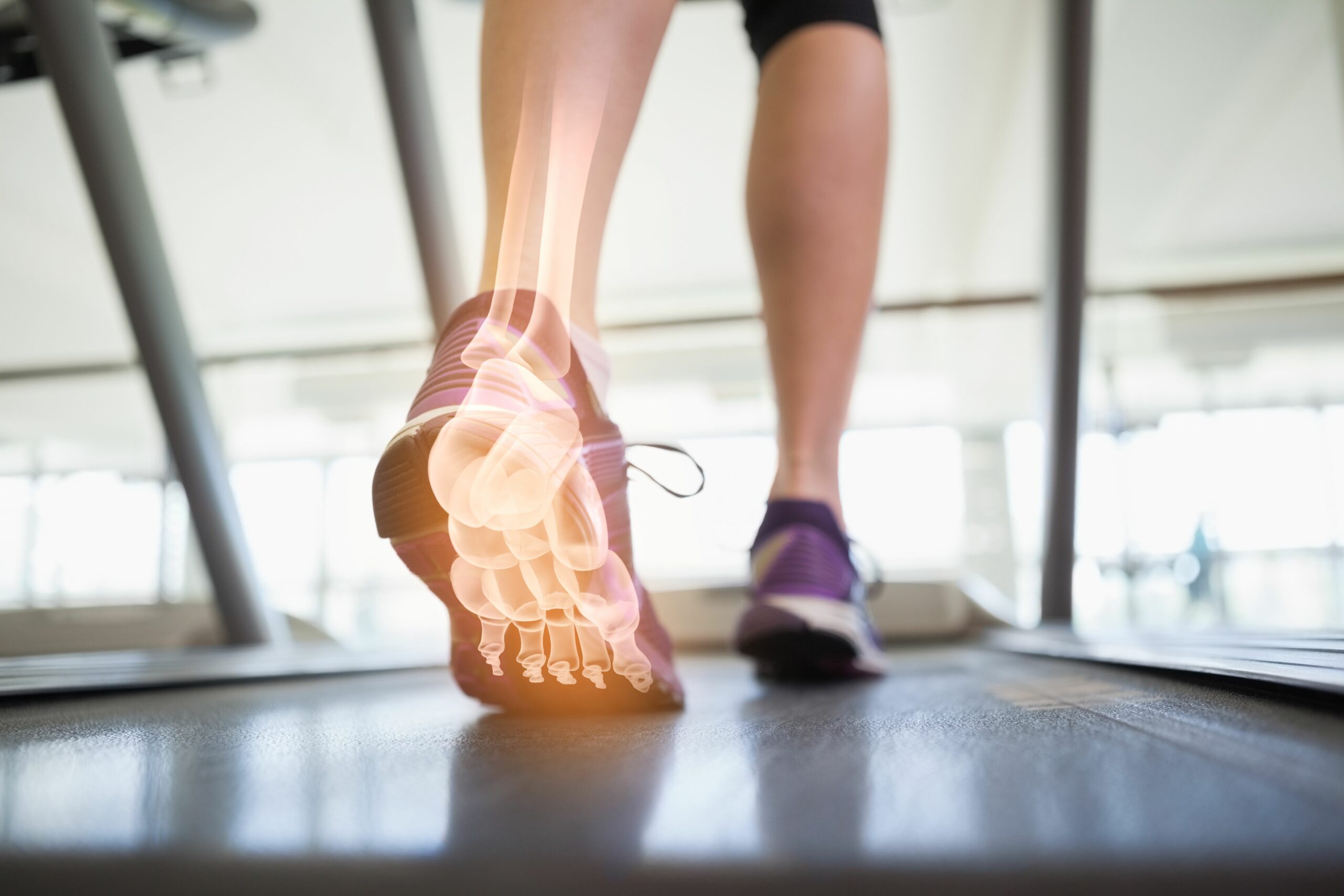
Anatomy TUESDAY – The Foot/Ankle Complex (Part 2) – Subtalar Joint
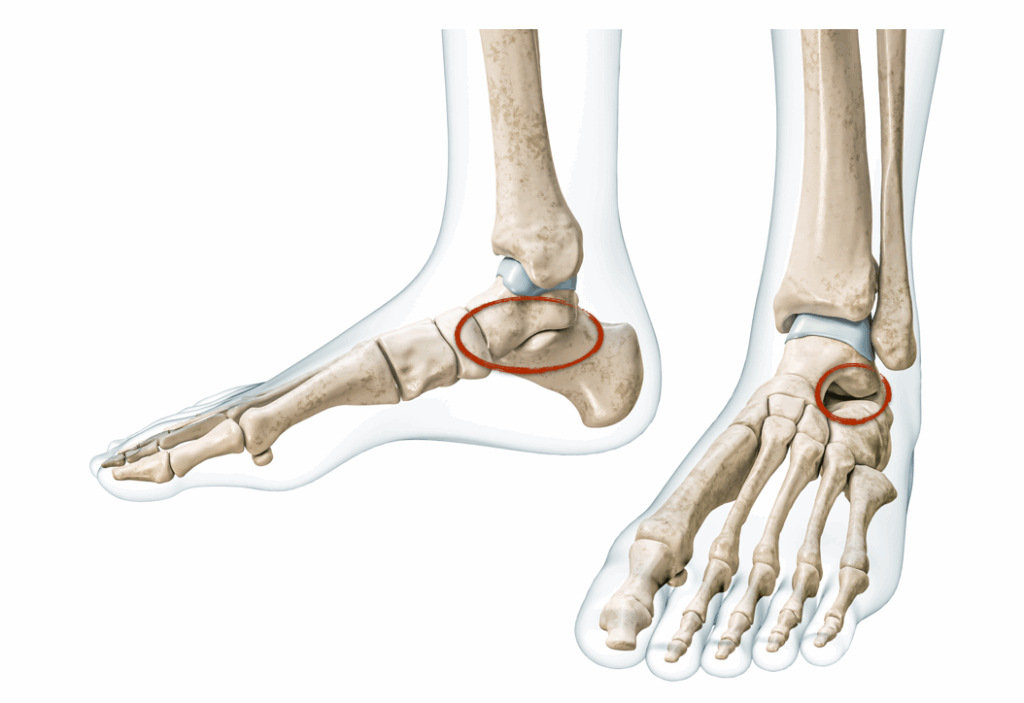
How many muscles attach to the talus? Zero. I missed that question on my PT licensing exam and I will never forget it. Now, hopefully you will remember this too.
The talus acts as a ball-bearing, sitting between the mortise (distal tibia and fibula) and the calcaneus (heel bone). It articulates at three different facets with the calcaneus (posterior, anterior and middle) with the posterior facet being concave while the anterior and middle facets are convex. (Click the picture for a reference article of the illustration below).
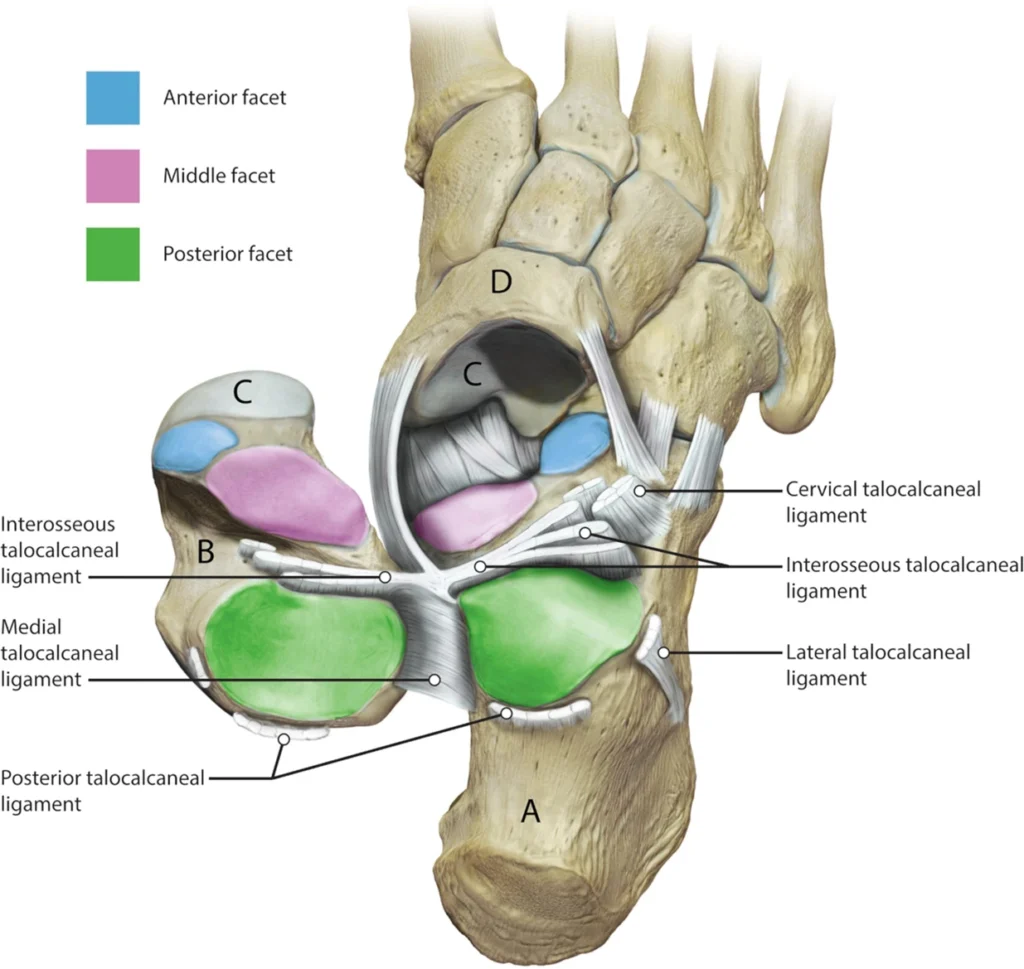
This orientation allow for the subtalar joint to be the center of rotation for the foot. The articulations are supported by lateral, posterior and medial talocalcaneal ligaments and an interosseus talocalcaneal ligament that lies within the tarsal canal.
The main function of this joint is to dampen the rotational forces imposed by body weight while maintaining contact of the foot with the ground. The subtalar joint is a uniaxial joint with one degree of freedom: supination/pronation. But supination and pronation are not pure motions.
Supination (20˚) – adduction, inversion, plantarflexion
Pronation (6˚-10˚) – abduction, eversion, dorsiflexion
(Normally, there is 2x more inversion than eversion)
Subtalar joint pronation causes adduction of the talus that carries the tibia and fibula into internal rotation. Remember, the superior articular surface of the talus is wider medially allowing for this rotation. This is the primary shock-absorbing mechanism. This allows for splaying of the adjacent tarsal bones which also allows your foot to conform to uneven surfaces.
Subtalar joint supination is the switch that locks everything up and allows for a solid platform for pushing off. Supination is closed-packed position of the STJ, with ligamentous tension drawing the talocalcaneal joint surfaces together.
Why does this matter?
Your foot is designed to pronate AND supinate and the STJ lies at the center of this function. Pronation allows for shock absorption while supination allows for force production. Too much or too little of either motion may result in a breakdown of tissues up the biomechanical chain.
Over pronators feel like they are walking on sand. Lots of cushion but difficulty producing force. Over supinators feel like they are walking on cement. Too much or not enough pronation may make it difficult to stand on one leg. Try it. Can you stand on one leg for more than 10 seconds? Does your foot tend to roll in or out?
It isn’t uncommon to see a lack of subtalar joint eversion after a lower extremity injury or with chronic low back pain. This is a compensation the body makes in an attempt to protect the injured area. If you don’t evert, then you don’t load the muscles of the leg above. And long after the pain for the original injury dissipates, it isn’t uncommon for the subtalar joint to remain stuck, causing breakdown or overuse injury higher up the biomechanical chain. (This is fixable, by the way). It’s why some people end up with an entire side of their body being in pain. “My left ankle hurts and so does my knee and my hip and when I get headaches, it is on the left side of my head,” is a statement I’ve heard a lot.
Consider the subtalar joint. It is a small joint that packs a big punch when it comes to function. Restoring functional rotation begins at the subtalar joint.
Because nobody has time to be in pain.
Until next time…
Kind Regards,
MoveWell Academy
[email protected]