Muscle Minute TUESDAY – Meet the Upper Trapezius
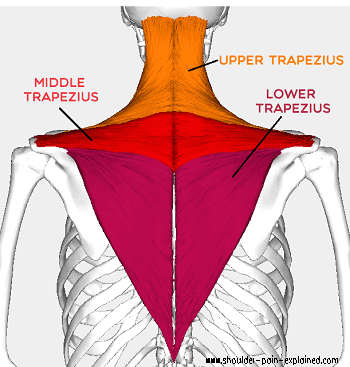
Wait one second. Now we’re just going to talk about one portion of one muscle?
That’s right. The upper trapezius is one of the most problematic portions of one muscle in the body, often exhibiting trigger points associated with shoulder impingement, headaches, neck pain, cervical radiculopathy and TMJ pain. If you own a cell phone and have a dominant hand, you probably have a trigger point in one or both of your upper trapezius muscles. Let’s take a deeper dive.
| Origin | external occipital protuberance, medial third of superior nuchal line, C7 spinous process |
| Insertion | lateral third of the clavicle, acromion (scapula), spine of the scapula |
| Action | upward rotation and elevation of scapula |
| Innervation | spinal accessory n. (CN XI, C3, C4) |
| Antagonists | rhomboid, lower trapezius |
The Real World Upper Trapezius
Why is this muscle so problematic? The primary real world job of the upper trapezius is to hold your head on your shoulders. The human head on average weighs 11 lbs and is designed to sit on top of your shoulders. Even a slight deviation into the forward head position drastically increases the weight of your head and the demand on the upper trapezius muscle.
This constant demand creates over activation of the upper trapezius, resulting in trigger points. The “XX” marks common trigger points and their pain referral regions (red area). Upper trapezius trigger points may result in headaches, ringing in the ears, vision changes and jaw pain. Trigger points set up in muscles that are chronically short, creating an overactive neurological response.
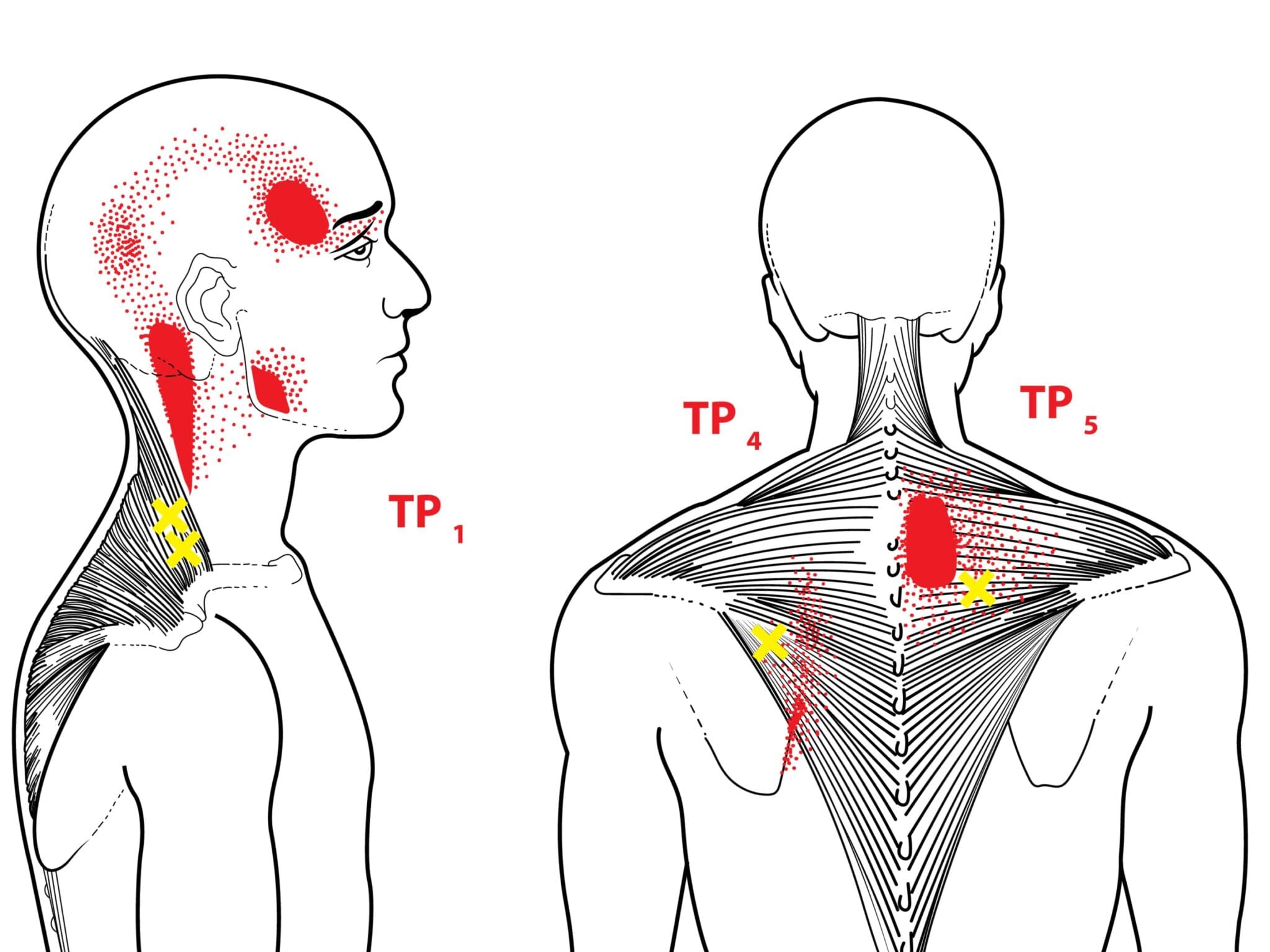
The upper trapezius attachment at the acromion allows for initiating upward rotation of the scapula required for arm elevation. Its attachment to the lateral clavicle allows it to upwardly rotate the clavicle as well, but this attachment is key in understanding the posterior lateral pull of the the clavicle, which often results in an anterioly displaced medial clavicle at the sternoclavicular joint.
Here’s a short list of why this matters:
- If the upper trapezius is tight, the lower trapezius is weak.
- If the lower trapezius is weak, arm elevation will be impaired (rotator cuff tendonitis/impingement)
- A tight upper trapezius may be the cause of headaches, jaw pain and visual changes
- A tight upper trapezius may affect sternoclavicular joint function, a key joint in lifting your arm from 0˚-90˚.
- Forward head posture and one shoulder sitting higher than the other are common causes of upper trapezius over activity.
- Rarely is the upper trapezius weak, which means shoulder shrugs should not be high priority on your shoulder patient’s exercise program. Overhead pressing activates the lower trapezius and should be emphasized.
Conventional thinking says: The upper trapezius needs to be strengthened in patients with neck and shoulder pain.
Real World Thinking says: The upper trapezius is usually tight and over active due to constant requirement of holding a forward head on your shoulders. Fix the postural problems of an elevated shoulder and forward head by restoring normal thoracic spine extension and rotation and the upper trapezius will relax. Don’t let this small muscle dominate your day.
Because nobody has time to be in pain.
Until next time…

Kind Regards,
MoveWell Academy
[email protected]