
Anatomy TUESDAY – Biceps Pulley System
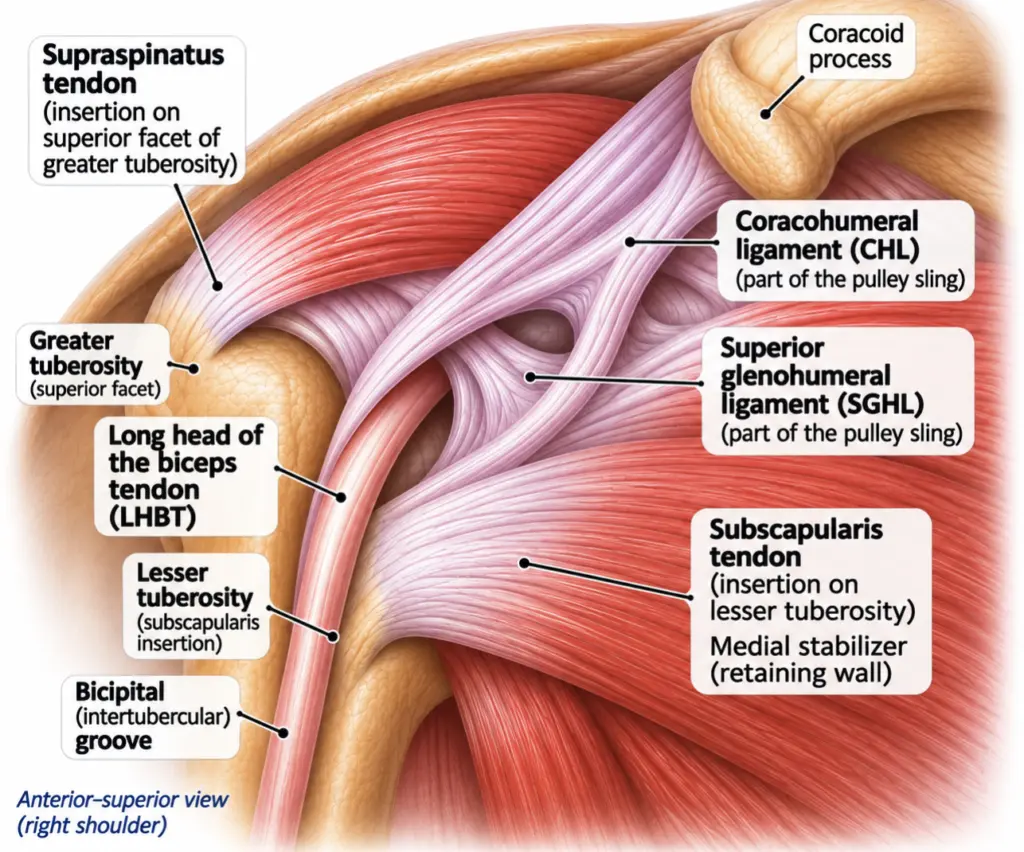
The long head of the biceps brachii tendon (LHBT) plays an important role in shoulder function. As it travels from its origin at the superior glenoid labrum and supraglenoid tubercle into the bicipital groove, it relies on a specialized group of soft-tissue structures for stability.
This stabilizing complex, known as the biceps pulley system, maintains the position of the tendon during shoulder movement. Understanding its anatomy is essential for recognizing biceps instability, rotator cuff injuries, and anterior shoulder pain.
Anatomy of the Biceps Pulley
The biceps pulley is located within the rotator interval, the triangular region between the supraspinatus and subscapularis tendons.
The pulley consists of four primary anatomical structures:
- Superior Glenohumeral Ligament (SGHL): A major stabilizer that helps prevent medial displacement of the biceps tendon.
- Coracohumeral Ligament (CHL): Reinforces the rotator interval and contributes to the ligamentous sling surrounding the tendon.
- Subscapularis Tendon: Its superior fibers provide important anterior and medial support to the biceps tendon, acting as a retaining wall against medial subluxation of the tendon.
- Supraspinatus Tendon: Its anterior fibers contribute to the superior aspect of the pulley complex and help reinforce the superior/lateral aspect.
Together, these structures form a stabilizing sling that guides the long head of the biceps tendon as it transitions from the glenohumeral joint into the bicipital groove.
Biomechanical Function
The primary function of the biceps pulley is to maintain proper alignment and stability of the long head of the biceps tendon during shoulder movement.
As the shoulder moves through flexion, abduction, and rotation, the pulley helps control tendon tracking and prevents excessive medial translation.
The SGHL and CHL serve as key ligamentous restraints, while the adjacent rotator cuff tendons provide additional structural support.
Disruption of this complex may allow the biceps tendon to shift from its normal position, resulting in abnormal tendon mechanics, irritation, and instability.
Relationship to the Rotator Cuff
The biceps pulley is closely associated with the superior subscapularis and anterior supraspinatus tendons.
The superior subscapularis is particularly important because it supports the medial aspect of the biceps tendon near the entrance to the bicipital groove. When the upper subscapularis is torn, the biceps tendon may become unstable and migrate medially.
Similarly, injury to the anterior supraspinatus can compromise the integrity of the pulley complex. A tear of the supraspinatus may compromise superior and lateral stability of the bicep long head tendon.
Because of these anatomical relationships, biceps pulley lesions frequently occur alongside rotator cuff injuries, particularly tears involving the superior subscapularis.
Biceps Pulley Injuries
Pulley lesions may develop from acute trauma, repetitive overhead activity, or degenerative changes within the shoulder.
Damage to the pulley can result in:
- Biceps subluxation: Partial displacement of the tendon from its normal position.
- Biceps dislocation: Complete displacement of the tendon from the bicipital groove.
- Biceps tendinopathy: Tendon irritation or degeneration associated with abnormal mechanics.
- Associated rotator cuff tears: Particularly involving the superior subscapularis and anterior supraspinatus.
Patients may experience anterior shoulder pain, clicking, catching, or discomfort with overhead activity.
MRI and MR arthrography can help identify pulley abnormalities and associated rotator cuff pathology. Dynamic ultrasound may also demonstrate biceps tendon instability during shoulder movement.
Clinical Significance
For someone with suspected medial LHBT instability, it is important to answer these questions:
Pulley integrity: Is there evidence of SGHL or CHL disruption on imaging?
Dynamic biceps tendon tracking: Does the tendon move medially during passive shoulder external rotation?
Superior subscapularis integrity: Is there evidence of partial tearing or weakness?
External rotation mobility: Is there restriction, excessive motion, or symptom reproduction?
Scapular mechanics: Are there movement abnormalities that may contribute to shoulder loading? Scapular elevation, downward rotation and/or protraction are often associated with pathologies of the rotator interval.
Why does this matter?
The biceps pulley system is a specialized stabilizing complex formed primarily by the superior glenohumeral ligament, coracohumeral ligament, and contributions from the subscapularis and supraspinatus tendons.
Its primary role is to maintain the position of the long head of the biceps tendon as it enters the bicipital groove.
Disruption of this system can lead to biceps instability, tendon degeneration, and associated rotator cuff pathology.
Understanding the anatomy of the biceps pulley is essential for recognizing the connection between biceps tendon instability and anterior rotator cuff injuries.
Because nobody has time to be in pain.
Until next time…

Kind Regards,
MoveWell Academy
[email protected]