
Kinesiology THURSDAY – Six Degrees to the Upper Trapezius
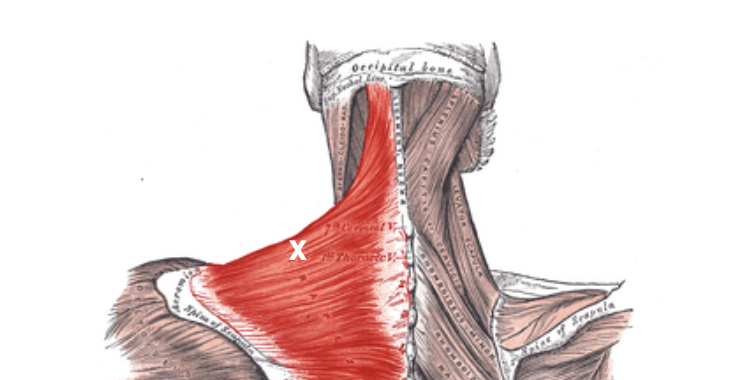
I’m not sure if I can pull this off, but this next series of kinesiology blogs are a nod to the theory of six degrees of separation, which states that everyone on Earth is connected to everyone else through a chain of no more than six acquaintances. As therapists or patients experiencing pain, it can be frustrating to get to the root of a biomechanical problem. We all want to get to the fix, but sometimes even the most well-intentioned are not sure where to turn. This blog series is intended to highlight six connections to some of the most common orthopedic problems. Let’s kick it off with the “knot” that almost everyone has: the upper trapezius.
But first…what’s the point of a trigger point?
Remember, trigger points set up in muscles that are chronically short. They tell us a story about how someone is moving (or not moving) and/or how someone is posturing. If you are having consistently massage or release a trigger point, then there is a problem still waiting to be solved. We don’t get trigger points from a lack of massage (just like we don’t get ulcers from a lack of TUMS in our diet). Massage helps release the upper trapezius, but it doesn’t fix the source of the problem. If we can determine the true source of the trigger point (and usually the intervention is a combination of manual therapy and movement re-training), then we take a giant step towards pain-free living.
Six degrees to the upper trapezius
- Decreased thoracic rotation – You should be able to lie on your side with your hips and knees bent to 90 degrees and roll your shoulder back to touch your scapula to the floor. A lack of thoracic mobility is often associated with tight upper trapezius
- Weak lower trapezius – The lower trap is a functional antagonist to the upper trap. If the lower trap is weak, the upper trap becomes over active with arm elevation. The lower trap is placed in a long/weak position when we slouch (increased thoracic kyphosis. It is best activated with arm elevation past 90˚ (think overhead press).
- Forward head posture – There should be no major muscle activity required to hold your head on your shoulders at rest. But if your head is positioned in front of your shoulders (as occurs with increased thoracic kyphosis), then the upper trapezius must activate to stabilize the head for prolonged periods of time, resulting in a chronic trigger point.
- Anteriorly displaced medial clavicle (posterior lateral clavicle) – The upper trapezius inserts on the lateral third of the clavicle. An anteriorly displaced medial clavicle (which is simple to assess at the SC joint), results in a posteriorly displaced lateral clavicle and chronic shortening of the upper trapezius. Here’s how to fix it.
- Quadratus lumborum trigger point – Most elevated shoulder girdles start with an elevated pelvis on one side. At the root of that problem is often a quadratus lumborum trigger point. This muscle originates at the pelvis and attaches to the twelfth rib. It usually becomes tight in the presence of a weak gluteus medius or a supinated subtalar joint. (that’s two extra degrees for no extra charge)
- Occipital bone hypomobility – The upper trap inserts on the external occipital protuberance (EOB). Decreased mobility of the occipital bone may lead to upper trap trigger points. Release it with a still point inducer or by gently cradling the head with your hands with light pressure on the EOB. It isn’t uncommon for tenderness to be more apparent on the side of the tight upper trapezius.
Why does this matter?
Phew! That is quite a list. But if you are dealing with an upper trapezius trigger point, now you have at least six avenues to run down. If you find yourself having to repeat the same treatment over and over without getting the long-term results you want, then consider running down a different path. Your running will not be in vain, and your patients will thank you. Stay tuned for more six degrees of separation.
Because nobody has time to be in pain.
Until next time…
Kind Regards,
MoveWell Academy
[email protected]