

Anatomy TUESDAY – The Femoral Nerve and the Quad Stretch
A patient presents with anterior thigh pain and says their leg feels weak when climbing stairs. Another reports difficulty controlling the knee while walking downhill. A third describes numbness along the inside of the lower leg.
It would be easy to focus on the quadriceps, hip flexors, or knee. But sometimes the problem isn’t primarily muscular or articular.
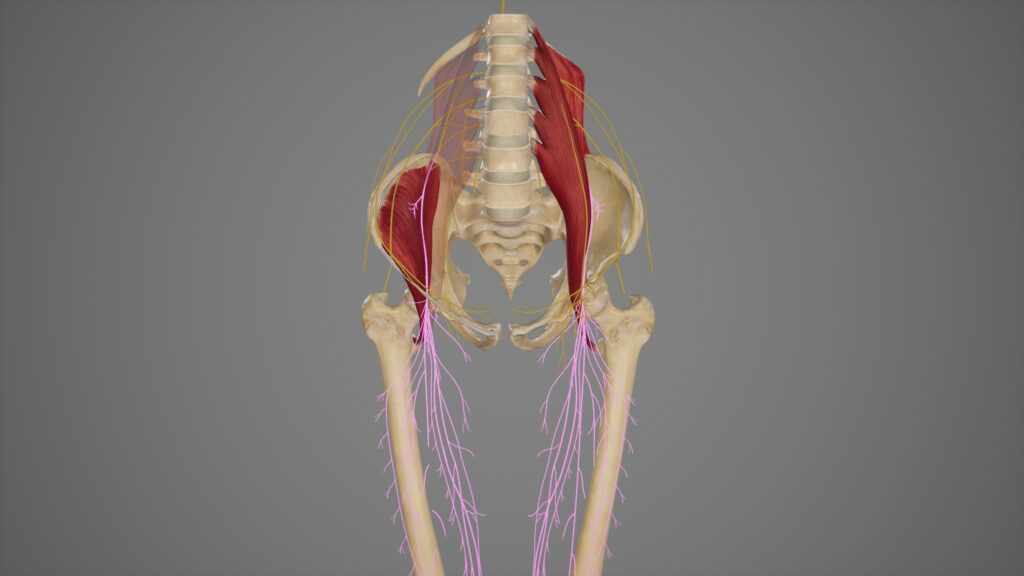
The femoral nerve provides an excellent example of why orthopedic clinicians need to think neurologically when evaluating lower-extremity complaints. Its path from the lumbar spine, through the pelvis, beneath the inguinal ligament, and into the thigh means dysfunction can present as pain, weakness, sensory disturbance—or a combination of all three.
Follow the Femoral Nerve
The femoral nerve arises from the posterior divisions of the L2, L3, and L4 nerve roots within the lumbar plexus.
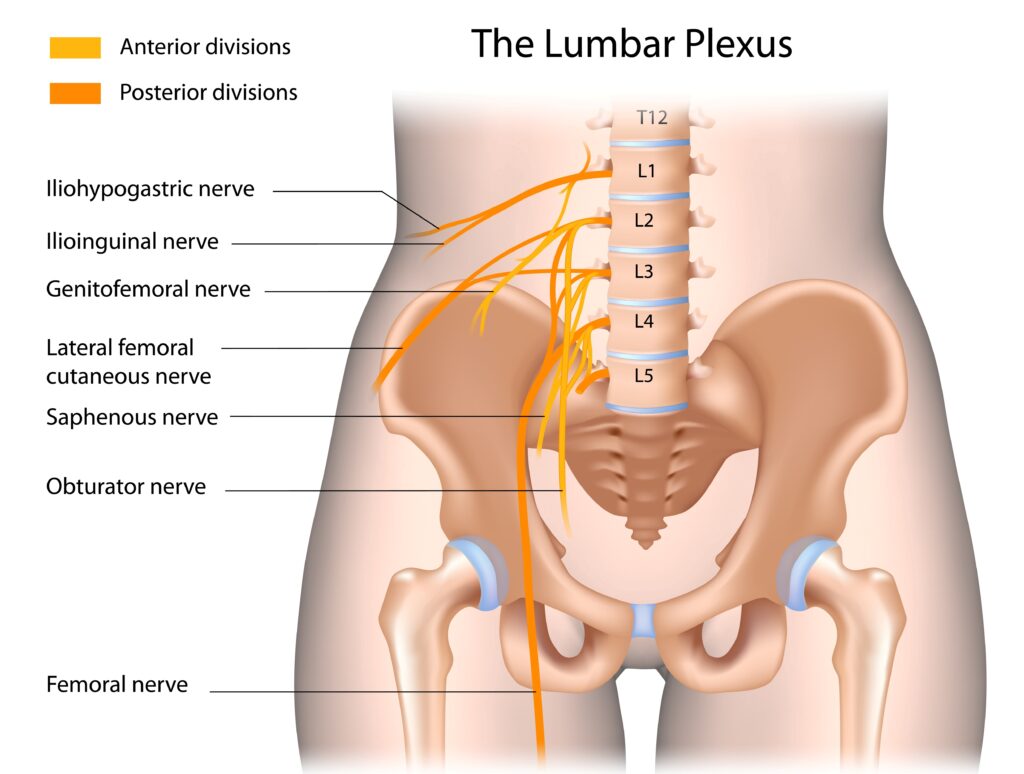
It forms within the substance of the psoas major before emerging from its lateral border. From there, it travels in the groove between the psoas major and iliacus, deep to the iliac fascia.
This relationship is clinically important.
The nerve travels through a relatively confined anatomical environment alongside two powerful hip flexors. Conditions affecting the iliopsoas region—including hematoma, swelling, surgery, or other space-occupying processes—can potentially compromise the nerve.
The femoral nerve then passes beneath the inguinal ligament and enters the femoral triangle.
An important anatomical pearl: despite its name, the femoral nerve does not travel within the femoral sheath. The nerve lies lateral to the femoral artery and outside the sheath.
Once in the thigh, it divides into multiple motor and sensory branches.
What Does the Femoral Nerve Do?
The femoral nerve is perhaps best known for innervating the quadriceps, but it also innervates the sartorius, iliacus and pectineus.
Through the quadriceps, the femoral nerve is critical for knee extension and more importantly deceleration of knee flexion when your foot hits the ground. This makes it essential for activities such as: rising from a chair, stair climbing, walking downhill, squatting and preventing the knee form buckling.
Significant femoral nerve dysfunction can therefore look remarkably similar to quadriceps weakness from a knee disorder.
Don’t Forget Sensation
The femoral nerve also carries sensory information.
Its anterior cutaneous branches supply portions of the anterior and medial thigh.
The saphenous nerve is the terminal sensory branch of the femoral nerve. It travels through the adductor canal and continues along the medial knee and lower leg toward the medial foot.
This produces an important clinical finding:
Femoral nerve involvement can produce sensory symptoms well below the knee.
A patient complaining of medial lower-leg numbness may have a neurological problem originating much farther proximally.
Femoral Nerve or Lumbar Radiculopathy?
An L3 or L4 radiculopathy can produce anterior thigh or medial leg symptoms and quadriceps weakness that resemble femoral neuropathy. But a lumbar nerve-root lesion may involve muscles supplied by other peripheral nerves arising from the same roots.
For example, assessing hip adduction can be useful because the adductors receive substantial innervation from the obturator nerve while sharing L2–L4 root contributions. If quadriceps function is impaired but hip adduction is relatively preserved, a femoral nerve lesion becomes more plausible.
If weakness crosses multiple peripheral nerve territories sharing the same nerve roots, a more proximal lesion deserves greater consideration.
The Femoral Nerve Is Also Designed to Move
Like the sciatic, median, radial, and ulnar nerves, the femoral nerve is not a fixed electrical wire.
For the femoral nerve, the position that generally creates the greatest mechanical loading is a combination of:
Lumbar/spinal flexion + hip extension + knee flexion, with positioning of the pelvis and hip used to further bias the femoral neural pathway.
In a prone femoral nerve neurodynamic test, the major progression is usually:
- Knee flexion — begins loading the femoral nerve and upper lumbar roots.
- Hip extension — increases loading proximally because the femoral nerve passes anterior to the hip.
- Maintain the pelvis/lumbar spine in a controlled position — preventing compensatory anterior pelvic tilt/lumbar extension keeps the intended hip extension rather than allowing the pelvis to escape the position.
- Spinal flexion, when incorporated into a more global neurodynamic position, can further increase mechanical loading of the upper lumbar neural system.
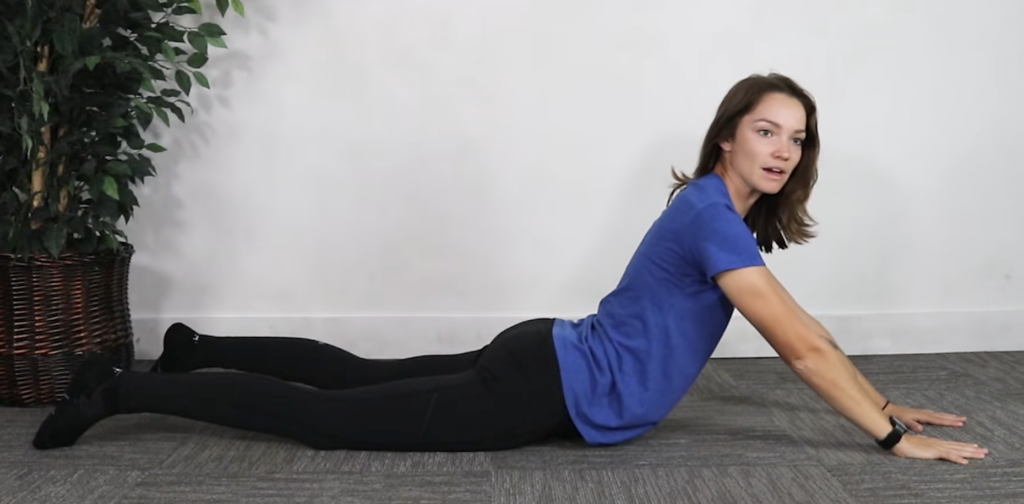
Here is an example of femoral nerve flossing:
Femoral Nerve vs. Meralgia Paresthetica
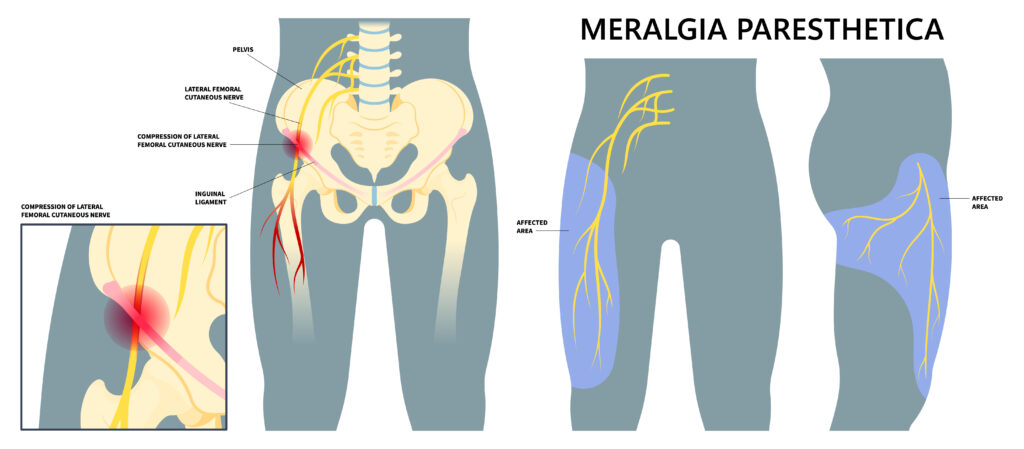
Another useful distinction involves the lateral femoral cutaneous nerve.
Patients with burning, tingling, or numbness over the anterolateral thigh are sometimes assumed to have femoral nerve involvement.
But the lateral femoral cutaneous nerve is a separate nerve. It is sensory only.
Meralgia paresthetica therefore typically produces sensory symptoms over the lateral thigh without quadriceps weakness or loss of the patellar reflex.
That’s a valuable localization clue.
As with other peripheral nerves, aggressively stretching an irritable nerve is generally not the objective.
Early neurodynamic interventions usually emphasize comfortable excursion, with greater mechanical loading introduced as tolerance improves.
Sliders encourage movement. Tensioners increase neural loading.
Why does this matter?
The femoral nerve connects the lumbar spine to the quadriceps and continues through its sensory branches toward the medial leg. Its anatomy explains why femoral nerve dysfunction can masquerade as hip flexor tightness, quadriceps weakness, knee dysfunction, or even medial lower-leg symptoms.
When evaluating anterior thigh symptoms, don’t just test the muscle.
Follow the nerve.
Because nobody has time to be in pain.
Until next time…

Kind Regards,
MoveWell Academy
[email protected]