
Kinesiology THURSDAY – The Biceps-Radial Head Connection and Lateral Elbow Pain
Lateral elbow pain is commonly labeled “tennis elbow,” or lateral epicondylalgia. And for good reason—the common extensor tendon, particularly the extensor carpi radialis brevis (ECRB), is frequently involved. But not every painful lateral elbow originates from the tendon.
One structure that deserves more attention is the radial head. Even more interesting is the muscle that attaches just below it: the biceps brachii.
Could excessive tension in the biceps alter radial-head mechanics and contribute to symptoms that look like tennis elbow? The research doesn’t completely answer that question yet, but there is some fascinating biomechanical evidence suggesting that the connection is plausible.
Follow the Biceps to the Radius
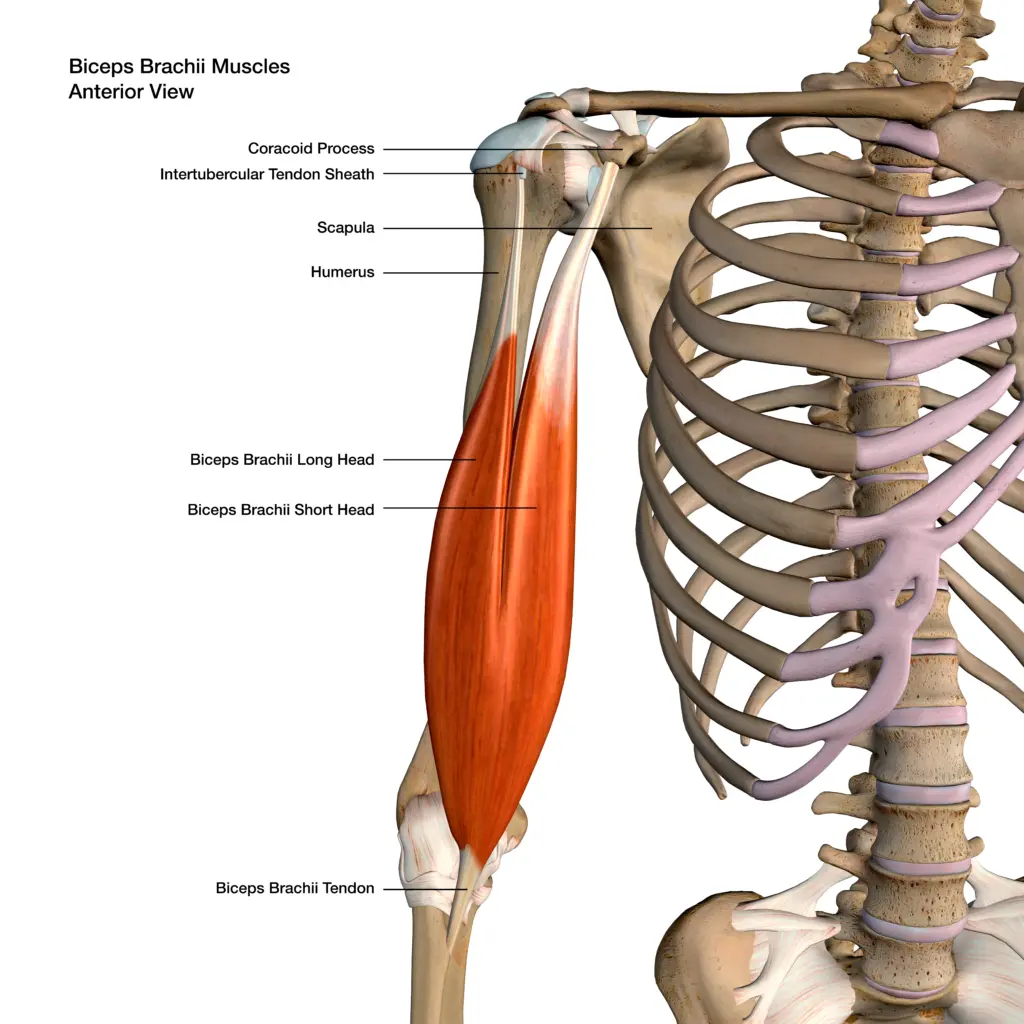
Most of us think of the biceps as an elbow flexor and forearm supinator. But its distal attachment is important when considering elbow mechanics.
The distal biceps tendon attaches to the radial tuberosity, just distal to the radial head. Therefore, whenever the biceps develops tension, it applies force directly to the proximal radius.
Normally, the radial head is stabilized by several structures, including the annular ligament, radiocapitellar joint capsule, quadrate ligament and interosseous membrane. These structures allow the radial head to rotate while maintaining its relationship with the capitellum.
But what happens when the force produced by the biceps increases?
In a cadaveric biomechanical study, Badre and colleagues progressively loaded the biceps while measuring radial-head position. As biceps loading increased, anterior translation of the radial head increased significantly. The amount of translation became progressively greater when stabilizing soft tissues were compromised.
This doesn’t mean that a tight biceps routinely “pulls the radial head out of place.” The study involved simulated Monteggia injuries rather than people with ordinary lateral elbow pain.
It does, however, demonstrate an important biomechanical principle:
Biceps tension can influence the position and stability of the radial head.
Forearm Position Matters Too
The radial head isn’t stationary during normal forearm movement.
Research examining radial-head kinematics has shown that the center of the radial head moves anteriorly during pronation and posteriorly during supination relative to the capitellum.
Now consider someone who already has increased biceps tone, altered forearm mechanics or subtle radiocapitellar instability. This is what I observed in a patient complaining of lateral elbow pain who is a Pilates/yoga instructor. With hands planted on the ground, the forearm is in pronation, loading the radial head differently than when in open chain positions of the wrist.

The combination of:
biceps tension + forearm rotation + gripping + repetitive loading could potentially change the mechanical environment around the radial head and mimic symptoms of lateral epicondyalgia.
Elbow Position Changes the Biceps’ Effect
The relationship becomes even more interesting when elbow position is considered.
The biceps doesn’t exert exactly the same influence on the radiocapitellar joint throughout elbow motion. When the elbow is relatively extended, its force can help compress the radial head against the capitellum. As elbow flexion increases toward and beyond 90°, its mechanical effect changes and its compressive contribution decreases.
Therefore, saying that the biceps simply “pulls the radial head anteriorly” is probably an oversimplification.
A better way to think about it is:
Biceps tension changes the forces acting on the proximal radius, and the resulting radial-head mechanics depend upon elbow position, forearm rotation, ligamentous stability and external loading.
Where Do Trigger Points Fit In?
Clinically, I have encountered patients diagnosed with tennis elbow who also have a very distinct taut band or trigger point in the biceps. Treating that area sometimes produces an immediate improvement in lateral elbow symptoms.
There is good evidence that myofascial trigger points can be associated with lateral epicondylalgia.
Studies have identified active trigger points in muscles including the ECRB, ECRL, extensor digitorum and brachioradialis in people with lateral epicondylalgia. Compression of these trigger points can reproduce patients’ familiar lateral elbow and forearm pain.
A review of the literature also concluded that myofascial pain and trigger points may contribute to lateral epicondylalgia and that treatments directed toward the myofascial component can improve pain and function.
However, the evidence specifically connecting a biceps trigger point to lateral epicondylalgia is much weaker.
This is where we need to separate clinical observation from established evidence.
A Possible Mechanical Explanation
Rather than assuming that a biceps trigger point simply refers pain to the lateral elbow, another possibility is worth considering.
Imagine a patient with chronically increased biceps tension.
Increased biceps tension could increase force through the distal biceps tendon and radial tuberosity. In a mechanically normal elbow with intact stabilizers, this may have little clinical consequence.
But suppose that same patient also has subtle annular-ligament laxity, previous elbow trauma, altered forearm mechanics or mild radiocapitellar instability.
Now increased biceps tension could potentially contribute to altered radial-head mechanics.
The hypothetical sequence becomes:
Increased biceps tone >
↓
increased force through the distal biceps tendon
↓
altered loading of the proximal radius
↓
altered radial-head/radiocapitellar mechanics
↓
lateral elbow irritation
↓
pain with gripping, wrist extension or forearm rotation
The result could look remarkably similar to tennis elbow.
Importantly, this entire sequence has not been demonstrated experimentally in patients with lateral epicondylalgia. It should therefore be considered a biomechanically plausible clinical hypothesis rather than an established cause of tennis elbow.
What Should Clinicians Look For?
When lateral elbow pain doesn’t behave like a straightforward tendinopathy, it may be worth expanding the examination.
Palpate the common extensor tendon—but don’t stop there.
Examine the radial head and radiocapitellar joint.
Assess pronation and supination.
Palpate the brachioradialis, supinator and biceps.
Look for excessive tone or tenderness in the distal biceps.
Compare radial-head mobility bilaterally.
And pay attention to whether treating the biceps changes forearm rotation, radial-head mobility or the patient’s familiar lateral elbow symptoms.
That doesn’t prove that you have “put the radial head back in place.” Manual treatment can alter pain sensitivity, muscle tone and joint mechanics without correcting a true subluxation.
But if lateral elbow pain changes substantially after addressing the biceps and proximal radioulnar region, that finding may tell you something important about the patient’s particular presentation.
Check out this video for some helpful manual techniques to correct lateral elbow pain.
Why does this matter?
Lateral elbow pain is probably better viewed as a region with several potential pain generators rather than a single diagnosis.
The common extensor tendon may certainly be involved. But so may the radial tunnel, radiocapitellar joint, annular ligament, radial head and surrounding musculature.
And because the biceps attaches directly to the radius, it has the ability to influence forces acting on this entire system.
We don’t yet have evidence showing that a biceps trigger point causes radial-head displacement and subsequently produces tennis elbow. What we do have is evidence that biceps loading can influence radial-head translation, that radial-head position changes with forearm rotation, and that myofascial dysfunction is common in people with lateral epicondylalgia.
Sometimes the painful tendon may be only part of the story.
Clinical takeaway: When treating stubborn lateral elbow pain, don’t just examine where it hurts. Follow the mechanics—and don’t forget to check the biceps.
Because nobody has time to be in pain.
Until next time…

Kind Regards,
MoveWell Academy
[email protected]