

All About You FRIDAY – The Parts of the Whole
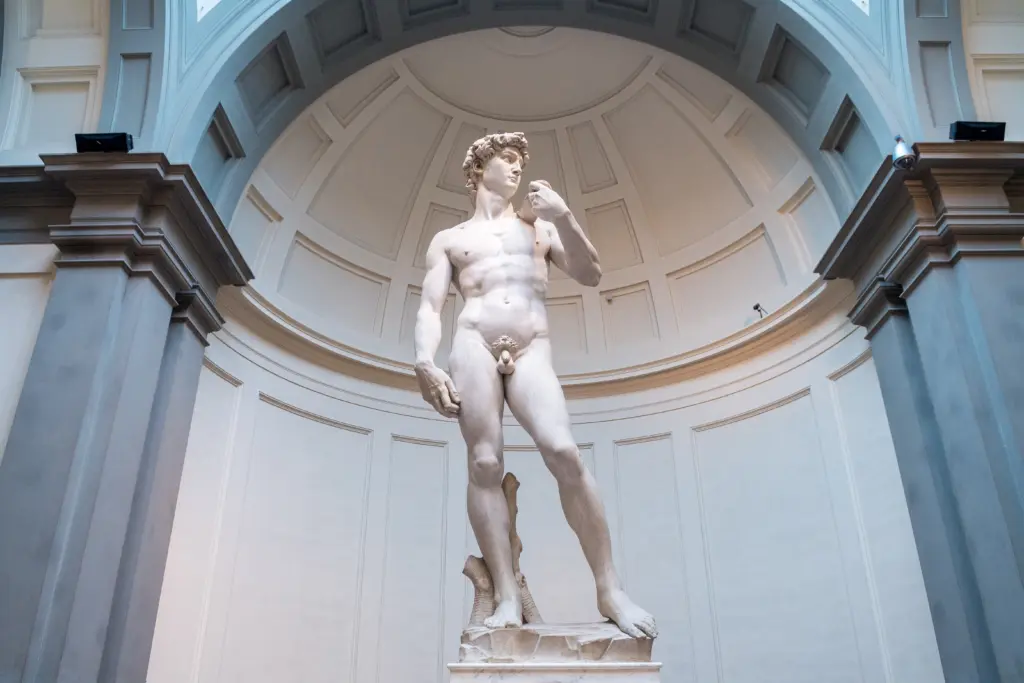
I’ve seen him before. Michelangelo’s David. The first time I laid eyes on him in 2014, I audibly gasped. Standing 17 feet tall underneath a dome in the Galleria dell’Accademia in Florence, Italy, he is a sight to behold. It’s easy to gaze at the whole statue and have that be enough. More than enough.
I just visited Florence again. This time I was prepared.
As I turned the corner to step into the Hall of Prisoners, I knew what to expect. Somehow, my expectation didn’t lessen my reaction. I stood for a moment in reverence. I began to take note of some of the things I may have missed the first time.
The Hall of Prisoners is a long room bordered by Michelangelo’s unfinished works. Unlike other sculptors of his time, Michelangelo believed forms of bodies were buried in the stone and it was his job to uncover them. That comes through in the work of the Prisoners who look like they are emerging from the rough stone.
I can appreciate that room. How many times have I had multiple projects going, getting distracted from one only to start another? The reason the Hall of Prisoners even exists is because Michelangelo was commissioned for the ultimate distraction: painting the ceiling of the Sistine Chapel.
As I walked past the prisoners and closer to David, obvious questions popped into my head. Here are the answers to my questions:
This statue depicts the moments before David went into battle against the Philistine giant, Goliath. He is naked, probably not because he actually fought in the nude, but because Michelangelo worked in the classic tradition of heroic nudity, where an unclothed body stood for courage, dignity and virtue. He was facing the giant with nothing but a sling and his faith in God.
His right hand is unusually large, with the abductor digiti minimi bulging to draw attention to the stone in his right hand. His head is also larger than normal proportion, with his eyes etched in deeper. David was originally intended to sit atop the the Florence cathedral. The enlargement of the head and right hand were designed to correct for the viewer who would see if from far below and to draw ones attention to the important parts of the statue: the head where intellect lies, and the hand where action occurs.
At first glance he looks very relaxed. His grip on the stone is gentle. His posture shifted to his right leg. But as you walk around the statue in a clockwise orientation, you feel the tension build when you stand to his left and look up at his gaze. His neck is tense. His brow slightly furrowed with a sideways glare towards an enemy he has yet to lay eyes on. This side of the statue feels like a coiled spring.
David is a masterpiece.
We got back on Monday night and less than 24 hours later, I was thinking about David again as I sat in a recording studio at the Detroit School of Rock and Pop. My band, Drawing Straws, was starting our in-studio recording of War Pigs by Black Sabbath, a song that lasts almost 8 minutes.
We’ve played it many times before but unlike previous performances, we don’t get to play it all together in the studio. We lay down tracks one at a time.
First, the drummer lays down his track to the metronome while the bass player and myself (rhythm guitar) play along to keep him in the right place. Then the bass player lays down his track followed by my part. We painstakingly listen and re-listen to parts and make corrections as we go along, laying the foundation for the entire tune. Then the lead guitar players will record the solos and finally the vocal track gets laid down.
“That is a cool part,” I heard one of the guitar players say as our drummer did his thing. And after I played my part, I heard the drummer say, “I had no idea all of that was going on.” I hear things during those recording sessions that I have never heard before in all the times we’ve played that tune.
It has been said that the whole is greater than the sum of its parts. But I think it’s through understanding and appreciating the individual parts that the whole gains new meaning. We should pay attention.
Maybe I’m not just talking about great works of art and music. Maybe I’m talking about the people in my life who make my world a better place. Maybe that’s worth my contemplation.
One final note about Micheangelo’s David.
He is carved from a solid piece of Carrara marble from a quarry in Tuscany, considered bianco ordinario (ordinary white) as it contained flaws and imperfections. Decades earlier, it was abandoned by two separate sculptors, Agostino di Duccio and Antonio Rossellino, because they considered it unworkable.
A masterpiece made out of abandoned stone when placed in the hands of a man who saw potential. Something to think about.
It’s been a long week. Don’t forget to celebrate…the parts of the whole.
Until next time…

Kind Regards,
MoveWell Academy
[email protected]