Anatomy TUESDAY – Inferior Glenohumeral Ligament Complex
The shoulder is one of the most mobile joints in the human body, allowing a wide range of movements essential for everyday activities, sports, and physical work. However, this remarkable mobility also makes the shoulder vulnerable to instability and injury.
One of the most important structures responsible for maintaining shoulder stability is the Inferior Glenohumeral Ligament Complex (IGHL Complex).
The IGHL complex plays a critical role in preventing excessive movement of the humeral head, particularly when the arm is raised and rotated outward. Injuries to this ligament complex can contribute to shoulder dislocations, recurrent instability, pain, and functional limitations.
What Is the Inferior Glenohumeral Ligament Complex?
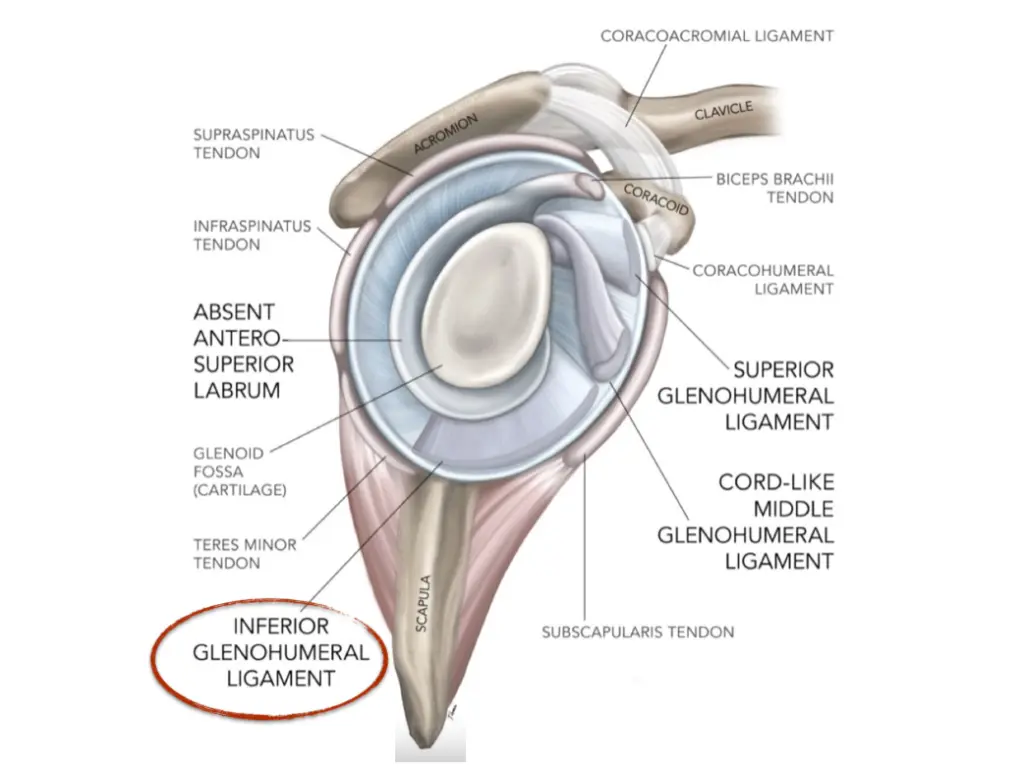
The Inferior Glenohumeral Ligament Complex (IGHL) is a capsuloligamentous structure located in the lower portion of the glenohumeral joint, where the head of the humerus articulates with the glenoid cavity of the scapula.
It forms an important part of the shoulder’s joint capsule and acts as a primary stabilizer when the arm is abducted, especially at approximately 90 degrees. The IGHL complex helps prevent excessive translation of the humeral head and reduces the risk of dislocation during demanding shoulder movements.
The IGHL complex consists of three major components:
- Anterior Band of the Inferior Glenohumeral Ligament
The anterior band is a strong ligamentous thickening located in the front-lower portion of the shoulder capsule.
Its primary functions include:
- Resisting excessive anterior translation of the humeral head.
- Providing stability during shoulder abduction and external rotation.
- Helping prevent anterior shoulder dislocation.
- Supporting the joint during overhead and throwing activities.
The anterior band is particularly important when the shoulder is positioned at 90 degrees of abduction with external rotation.
- Posterior Band of the Inferior Glenohumeral Ligament
The posterior band is located in the back-lower portion of the glenohumeral capsule.
Its functions include:
- Resisting excessive posterior translation of the humeral head.
- Supporting shoulder stability during flexion, adduction, and internal rotation.
- Contributing to the control of humeral head movement during functional activities.
The posterior band works together with the anterior band to maintain balanced stability.
- Axillary Pouch
The axillary pouch is the redundant, pouch-like portion of the inferior joint capsule connecting the anterior and posterior bands. The axillary pouch also contributes to inferior stability, particularly when the arm is abducted.
Together, these three structures form a hammock-like support system beneath the humeral head.
Another point of view…
If the IGHL is torn, rehabilitation should target strengthening of supporting structures:
- Latissimus dorsi and teres major are responsible for decelerating abduction and external forces protecting the inferior sling
- Anterior deltoid and pectoralis major decelerate external rotation protecting the anterior band
- Posterior deltoid, infraspinatus and teres minor decelerate internal rotation, protecting the posterior band
Another thing to consider in the case of IGHL injury is the resting position of the scapula:
- Downward rotation of the scapula places the humerus in relative abduction (trigger points in rhomboid and pec minor)
- Protraction of the scapula places the humerus in relative external rotation (trigger points in pec minor and serratus anterior)
Why does this matter?
IGHL injuries usually occur with rapid abduction/external rotation forces of humerus. In cases where the ligament is torn, it is important to protect the ligament from excessive tension during the months of healing. Considering the supporting muscles and scapular position during this time is key.
Because nobody has time to be in pain.
Until next time…

Kind Regards,
MoveWell Academy
[email protected]