
Kinesiology THURSDAY – Carrying Groceries (One Trip or Bust)
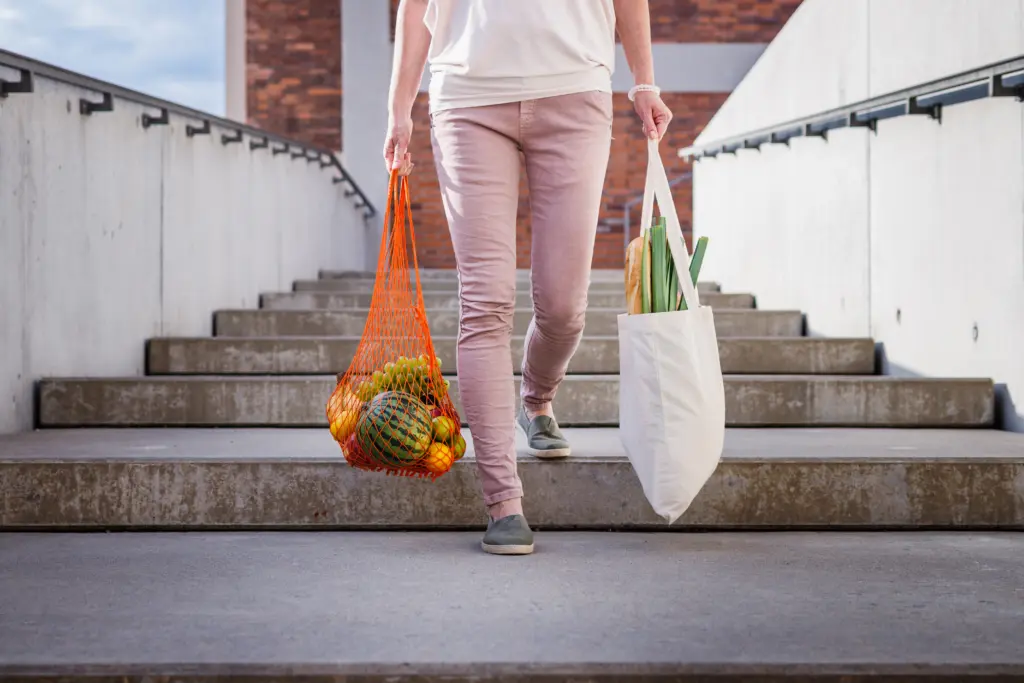
You walk out of the grocery store with several bags in each hand. They’re heavy, but the car isn’t that far away. So naturally, you try to make it in one trip. By the time you reach the car, your fingers are tired, your shoulders are working, and you may even feel the effort through your trunk and hips.
Carrying groceries seems like a simple task, but from a kinesiology perspective, it’s a great example of how the body manages load, balance and movement at the same time.
Your Hands Have to Hold the Load
The most obvious work occurs at the hands and forearms.
Your finger flexor muscles contract to isometrically maintain your grip on the handles while muscles on both sides of the wrist co-contract to keep the wrist relatively stable.
As the bags get heavier, grip demand increases. Thin plastic or reusable bag handles can make the task feel even harder because the load is concentrated over a relatively small area of the fingers.
But your hands are only the beginning of the kinetic chain.
Your Shoulders Have to Stabilize the Weight
Interestingly, your arms may not appear to be doing much while you’re carrying groceries. They often simply hang at your sides. But that doesn’t mean the shoulder muscles aren’t working.
The weight of the bags creates a downward pull through the arms. Muscles surrounding the shoulder and scapula must help control that load and maintain the position of the shoulder complex.
The supraspinatus and deltoid counteract the downward pull on the humeral head while the upper trapezius, lower trapezius and serratus anterior stabilize against the downward rotation of the scapula.
This is an important kinesiology concept: Muscles don’t have to produce visible movement to be working. Sometimes their job is simply to prevent unwanted movement.
Your Trunk Keeps You Upright
Now imagine carrying a heavy grocery bag in only your right hand.
The additional weight shifts your combined center of mass toward the right. Without a response from your trunk, the weight would tend to pull your body toward that side.
Your trunk muscles therefore have to generate force to resist that tendency. The obliques, quadratus lumborum, erector spinae and deeper trunk stabilizers all contribute to maintaining your torso over your pelvis and preventing excessive side bending to the right.
This is essentially the same principle behind a suitcase carry used in strength training.
Your Hips Are Working Too
The challenge continues farther down the kinetic chain.
Walking already requires the hip abductors—particularly the gluteus medius and gluteus minimus—to help control the pelvis each time you stand on one leg. Add grocery bags and those muscles must now control a heavier system.
This becomes particularly interesting with an uneven load.
If you carry all the bags in one hand, this heightens the demand on the opposite hip abductors to prevent the pelvis from dropping to the side you are carrying the load.
So carrying groceries isn’t simply carrying something while you walk. It’s loaded gait.
Why One Heavy Bag Feels Different Than Two
Suppose you have 20 pounds of groceries.
Carrying 10 pounds in each hand creates a relatively symmetrical load. Carrying all 20 pounds in one hand creates a very different mechanical problem.
The total grocery weight hasn’t changed. But the distribution of the load has.
An asymmetrical load creates a greater demand on the muscles responsible for resisting trunk side-bending and controlling the pelvis. A balanced load generally reduces that asymmetrical demand, although your hands, shoulders and entire body still have to manage the additional weight.
Here’s a helpful hint: If you have weakness on one hip, carry the load on that side. It seems counterintuitive, but carrying on the same side of your weakness counteracts the pelvic drop that occurs to the opposite side, reducing the load on your hip abductors.
Then There Is the Walking
Normally, your arms swing naturally during walking. That arm swing helps coordinate rotation between the upper and lower body.
Put grocery bags in both hands and suddenly that arm swing becomes restricted.
Your gait may change subtly. You may shorten your stride, increase trunk stiffness or alter how your pelvis and trunk rotate. The heavier the load becomes, the more likely your body is to modify its normal walking strategy.
Why Carrying Groceries Is Actually Good Functional Training
We often think of strength in terms of squats, presses and rows at the gym. But everyday strength frequently involves something different.
Carrying groceries requires grip strength, shoulder stability, trunk control, hip stability, balance and walking capacity—all at the same time.
That makes carrying tasks particularly relevant to maintaining independence as we age.
Why does this matter?
Carrying groceries is much more than a grip-strength exercise.
Your hands hold the bags, your shoulders stabilize the arms, your trunk resists the pull of the load, your hips control your pelvis, and your legs continue moving you forward.
And when one hand carries more than the other, your body has to solve an entirely different balance problem.
So the next time you’re determined to carry every grocery bag into the house in one trip, remember: You’re not just carrying groceries. You’re performing a loaded carry.
Activate your core, hip, shoulder and hand muscles with this functional exercise. It does a body good.
Because nobody has time to be in pain.
Until next time…
Kind Regards,
MoveWell Academy
[email protected]