
Anatomy TUESDAY – Serratus Anterior – More than a Protractor
If you learned the serratus anterior in anatomy class, you probably learned one primary action: It protracts the scapula.
That’s true—but it leaves out much of what makes this muscle so interesting.
The serratus anterior is one of the most important muscles for controlling the scapula during movement of the arm. It helps keep the scapula against the rib cage, contributes to upward rotation during arm elevation, and helps position the glenoid so the humerus can move efficiently overhead.
In other words, the serratus anterior doesn’t simply move the scapula forward.
It helps create a stable, mobile platform for the entire shoulder.
Anatomy of the Serratus Anterior
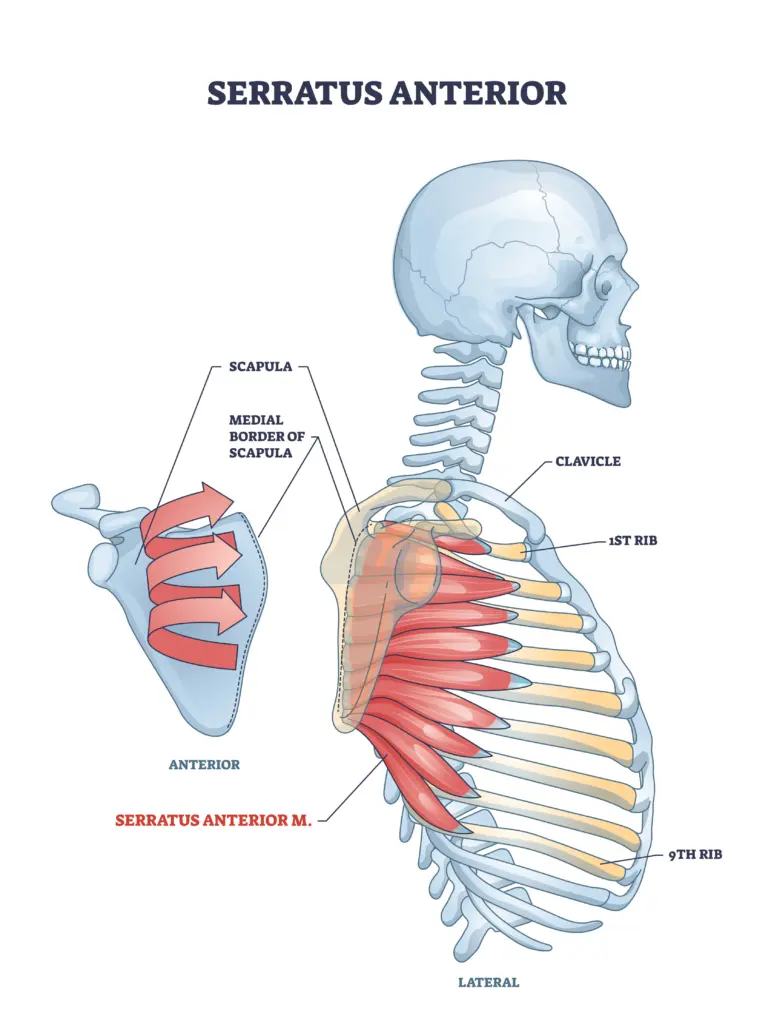
The serratus anterior gets its name from its distinctive saw-toothed appearance along the lateral chest wall.
It originates from approximately the upper eight or nine ribs and wraps around the side of the thorax before inserting along the anterior surface of the medial border of the scapula.
That last part is important.
The muscle essentially lies between the scapula and the rib cage. Because of this position, contraction of the serratus anterior can pull the scapula tightly against the thorax while also moving it around the rib cage.
But the entire muscle doesn’t necessarily perform exactly the same job.
One Muscle, Different Fiber Directions
The serratus anterior can be considered in upper, middle and lower portions based on differences in fiber orientation and attachment.
The upper fibers attach near the superior angle of the scapula and contribute to stabilization of the scapula against the thorax.
The middle fibers have a strong horizontal orientation and are particularly well positioned to produce scapular protraction.
The lower fibers converge toward the inferior angle of the scapula. These lower fibers are particularly interesting because their line of pull gives them excellent leverage for producing upward rotation of the scapula.
And upward rotation becomes extremely important with arm elevation.
What Happens When You Raise Your Arm?
Try raising your arm above your head. The humerus obviously moves, but the scapula must move too.
During normal arm elevation, the scapula undergoes a combination of:
- Upward rotation
- Posterior tilt
- External rotation
These movements help orient the glenoid upward and allow the humerus and scapula to work together throughout elevation.
The serratus anterior is a major contributor to this process.
Its lower fibers pull the inferior angle of the scapula laterally around the thorax. This contributes to upward rotation and helps position the scapula appropriately as the arm rises.
The serratus anterior works closely with the upper and lower trapezius to form the scapular force couple. A force couple is defined as several muscles pulling in different directions to create rotation of a bone.
In the scapular force couple, during arm elevation, the upper trapezius pulls up through the spine and acromion of the scapula, the lower trapezius pulls down and the serratus anterior applies force along the medial border and inferior angle to pull forward.
Together, they create the scapular upward rotation necessary for efficient overhead movement.
But upward rotation isn’t the whole story.
The serratus anterior also contributes to posterior tilting of the scapula during arm elevation. This is an important movement that is easy to overlook.
As the arm elevates, the superior portion of the scapula tilts posteriorly while the inferior angle moves closer to the thorax. This changes the orientation of the acromion and glenoid relative to the humerus.
If the serratus anterior becomes weak or inhibited, the problem isn’t necessarily simply “not enough protraction.” The entire three-dimensional position of the scapula can change.
The Serratus Anterior Is Also a Force-Transfer Muscle
There is another useful way to think about the serratus anterior.
When the hand is fixed—as during a push-up, plank or pushing activity—the serratus anterior isn’t simply moving the scapula around the thorax.
It is helping stabilize the scapula against the rib cage while forces travel through the upper extremity. This is why exercises such as the push-up plus, wall slide and serratus punch frequently appear in shoulder rehabilitation programs.
The goal isn’t necessarily just to make someone better at protraction. It is to improve scapular stability while the arm produces or accepts force. This is why having someone hold a high plank position while lifting one leg than the other, or reaching with one arm than the other may be more effective than a push-up plus to teach the serratus anterior what we really want it to do.
Remember, if we want a muscle to learn to stabilize, we need to put it in environments where stability is required. Can the serratus anterior protract the scapula? Yes. But it’s main job is to stabilize the scapula on the ribs.
Why Does the Scapula Wing?
One of the clearest demonstrations of serratus anterior function occurs when the muscle loses its nerve supply.
The serratus anterior is innervated by the long thoracic nerve, primarily from the C5, C6 and C7 nerve roots. The nerve travels along the lateral chest wall on the superficial surface of the serratus anterior—a relatively exposed course that can make it vulnerable to injury.
When the long thoracic nerve is significantly impaired, the serratus anterior may become weak or paralyzed. Without adequate serratus activity, the scapula is no longer held firmly against the thorax.
The medial border can become prominent, producing the classic appearance of medial scapular winging. Winging often becomes especially obvious when the person pushes against a wall.
Why?
Because pushing requires the serratus anterior to stabilize and protract the scapula against the resistance created by the upper extremity. Without that stabilization, the medial border of the scapula lifts away from the rib cage.
Most patients will not report that their scapula is winging, as they can’t really see it. What is often reported is anterior shoulder pain (most likely from impingement syndrome) or limitations in arm elevation.
Why does this matter?
When evaluating shoulder function, it can be tempting to look almost exclusively at the glenohumeral joint. But the humeral head is moving on a socket that is itself moving.
That socket—the glenoid—is part of the scapula. If the scapula isn’t being appropriately controlled, the orientation of the glenoid changes as well.
That is why serratus anterior function deserves attention when examining patients who have difficulty with overhead movement, visible scapular winging or altered scapular mechanics.
The serratus anterior isn’t simply a scapular protractor. It holds the scapula against the thorax and works with the trapezius to produce the upward rotation and posterior tilt needed during arm elevation.
Think of it less as a muscle that pushes the shoulder blade forward and more as a muscle that helps steer the scapula around the rib cage.
Next time you encounter a patient with painful arm elevation, remember to check serratus anterior function. And if it’s weak, remember it isn’t just a protractor. Train stabilization as the arm moves or takes on force. Muscles only learn the lessons we teach.
Because nobody has time to be in pain.
Until next time…
Kind Regards,
MoveWell Academy
[email protected]