

Muscle Minute TUESDAY – Meet the Teres Major
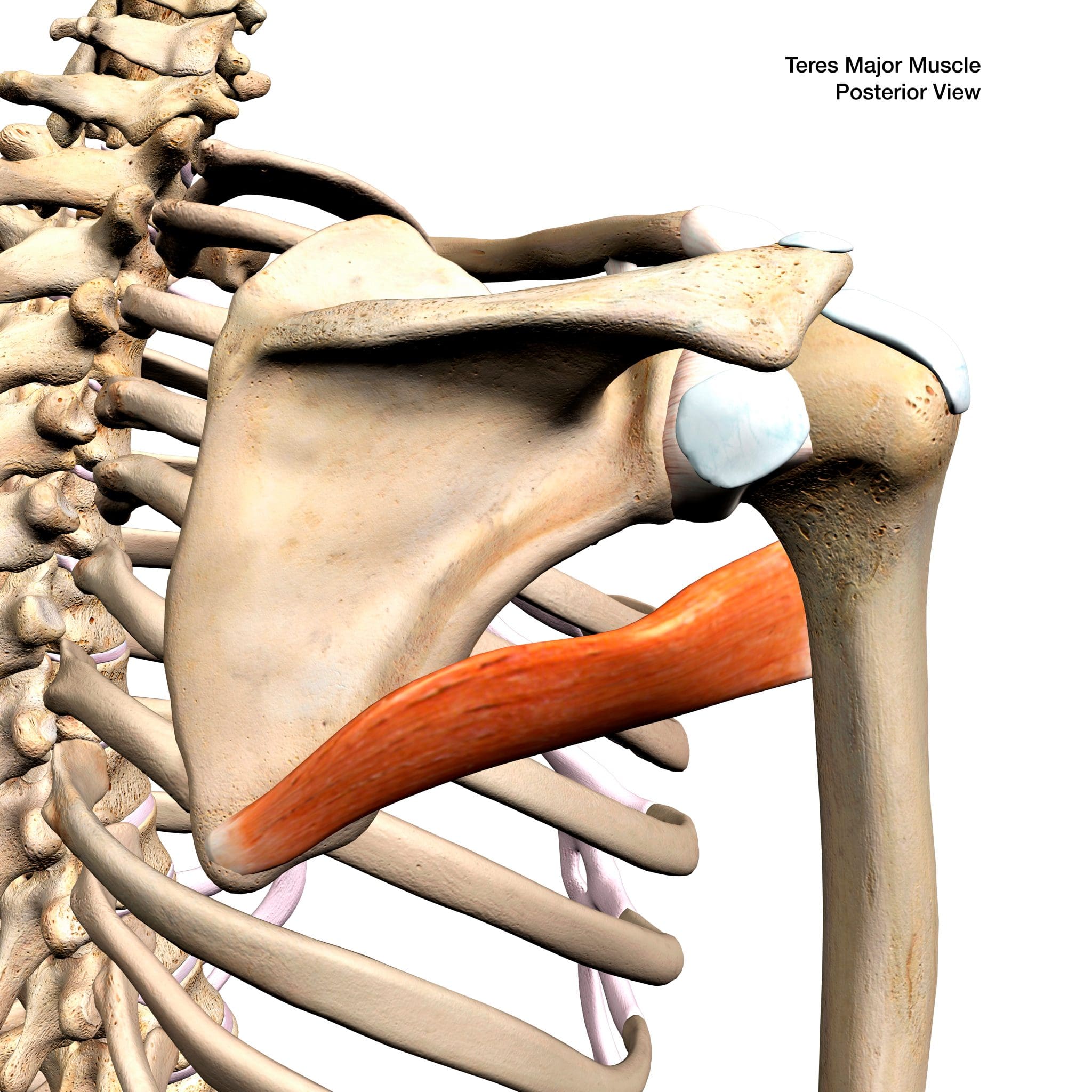
The teres major is small muscle with big impact. It lies in the posterior shoulder region, the lowest muscle you would feel if you palpated the back edge of your armpit. And it does exactly the same motions as it’s very large synergist, the latissimus dorsi. So, why do we need it? Let’s dive in.
| Origin | inferior angle of scapula (posterior aspect) |
| Insertion | medial lip of intertubercular groove of humerus |
| Action | extension, adduction and internal rotation (stability) |
| Innervation | lower subscapular n. (C5, C6) |
| Antagonists | posterior deltoid, teres minor, infraspinatus |
The Real World Teres Major
It isn’t uncommon to see this kind of set-up in the body: where two muscles perform the same action, but one is much larger and more superficial than the other. The muscles closest to the joint are designed for stability, while the larger, more superficial one is designed for power and movement. And this is the case for the teres major and latissimus dorsi.
The latissimus dorsi is activated with large movements like lat pull downs, pull ups and rows. The teres major is activated with shoulder extension from a fully flexed position (but not hyperextension) and in an isometric contraction, like a flexed arm hang or a tricep kick back or cable pull down while maintaining the shoulder in neutral extension. Remember, it is primarily a stabilizer, so when it is working you won’t see a lot of shoulder movement.
Note: I always thought it interesting when we were kids that the boys were tested with pull-ups and the girls were tested with flexed arm hangs. I guess back then, it was more important for boys to have strong lats while girls had strong teres majors.
If the teres major is activated more in isometric positions, then its significant is not in its strength, but more its length. This muscle doesn’t get a lot of press because it is rarely injured, but it can be a major culprit in shoulder impingement because it can limit external rotation of the humerus required for arm elevation.
Do the mirror test. If you stand in front of a mirror and you see knuckles, chances are you have a trigger point in the teres major. You should only be able to see the thumb and side of the index finger. The more knuckles you see in the mirror, the more internally rotated your shoulders are.
Here’s a short list of why this matters:
- A trigger point in teres major may be the cause of impingement of the shoulder with end range elevation
- Teres major injuries (rare) will usually occur with rapid isometric contractions into shoulder extension or internal rotation, like not following through with a volleyball or tennis serve
- And since injuries to this muscle are rare, and it doesn’t get a lot of press, you need to remember to check it for trigger points and refer to #1
Conventional thinking says: You can strengthen and stretch the teres major muscle just like the lats because they do the same thing
Real World Thinking says: There is a reason why two muscles do the same thing, but one is deeper. The teres major is primarily a stabilizer of extension, adduction and internal rotation. More importantly, prolonged positions in any of those motions will create trigger points that will limit external rotation in end range elevation. A short/tight teres major is a common cause of shoulder impingement. Don’t forget it.
Because nobody has time to be in pain.
Until next time…

Kind Regards,
MoveWell Academy
[email protected]