Muscle Minute TUESDAY – Meet the Rhomboid Major and Minor
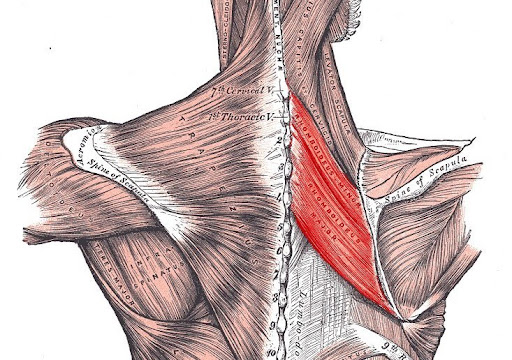
Pain in the upper back is often attributed to the rhomboid, but it is helpful to understand the reason for the pain. Is it tight? Or is it long/weak? It makes a difference in determining the best course of treatment. Let’s take a deeper dive:
| Origin | spinous process C7-T5, nuchal ligaments |
| Insertion | medial border of scapula |
| Action | scapular retraction, downward rotation and elevation (rhomboid minor) |
| Innervation | dorsal scapular n. (C5) |
| Antagonists | serratus anterior, infraspinatus, upper trapezius, pec minor |
The Real World Rhomboid
Is it tight or weak? Before you take out the foam roller or ball to try to get rid of “rhomboid pain”, it’s best to ask if upper back pain stems from the rhomboid being tight or weak. If the rhomboid is tight, we would observe a scapula that is either retracted (not common), downward rotated (more common), and/or elevated (very common). If the rhomboid is weak, we would observe trigger points in one or more of its antagonists. Check out that list in the table above.
If the rhomboid is tight, then massage or deep pressure to the rhomboid would be effective, but if the rhomboid is weak, then strengthening the rhomboid OR stretching its antagonists and improving thoracic extension and rotation would be the answer to alleviating pain. The latter usually yields the best results.
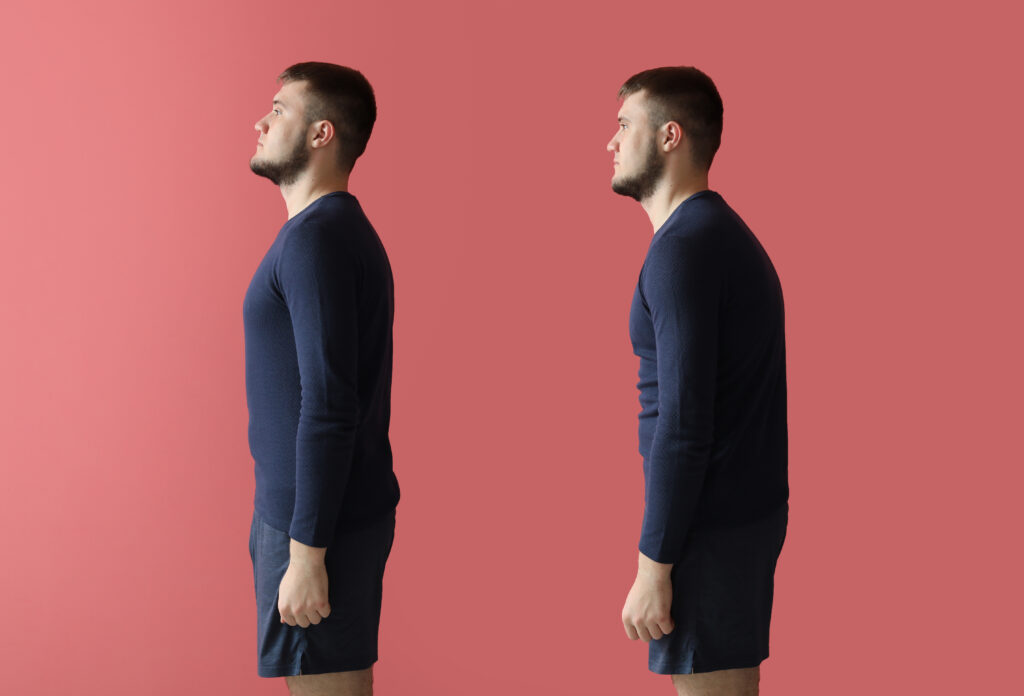
Most people with upper back pain display the posture on the right, with increased thoracic kyphosis and forward head. This places the rhomboid major in a long/weak position (protraction). The forward head posture places rhomboid minor in a potentially short position as it is contributes to scapular elevation.
How does forward head posture elevate and upwardly rotate the scapula? The answer lies in the role of the upper trapezius muscle in holding your head on your shoulders. The more forward your head is, the more active the upper trapezius becomes, resulting in a scapula that is elevated and upwardly rotated. There is a fascial connection between rhomboid minor and levator scapula, both acting as scapular elevators. If there is any trigger point to be found in the rhomboid with this posture, it is in rhomboid minor.
Incidentally, the rhomboid is best activated with horizontal abduction of the shoulder on a neutral thoracic spine.
Here’s a short list of why this matters:
- If someone complains of upper back pain, chances are the rhomboid major is in a long/weak position
- Strengthen the rhomboid major with rowing activities with the arm abducted 90˚. (MMT in this position showed the highest EMG activation versus prone with hand behind the back)
- If there is a trigger point, it is most likely in rhomboid minor and due to excessive scapular elevation. Treat this by improving thoracic extension and rotation to get rid of forward head posture
Conventional thinking says: Pain in your mid-back comes from a tight rhomboid. Stretch it or use a ball to roll it out.
Real World Thinking says: Most upper back pain stems from the rhomboid being long and weak. Correct it by releasing muscles that limit thoracic rotation and extension and correct forward head posture.
Because nobody has time to be in pain.
Until next time…
Kind Regards,
MoveWell Academy
[email protected]