Kinesiology THURSDAY – 8 Hardest Moves after 60 – Balance on One Leg

Try this. Stand up, lift one foot off the ground, and balance on the other.
Now count. If you can hold it for 10 seconds, that’s a good sign. If not… it’s something worth paying attention to. Because this “simple” ability is one of the strongest predictors of whether someone will fall.
Balancing on one leg isn’t just a test—it’s something you do all the time without realizing it. Every time you take a step, climb stairs, step over something or turn while walking, you are briefly on one leg. Trips turn into falls if your body can’t control that position, even for a moment.
Balance isn’t just about strength.
It’s a combination of muscle control, joint stability, vision, inner ear function and nervous system response. As we age, muscles react more slowly, the brain processes position less efficiently, and ankles and hips become less responsive. So even if you feel “strong”, you balance can still decline.
Kinesiology of Balancing on One Leg
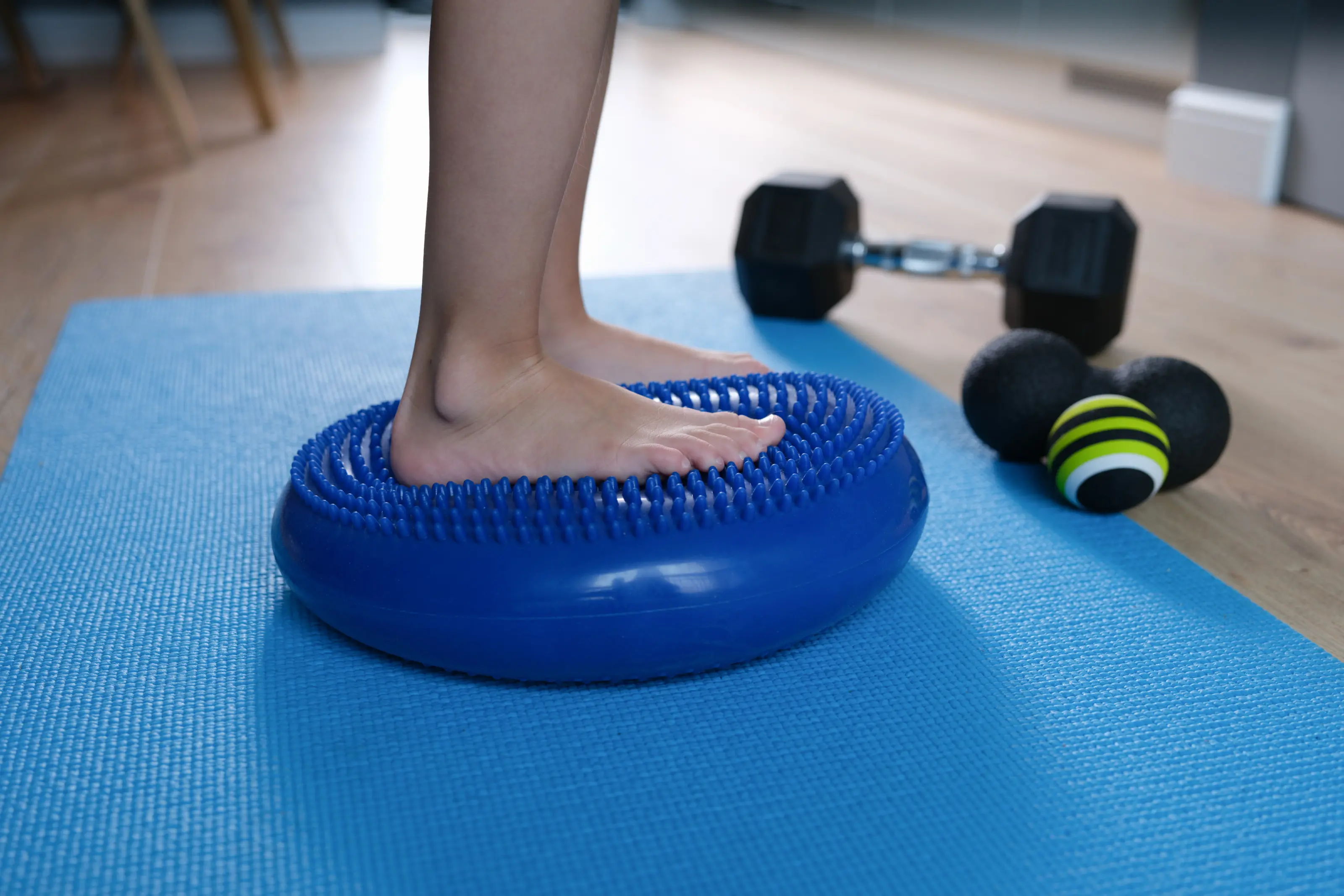
Balancing on one leg requires two key factors: subtalar joint eversion and gluteus medius strength. If you observe someone successfully balancing on one leg, you will notice the foot they are standing on rocks slightly in and out. Small movements at the ankle result in stillness above. Lack of this movement at the ankle causes large movements to happen at the hips and trunk.
When you pick up one leg, the tendency for your pelvis to drop to that side is counteracted by the hip abductors: gluteus medius, gluteus minimus and tensor fascia lata. Weakness of these muscles results in greater trunk movement to maintain balance. Trigger points in the quadratus lumborum or adductor muscles may neurologically “weaken” the gluteus medius.
Hands-On Techniques to Improve Balancing on One Leg
If you want to help your patients balance on one leg more easily, perform the following:
- Release trigger points and fascia in the tibialis posterior and anterior to allow for more eversion and dorsiflexion
- Release trigger points in the quadratus lumborum
- Mobilize the subtalar joint to improve eversion
Real World Exercise
- Walking on a line (50 feet) – Find the longest hallway in your house and practice walking on a line SLOWLY. Take your time picking up one leg and putting it in front.
- High knee marching (50 feet) – Now do exercise #1 while picking up one leg so that your hip flexes more than 90 degrees.
- Half pancake (6 reps) – Sit on the floor with one knee bent and the other straight out to the side. Bend towards your extended leg and then return to the upright position. This stretches the quadratus lumborum. For a standing version, perform the triangle pose for 30 seconds.
- Stand on one leg (10 seconds) – Stand next to a wall and pick up one leg. Place the back of your hand or one finger on the wall to steady yourself.
- Ball pass under leg (6-10 reps) – Hold a ball in one hand. Pick up one leg and pass the ball underneath to the other hand. Once you get good at this, pass the ball underneath your knee for 6-10 reps without putting your foot down.
Weekly Goal: Practice single leg balance daily even if just for 1-2 minutes total. You can do it while brushing your teeth, waiting for the kettle or standing at your kitchen counter. Small, consistent practice makes a big difference.
Why does this matter?
The ability to balance on one leg for 10 seconds is one of the best indicators that you are protected against falls. This ability doesn’t disappear in a day. By checking and fixing small things like ankle mobility and hip weakness, you can ensure safe movement for years to come.
What’s Next
Next, we’ll look at something most people think they understand—but almost no one trains properly: walking (especially on uneven surfaces). Not just moving forward, but moving well, safely and confidently in the real world.
If you stay consistent with this series, you won’t just learn about these movements—you’ll keep them. I’ll see you next week.
Because nobody has time to be in pain.
Until next time…

Kind Regards,
MoveWell Academy
[email protected]