
Anatomy TUESDAY – The Sternoclavicular Joint: Small Joint. Big Job.
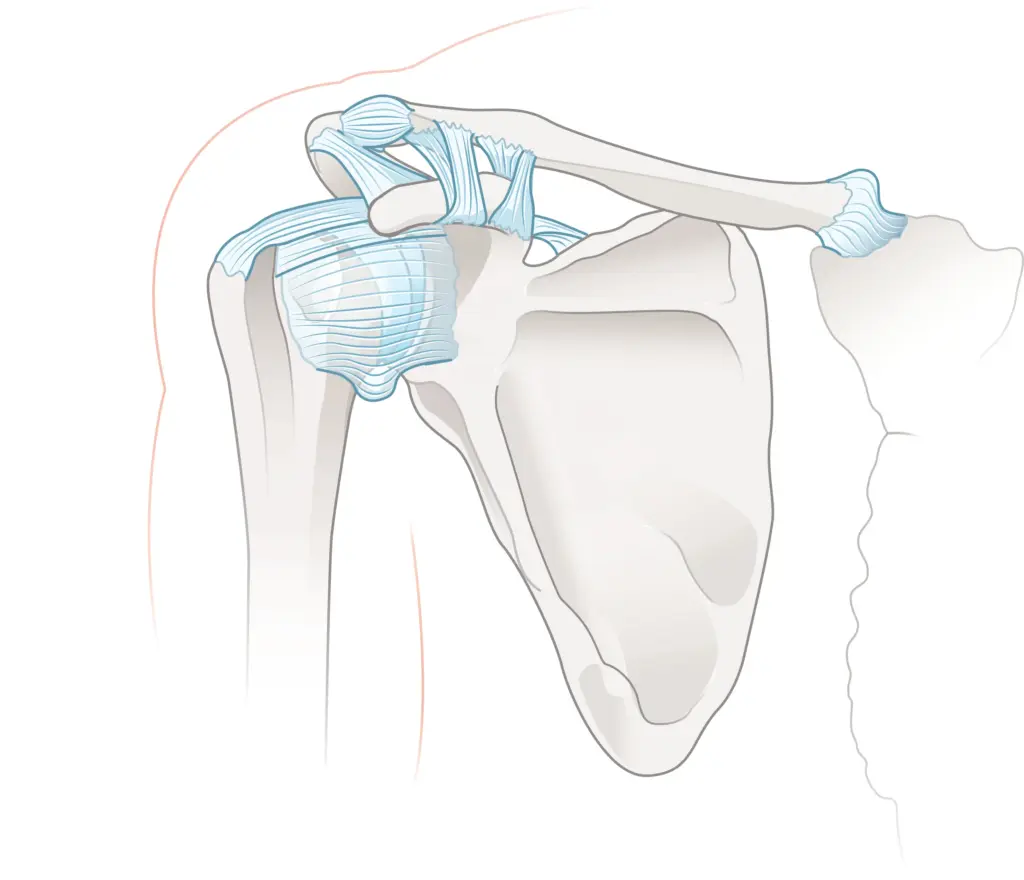
When you raise your arm overhead, what joint are you moving? The shoulder (glenohumeral) joint seems like the obvious answer. The scapula is probably the second structure that comes to mind.
But there’s another joint moving—one that is easy to forget.
It’s the sternoclavicular (SC) joint, the articulation between the medial end of the clavicle and the sternum. And here’s the remarkable part:
The sternoclavicular joint is the only true bony articulation connecting the entire upper extremity to the axial skeleton.
Your humerus connects to your scapula. Your scapula connects to your clavicle. But the clavicle’s articulation with the sternum is the only place where this entire system actually forms a synovial joint with the trunk.
That makes this little joint incredibly important.
A Small Joint Carrying a Big Responsibility
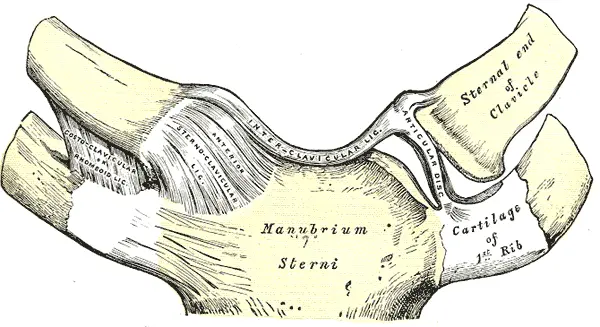
The sternoclavicular joint is formed primarily between the medial end of the clavicle and the manubrium of the sternum, with participation from the cartilage of the first rib.
Interestingly, the articular surfaces aren’t particularly well matched. The medial clavicle is relatively large compared with the small articular surface on the sternum.
So how does such a seemingly unstable arrangement work?
The sternoclavicular joint contains a fibrocartilaginous articular disc.
This disc divides the joint into two separate synovial compartments and attaches to surrounding structures, including the first costal cartilage and clavicle. The disc helps improve joint congruency, absorb forces and distribute loads traveling through the clavicle.
This becomes especially important when you consider what the clavicle does.
Forces generated through the arm don’t simply disappear at the shoulder.
When you fall on an outstretch arm or press through your hand, this is how the forces travel: hand > radius > interosseous membrane > ulna > humerus > scapula > coraclavicular ligaments > clavicle > sternoclavicular disc (SC joint).
The SC joint, in a sense, is the gateway between the arm and the trunk.
The Clavicle Has to Move for the Arm to Move
As you raise your arm overhead, the scapula upwardly rotates. One of the most important clinical pearls about the SC joint is simple:
The scapula cannot achieve normal movement without movement of the clavicle.
Phase I arm elevation (0˚-90˚) – Clavicle upwardly rotates around an axis at the SC joint. This achieves the first 30˚ of scapular upward rotation
Phase II arm elevation (90˚-180˚) – Clavicle upwardly rotates around its longitudinal axis at the AC joint to achieve an additional 30˚ of scapular upward rotation.
At the sternoclavicular joint, the clavicle can perform three primary motions:
- Elevation and depression
- Protraction and retraction
- Posterior and anterior axial rotation
All three become important during upper-extremity movement.
The mechanics of the SC joint are especially interesting because its convex-concave relationships change depending on the plane of movement. This is characteristic of saddle joints in the body.
During clavicular elevation and depression, the convex clavicular surface of the medial clavicle moves opposite to the concave surface of the sternum/disc complex. For instance, when you lift your arm up, the articular surface of the medial clavicle moves down.
But during protraction and retraction, the relationship is reversed—the clavicular surface is concave in the horizontal plane relative to the convex sternum and therefore moves in the same direction as the long lever arm of the clavicle. For example, if you reach across your body (horizontal adduction), the articular surface of the medial clavicle moves anterior.
What Keeps the Joint Stable?
Considering how small the sternal articulation is, the SC joint is remarkably stable.
Several strong ligamentous structures contribute. (see illustration above)
The anterior and posterior sternoclavicular ligaments reinforce the joint capsule in the anterior/posterior direction.
The interclavicular ligament spans across the superior aspect of the manubrium between the clavicles.
And the costoclavicular ligament connects the inferior clavicle to the first rib and its costal cartilage, preventing excessive superior movement of the medial clavicle.
Why Does This Matter?
The sternoclavicular joint can easily be overlooked during a shoulder examination because it isn’t usually where patients point when describing shoulder pain.
But watching and palpating the medial clavicle during shoulder movement can provide useful information about how the entire shoulder girdle is moving.
Do this test: Reach your arm overhead. Do you feel a pinch at the top of your shoulder? Chances are your medial clavicle is subluxed anteriorly or posteriorly causing a shoulder impingement. It isn’t the only cause of shoulder impingement, but is often involved in abnormal arm elevation mechanics.
Here’s how to fix an anteriorly displaced medial clavicle. And here’s how to fix a posteriorly displaced medial clavicle.
The sternoclavicular joint is the only true bony connection of the arm to the axial skeleton. Proper movement and alignment of this saddle joint is essential for pain-free arm elevation.
If the SC joint is subluxed or not functioning properly, often times the symptoms show up in the shoulder (glenohumeral joint) as an impingement. So, consider this small joint with a big job. Fix what you find.
Because nobody has time to be in pain.
Until next time…
Kind Regards,
MoveWell Academy
[email protected]