Anatomy TUESDAY – Clinical Anatomy Pearl 6 – Common Extensor Tendon
Patients often describe lateral elbow pain with a simple statement:
“It hurts every time I pick up a coffee cup.”
To the patient, it seems surprising that such a small movement can produce so much discomfort. To the clinician, however, this symptom makes perfect sense.
The common extensor tendon may be relatively small, but it performs an enormous amount of work. It stabilizes the wrist during gripping, absorbs repetitive tensile loads, and coordinates the fine motor control that allows us to write, type, lift, throw, and manipulate objects.
Understanding the anatomy and biomechanics of this tendon provides valuable insight into why lateral elbow tendinopathy develops—and why successful rehabilitation involves much more than strengthening the wrist extensors.
More Than Just a Wrist Extensor
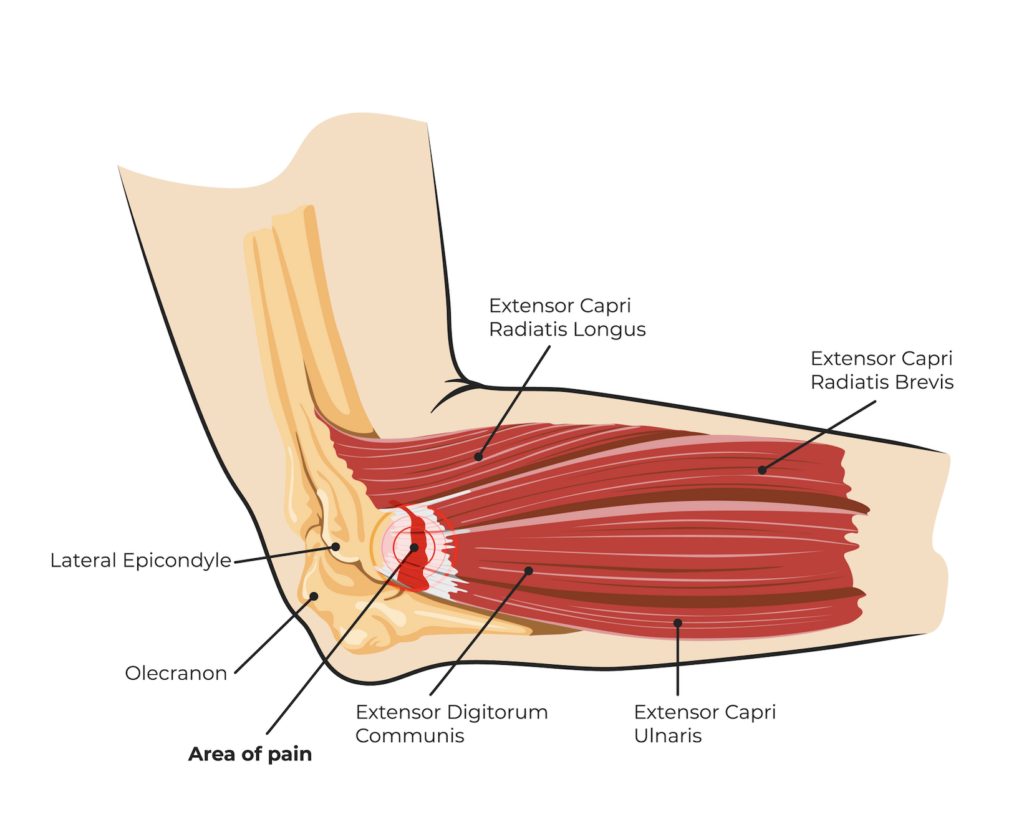
The common extensor tendon originates from the lateral epicondyle of the humerus and serves as the shared origin for several muscles, including:
- Extensor carpi radialis brevis (ECRB)
- Extensor digitorum communis
- Extensor digiti minimi
- Extensor carpi ulnaris
Among these, the extensor carpi radialis brevis (ECRB) is most frequently implicated in lateral elbow tendinopathy. Unlike the larger tendons of the lower extremity, the common extensor tendon is designed less for storing elastic energy and more for providing dynamic stability during hand function.
Its primary role is not producing wrist extension—it is stabilizing the wrist so the fingers can generate force efficiently.
The Hidden Role of Wrist Stability
Imagine carrying a heavy grocery bag.
Although your finger flexors produce the gripping force, the wrist extensors contract simultaneously to prevent the wrist from collapsing into flexion. This phenomenon, known as co-contraction, allows the hand to function efficiently.
Without the common extensor tendon stabilizing the wrist, grip strength decreases dramatically.
This explains why patients with lateral epicondylalgia frequently report pain while:
- Opening jars
- Carrying groceries
- Pouring coffee
- Using a screwdriver
- Lifting a suitcase
- Shaking hands
The tendon is working even when the wrist appears motionless.
Small Muscle, High Demand
One of the fascinating aspects of the common extensor tendon is the mismatch between its size and its workload.
Unlike the Achilles or patellar tendon, which experience large intermittent loads during running or jumping, the common extensor tendon experiences thousands of low-to-moderate repetitive contractions throughout the day: typing, using a mouse, holding a steering wheel, gardening, painting, carpentry, racquet sports.
These repetitive activities may individually seem insignificant, but collectively they create substantial cumulative tendon loading.
In many cases, tendinopathy results not from a single overload event but from repeated exposure without sufficient recovery.
Why does the ECRB get into trouble?
The extensor carpi radialis brevis occupies a mechanically disadvantaged position. It has a relatively small cross-sectional area, a short tendon, and a close relationship to the radiocapitellar joint.
During gripping, especially with the elbow extended, the ECRB experiences considerable tensile stress. Additionally, portions of the tendon may undergo compressive loading against the capitellum during certain wrist and forearm positions.
This combination of repetitive tension and compression helps explain why degenerative changes often develop within the ECRB origin.
Tendinitis v. Tendinosis
For many years, lateral epicondylitis was believed to be an inflammatory condition. Histological studies have since demonstrated that chronic cases are characterized primarily by tendinosis—a degenerative process involving collagen disorganization, increased ground substance, and neovascularization rather than acute inflammation.
This distinction has important implications.
Treatments aimed solely at reducing inflammation may provide temporary symptom relief but do little to restore tendon capacity. Instead, progressive loading remains the cornerstone of rehabilitation.
The Gripping Story
One of the simplest yet most informative assessments is grip strength.
| Age | Women (Dominant Hand) | Men (Dominant Hand) |
| 20–29 | 60–70 lb (27–32 kg) | 105–120 lb (48–54 kg) |
| 30–39 | 60–75 lb (27–34 kg) | 105–120 lb (48–54 kg) |
| 40–49 | 55–70 lb (25–32 kg) | 100–115 lb (45–52 kg) |
| 50–59 | 50–65 lb (23–29 kg) | 95–110 lb (43–50 kg) |
| 60–69 | 45–60 lb (20–27 kg) | 85–100 lb (39–45 kg) |
| 70+ | 35–50 lb (16–23 kg) | 70–90 lb (32–41 kg) |
Most right-handed individuals demonstrate approximately:
- Dominant hand: 5–10% stronger
- Left-handed individuals: often have little or no difference between hands
The commonly quoted “10% rule” is an oversimplification. Studies have shown dominance effects vary with handedness and occupation.
For reliable comparisons, grip strength should be measured with (ASHT Standard):
- Shoulder adducted and neutrally rotated
- Elbow flexed to 90°
- Forearm in neutral
- Wrist 0–30° extension
- 0–15° ulnar deviation
- Jamar dynamometer on Handle Position II (unless hand size dictates otherwise)
Three trials are typically performed, with the average recorded.
Patients with lateral epicondylalgia often demonstrate:
- 20–50% reduction in pain-free grip strength
- Greater reduction in pain-free grip than in maximal grip
- Improvement in grip strength that parallels improvements in tendon capacity
Pain-free grip strength is often more clinically useful than maximal grip because it reflects tendon irritability.
Real World Kinetic Chain Connection
Although symptoms occur at the elbow, contributing factors frequently originate elsewhere. The tennis backhand is a perfect example of how the common extensor tendon should be loaded. Starting from the ground up, the following eccentric loading should occur to decrease overload of the common extensor tendon:
- Opposite side subtalar joint eversion
- Opposite side knee flexion (loads the quadriceps)
- Opposite side hip flexion/IR (loads the gluteus maximus)
- Opposite thoracic rotation (loads obliques and erector spine)
- Same side scapular protraction (loads rhomboids)
- Same side elbow flexion (loads the triceps)
- And THEN, the common extensor tendon
Why does this matter?
The common extensor tendon is much more than the tendon involved in “tennis elbow.” It functions as a dynamic stabilizer of the wrist during gripping and precision tasks, tolerating thousands of repetitive contractions each day. Successful rehabilitation requires restoring tendon capacity, improving proximal control, and preparing the upper extremity to manage the cumulative demands of work, sport, and daily activity.
Join me next week where we will talk about the thing that holds us together. Fascia.
Because nobody has time to be in pain.
Until next time…

Kind Regards,
MoveWell Academy
[email protected]