

Kinesiology THURSDAY – Biomechanics of the Fibula
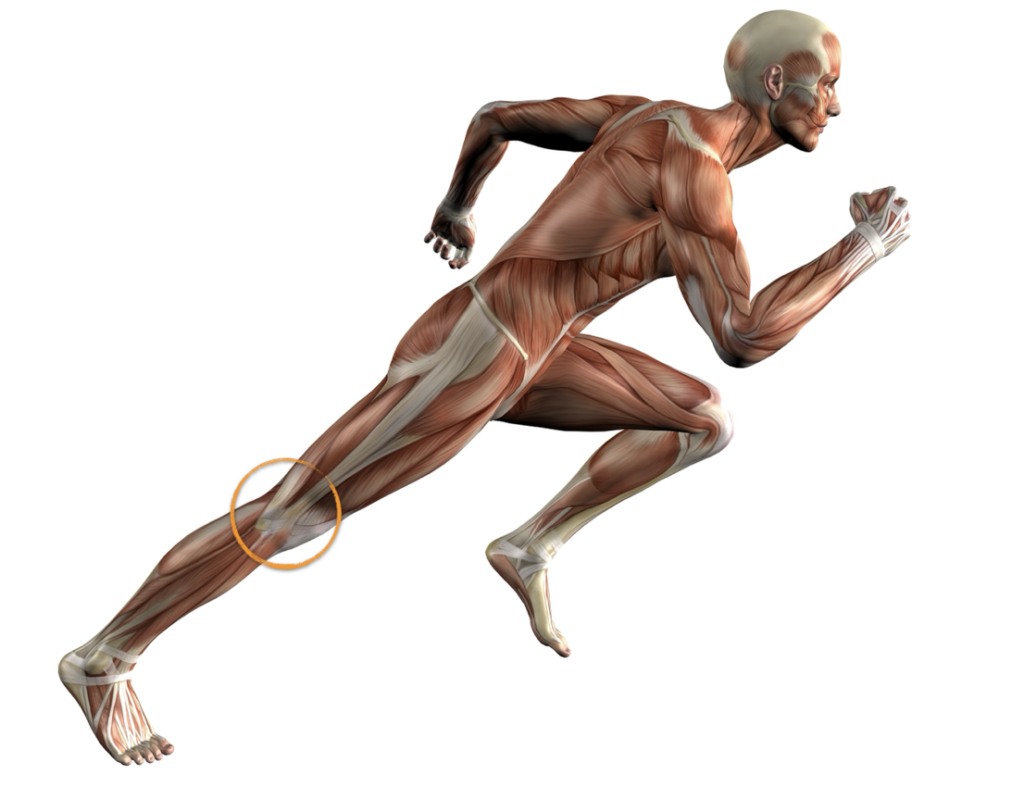
If you’ve ever experienced sharp lateral knee pain while running, then you’ve most likely felt the impact of the fibula. Although it’s often called the “non-weight-bearing bone,” the fibula is far more important during running than most people realize. It contributes to load sharing, ankle stability, energy storage, and force transmission throughout the gait cycle.
Here’s what the fibula is doing with every stride:
- The tibia carries most of the body’s weight, but the fibula still bears approximately 6–17% of the axial load, depending on ankle position and muscle activity.
- The fibula is the point of attachment of the peroneus longus and brevis, soleus, flexor hallucis longus, extensor hallucis longus and tibialis posterior
- It is also the attachment of the bicep femoris tendon coming from the ischial tuberosity (long head) and femur (short head)
- It absorbs shock at heel strike and transfers forces to the tibia via the interosseus membrane
- It resists internal rotation forces of the lower leg when the foot hits the ground
Running Phase Fibula’s Role
| Running Phase | Fibula’s Role |
| Initial contact | Stabilizes lateral ankle; begins load sharing |
| Midstance | Bears a portion of axial load; deforms slightly; transmits forces through the interosseous membrane |
| Terminal stance | Provides attachment for plantarflexors; helps stabilize the ankle during propulsion |
| Toe-off | Peroneals and soleus use the fibula as a stable lever for push-off |
| Swing | Supports dorsiflexor muscle function and prepares for the next landing |
When things go wrong…
Lack of subtalar joint eversion will cause the lower leg to remain externally rotated. Over time, this may cause compensatory shortening of the bicep femoris and a posteriorly subluxed fibular head.
Over pronation may cause excessive anterior migration of the fibula and weakening of the bicep femoris in decreasing internal rotation loads at heel strike.
Why does this matter?
The fibula is much more than a “spare bone.” During running it functions as a dynamic stabilizer, load-sharing structure, and muscular anchor. Its subtle movement at the ankle, interaction with the tibia through the interosseous membrane, and role in supporting the muscles that propel and stabilize the body make it essential for efficient, injury-free running.
Clinicians should remember that lateral leg pain in runners is not always muscular—the fibula has many reasons to be the cause of pain and subluxations are common in someone who over supinates. That’s the bad news. The good news is that it’s fixable.
Consider the fibula.
Because nobody has time to be in pain.
Until next time…

Kind Regards,
MoveWell Academy
[email protected]