Anatomy TUESDAY – Coracohumeral Ligament
The shoulder is one of the most mobile joints in the human body, allowing a remarkable range of movement. However, this mobility comes at the cost of inherent stability. To maintain a balance between movement and support, the shoulder relies on a complex network of muscles, tendons, ligaments, and capsular structures.
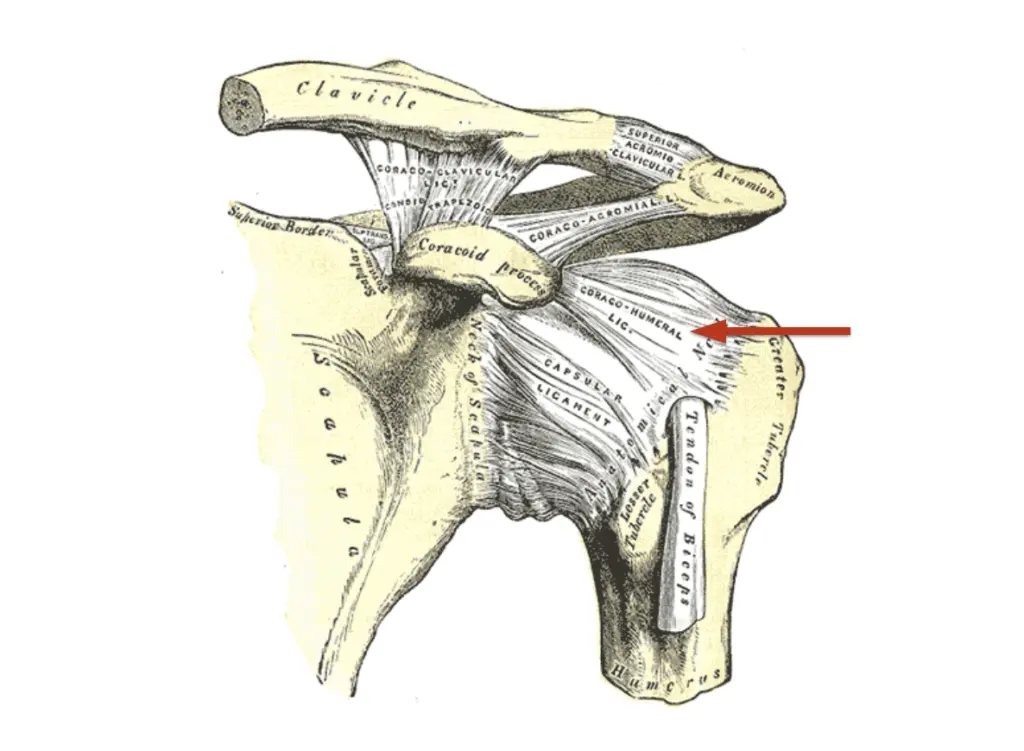
One important component of this stabilizing system is the coracohumeral ligament (CHL). Although relatively small, this ligament plays a significant role in maintaining glenohumeral joint stability, supporting the rotator interval, and limiting excessive movement of the humeral head.
Anatomical Deep Dive
The coracohumeral ligament is a strong, broad, fibrous ligament located along the superior aspect of the glenohumeral joint.
It extends from the coracoid process of the scapula toward the proximal humerus, blending with the joint capsule and adjacent rotator cuff structures.
Unlike some ligaments that form distinct cord-like bands, the coracohumeral ligament is a broad capsuloligamentous structure that contributes to the reinforcement of the superior shoulder capsule.
The ligament is commonly described as having two major components:
- Anterior fibers: Extend toward the lesser tubercle and blend with the subscapularis tendon and nearby capsular structures.
- Posterior fibers: Extend toward the greater tubercle and blend with the supraspinatus tendon and adjacent tissues.
This arrangement allows the ligament to reinforce the superior and anterior portions of the shoulder joint.
Palpate it by placing two fingers just inferior to the concavity of the clavicle. Extend and externally rotate your shoulder. You should feel the tip of the coracoid process under your palpating fingers. Palpate in a slight fanned out fashion towards the humerus to feel the CHL.
Small Ligament with a Big Job
- Limits inferior translation of the humeral head
- Checks excessive external rotation of the humerus, particularly when the arm is adducted
- Reinforces the rotator interval, the space between the supraspinatus and subscapularis
- Contributes to bicep tendon stability, stabilizing the long head of the bicep in the intertubercular groove
When things go wrong…
- Shoulder instability may occur with a CHL tear. Strengthening muscles that decelerate external rotation (subscapularis, pectoralis major, anterior deltoid) with the arm adducted will help protect the CHL while it is healing.
- If CHL is torn, ensure ipsilateral hip internal rotation and thoracic rotation are normal to minimize CHL tension with functional activities requiring eccentric shoulder external rotation
- Adhesive capsulitis may involve shortening of the CHL. Performing posterior glide of the humeral head while stretching into shoulder external rotation with the arm adducted may lengthen the CHL.
- Soft tissue mobilization in the rotator interval (from coracoid process fanning out to the humerus) may elongate and stretch the CHL in cases of limited shoulder ER.
Why does this matter?
The CHL is an unsung hero of shoulder stabilization and may also be a culprit in limiting shoulder ER in patients with adhesive capsulitis. Understanding how to palpate, stretch and mobilize this ligament will add depth to your treatment of shoulder patients.
Consider the coracohumeral ligament.
Because nobody has time to be in pain.
Until next time…
Kind Regards,
MoveWell Academy
[email protected]