Anatomy TUESDAY – Ulnar Nerve
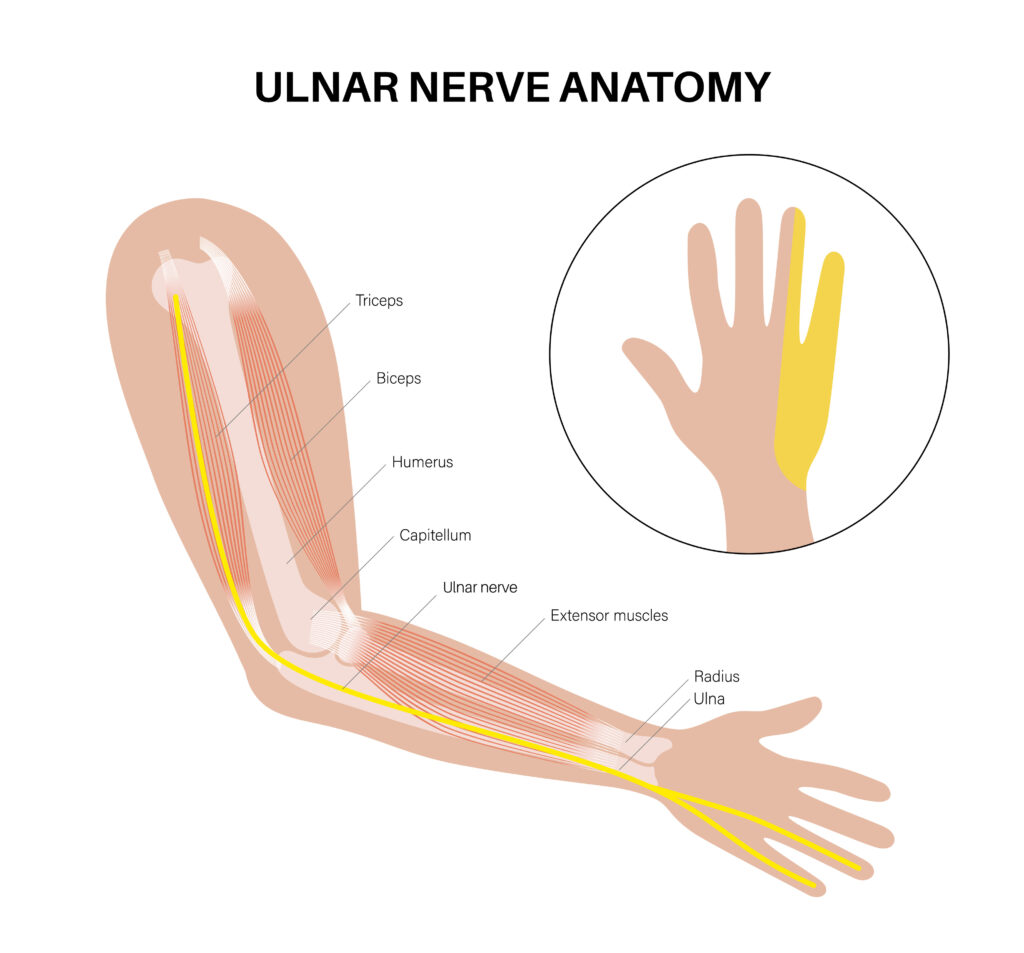
Most people know the ulnar nerve without realizing it.
Strike the inside of your elbow against a hard surface and you may experience an electric sensation traveling into the ring and little fingers. That familiar “funny bone” sensation is actually the ulnar nerve being mechanically irritated as it passes behind the medial epicondyle.
However, the ulnar nerve is much more interesting than an occasional elbow shock. Its long path from the neck to the hand, multiple potential compression sites, and important role in fine motor control make it essential anatomy for evaluating elbow, forearm, and hand complaints.
Follow the Ulnar Nerve
The ulnar nerve originates primarily from the C8–T1 nerve roots and arises from the medial cord of the brachial plexus.
It travels down the medial arm before passing behind the medial epicondyle of the humerus.
This is where the nerve becomes remarkably superficial. There is little tissue protecting it from external pressure—which explains why hitting this area produces such an intense neurological sensation.
From there, the nerve enters the forearm between the two heads of flexor carpi ulnaris (FCU) and continues toward the wrist.
Unlike the median nerve, the ulnar nerve does not travel through the carpal tunnel. Instead, it enters the hand through Guyon’s canal, a separate fibro-osseous tunnel on the ulnar side of the wrist. This is particularly relevant in cyclists because prolonged pressure from handlebars can irritate the nerve at the palm—sometimes called “handlebar palsy.” I’ve felt this myself.
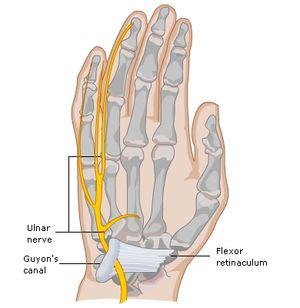
Understanding this pathway helps clinicians determine where along the nerve symptoms may originate.
The Cubital Tunnel: A Common Trouble Spot
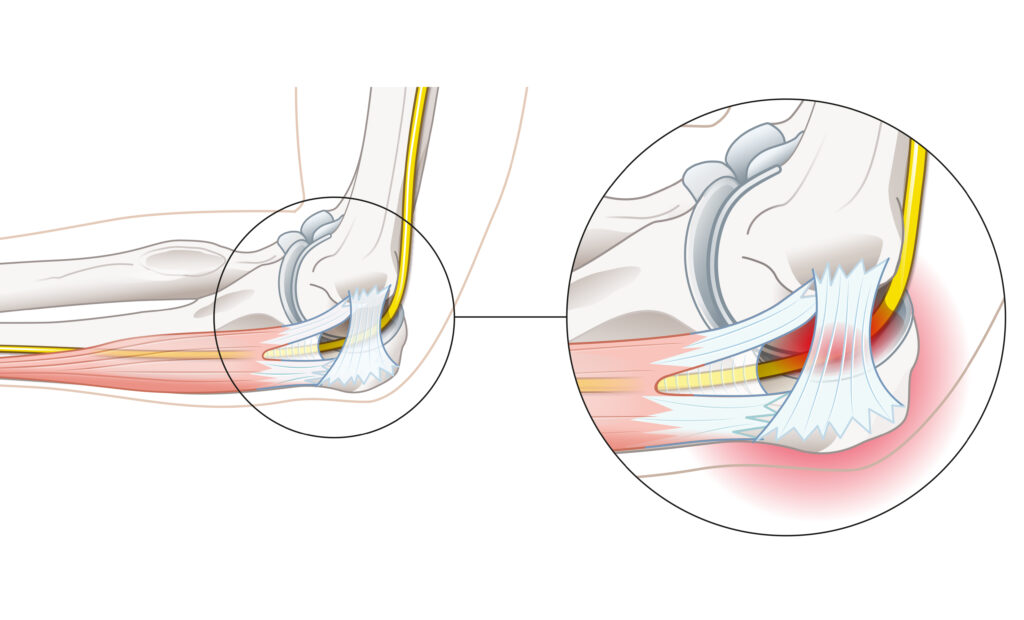
The elbow is one of the most important locations for ulnar nerve irritation.
The nerve passes through the cubital tunnel behind the medial epicondyle, where its mechanical environment changes significantly with elbow position.
As the elbow bends, the nerve must accommodate increasing excursion and strain, while the dimensions and pressure within the cubital tunnel change.
This helps explain why patients with cubital tunnel syndrome frequently report symptoms when:
- Sleeping with the elbow bent
- Holding a phone
- Driving
- Reading
- Working at a computer
- Leaning on the elbow
Nighttime numbness in the ring and little fingers is particularly common.
Sometimes one of the simplest interventions is also one of the most effective: reduce prolonged elbow flexion and direct pressure on the nerve.
What Does the Ulnar Nerve Do?
The ulnar nerve provides sensation to the little finger and the ulnar portion of the ring finger, but its motor function is especially important.
It innervates many of the small intrinsic muscles of the hand responsible for precise finger control.
These include most of the:
- Interossei
- Hypothenar muscles
- Lumbricals to the ring and little fingers
- Adductor pollicis
In the forearm, it also supplies the flexor carpi ulnaris and the ulnar portion of flexor digitorum profundus.
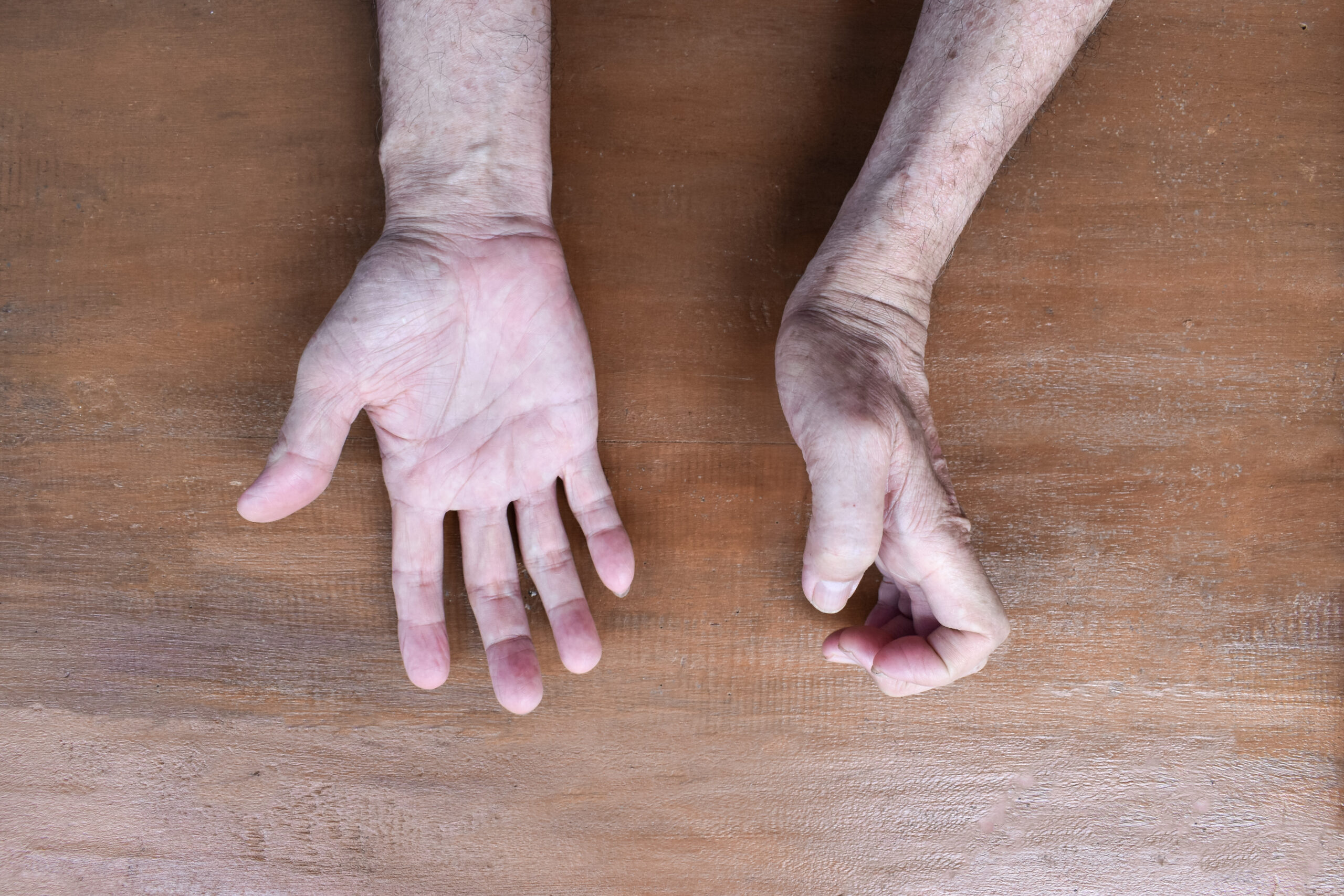
This means ulnar nerve dysfunction can affect much more than sensation.
If compression is significant, motor function may be affected including difficulty with:
- Spreading their fingers
- Bringing their fingers together
- Pinching
- Gripping
- Turning keys
- Opening containers
- Typing
- Playing musical instruments
- Manipulating small objects
If a patient reports feeling clumsy with holding or manipulating objects, possible compression sites of the ulnar nerve along its pathway must be evaluated.
Why Grip Weakness Matters
Grip strength isn’t produced by the finger flexors alone.
The intrinsic muscles of the hand stabilize and coordinate the fingers so larger muscles can generate force efficiently. When ulnar nerve function declines, patients may demonstrate surprisingly significant grip and pinch weakness.
One useful clinical example is Froment’s sign.
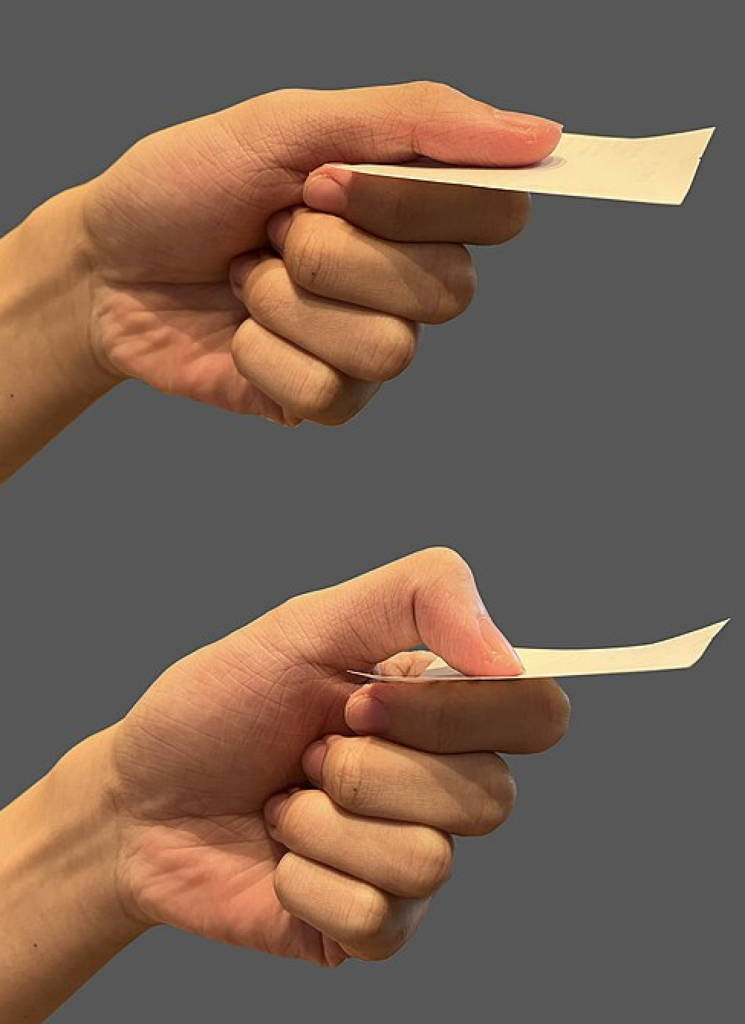
When a patient attempts to hold a piece of paper between the thumb and index finger, weakness of the ulnar-innervated adductor pollicis may cause the patient to compensate by flexing the thumb’s interphalangeal joint using the median-innervated flexor pollicis longus.
The compensation tells you something important:
The hand may still accomplish the task, but it is accomplishing it differently because of neurological weakness.
Don’t Forget the Neck
Ring- and little-finger numbness does not automatically equal cubital tunnel syndrome.
Symptoms may also arise from:
- C8–T1 radiculopathy
- Lower brachial plexus involvement
- Thoracic outlet pathology
- More proximal ulnar nerve irritation
- Peripheral neuropathy
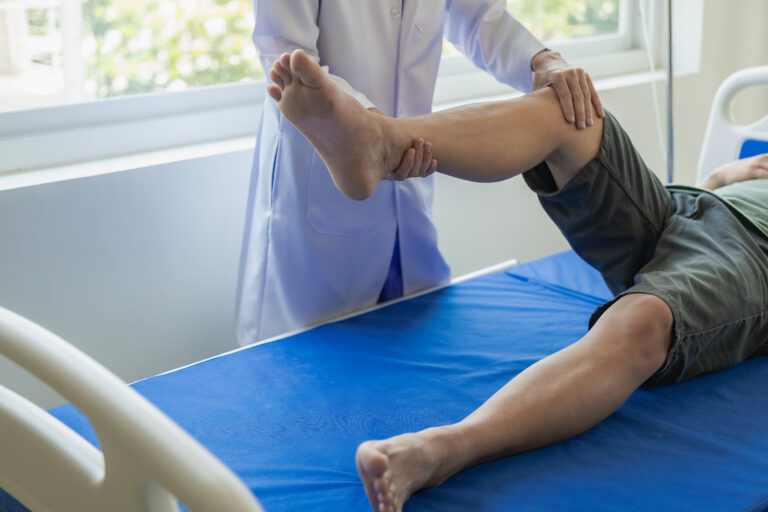
This is why the examination should follow the nerve rather than simply examine the location where symptoms are felt.
The Ulnar Nerve Is Designed to Move
Like the median and radial nerves, the ulnar nerve is a mobile biological tissue.
It must glide and accommodate changes in length as the shoulder, elbow, forearm, wrist, and fingers move.
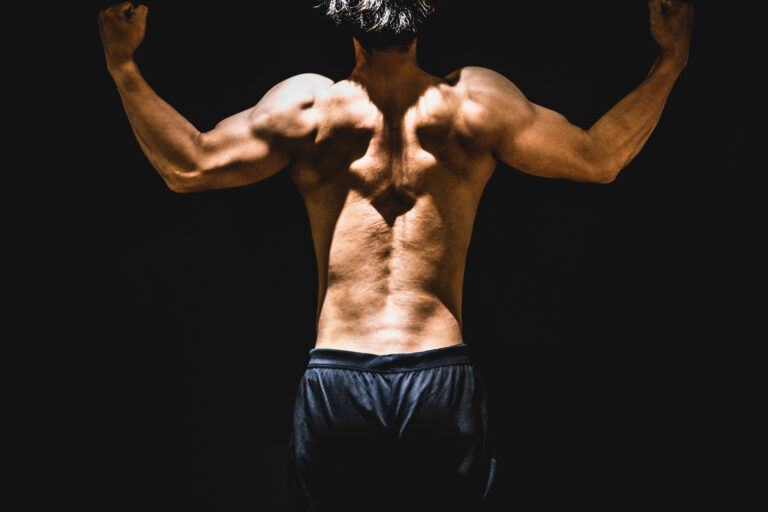
Try the Birdman sign:
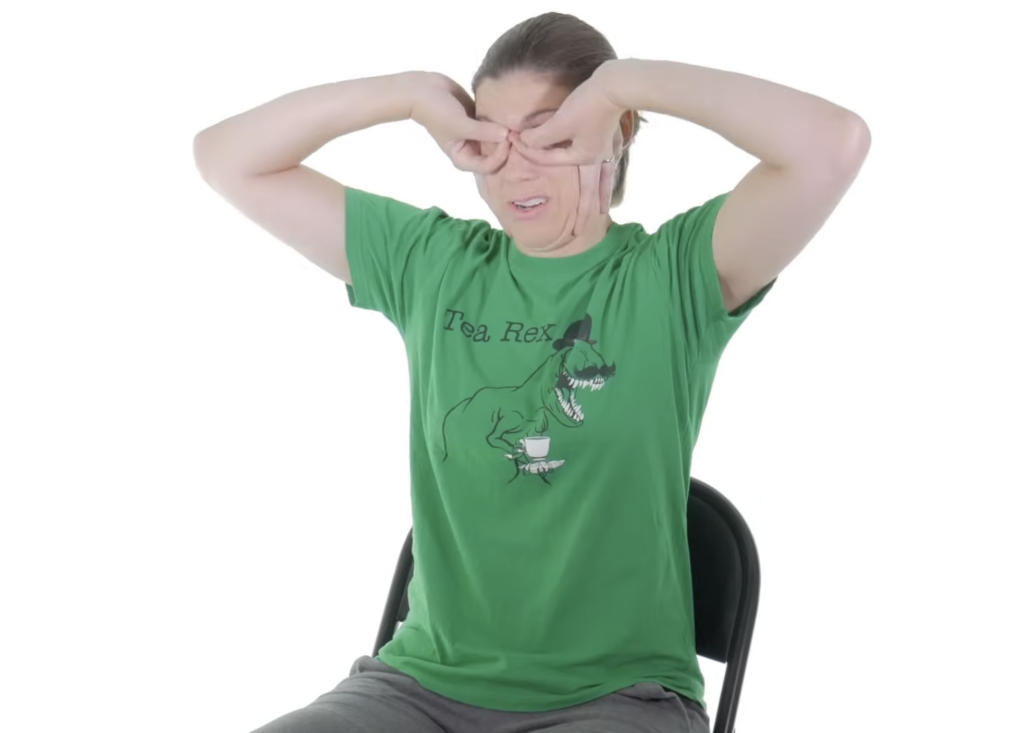
For the ulnar nerve, progressive neural loading commonly involves combinations of:
Shoulder depression → shoulder abduction/external rotation → forearm pronation → wrist and finger extension → increasing elbow flexion, with cervical movement used to modify neural loading.
if you can do “birdman” without pain, your ulnar nerve is gliding just fine. For tips on gliding the ulnar nerve click here.
Why does this matter?
The location of symptoms tells you where the patient feels the problem—not necessarily where the problem originates.
So, if your patient complains of persistent numbness, tingling or pain in the elbow or medial side of the hand, consider the ulnar nerve. Follow its path. Assess compression points. And restore gliding.
Because nobody has time to be in pain.
Until next time…
Kind Regards,
MoveWell Academy
[email protected]