Kinesiology THURSDAY – Floor Sitting for Health

It’s that time of year when hours may be spent wrapping presents and assembling new toys. It’s a perfect occasion to practice something that many ancient cultures used liberally to socialize, eat and work: the floor sit.
Floor sitting has been shown to improve core muscle activity and leg flexibility. Let’s look at four types of floor sitting:
Cross-Leg Sitting (pictured above) – If performed correctly, sitting in this way alleviates spinal pressure. It requires hip external rotation and flexibility in your hip adductors. If you find yourself struggling to get your weight on your sit bones in this posture, placing a yoga block or a towel under your butt can help ease you into this position.
Mother Sitting

Mother sitting is an adaptation of cross-legged sitting that requires less hip external rotation on one side. If you favor doing this one way, check the other side and see if it feels restricted. A limitation on one side is often associated with tightness in a deep hip external rotator, like the piriformis, on the leg that is upright. If it is restricted, you won’t feel a stretch while sitting, you will simply lean more to the side. You should be able to perform this sitting posture without placing a hand on the floor. Give it a try. Stretching the piriformis will ease the strain felt on the restricted side of this sitting posture.
Side Sitting
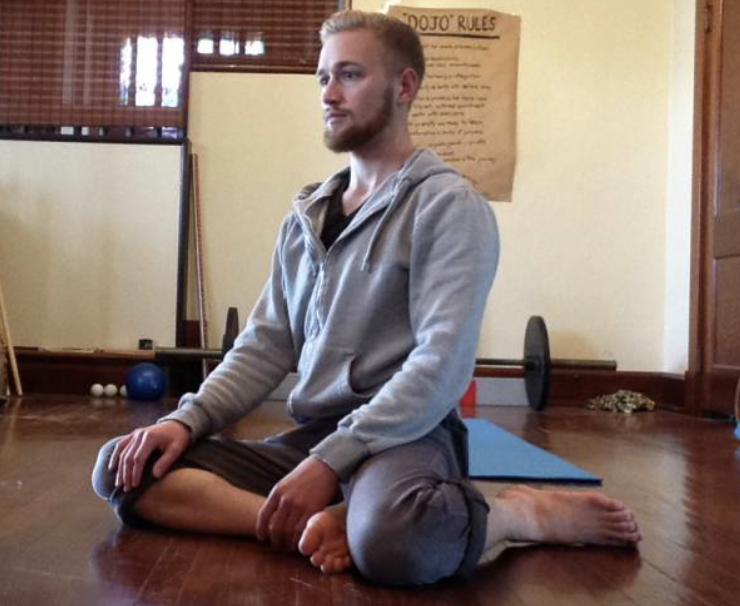
The side sit emphasizes hip internal rotation on one side and external rotation on the other. If there is a limitation, it is usually felt as a “jam” on the internally rotated hip (in this case his left hip). Stretching the adductors and hamstrings with the runner’s stride stretch can help improve this sitting posture. If done correctly, this posture minimizes spinal pressures and is a transitional move to kneeling and then standing up from the floor.
Kneeling
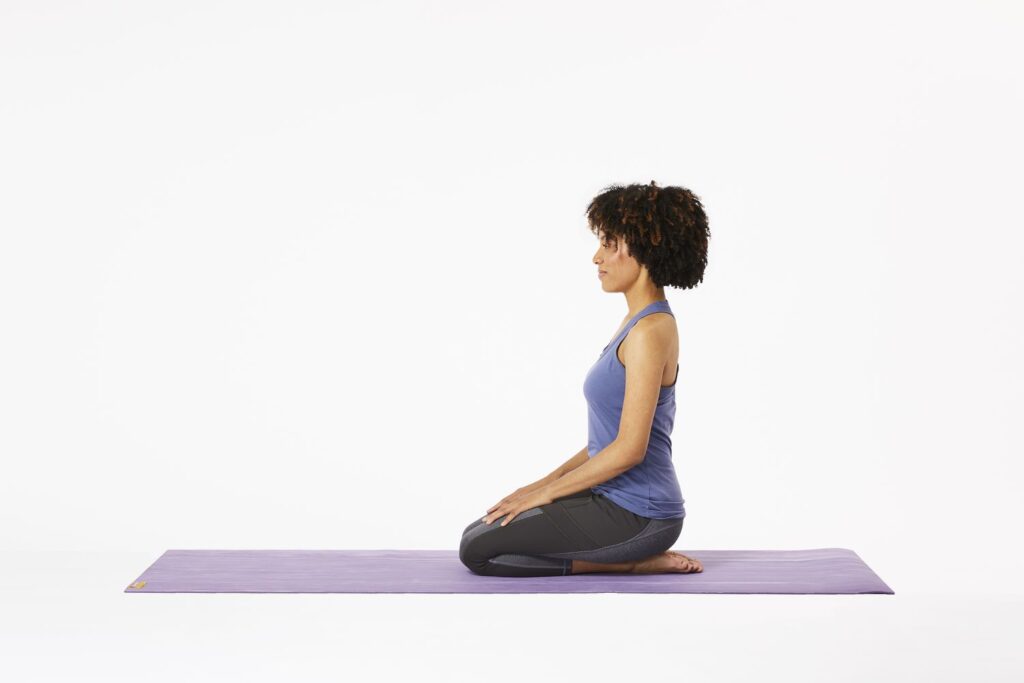
This form of sitting requires knee flexion and ankle plantar flexion flexibility. Notice the straight spine, signaling minimal lumbar pressure. This is also one of the best ways to stretch the tibialis anterior muscle and vastus lateralis, vastus medialis and vastus intermedius (3 out of the 4 quad muscle). If this position is uncomfortable, place a rolled up towel behind your thighs or sit on a yoga block to ease your way into this position.
Why does this matter?
Floor sitting activates key core muscles, decreases spinal pressures and improves hip, knee and ankle flexibility. Incorporating only 5 minutes of floor sitting in a day can yield benefits in mobility. These types of sitting may also be used diagnostically to determine where restrictions may be causing lower back pain and knee pain.
So, go grab those presents and practice some floor sitting while you wrap things up. It will be a win/win.
Because nobody has time to be in pain.
Until next time…
Kind Regards,
MoveWell Academy
[email protected]