
Kinesiology THURSDAY – IT Band Friction Syndrome
Looking for a great way to lose weight and get in shape? Are escalating gas prices putting a strain on your budget? Cycling is one of the fastest growing sports for people between the ages of 25-64, and with good reason. Not only is it an excellent mode of alternative transportation, but it offers a low-impact option for getting active, losing weight and getting in shape.
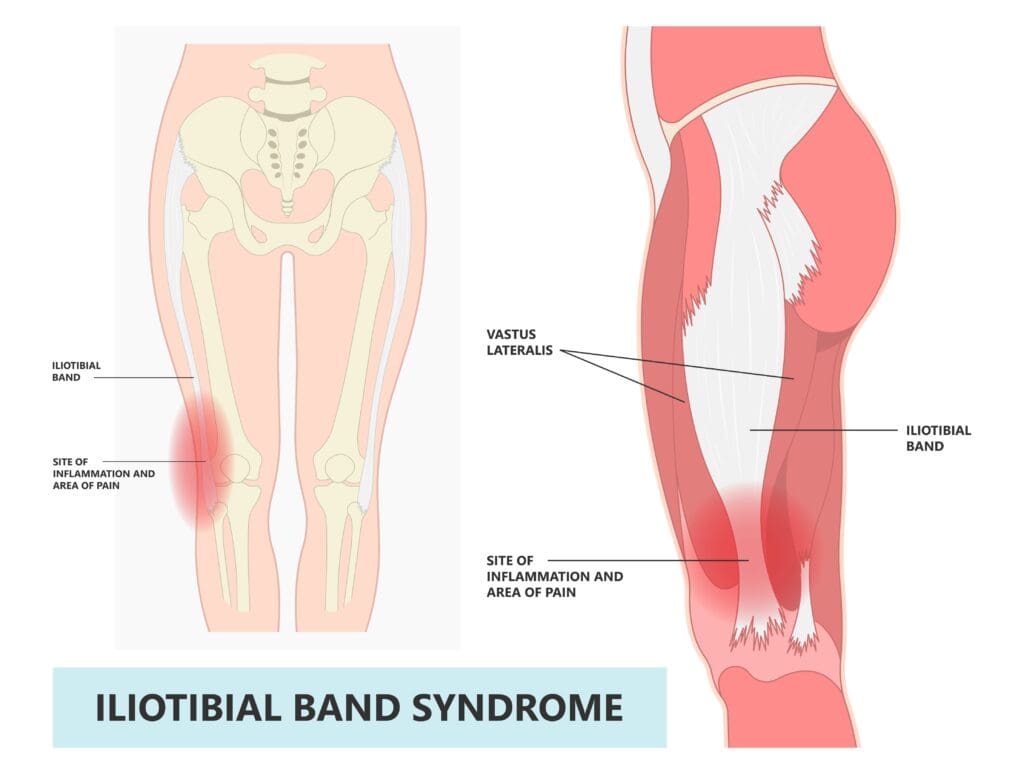
But sometimes even good things can cause aches and pains. Due to the bent over posture of riding, many cyclists eventually suffer from lower back pain or IT band friction syndrome. The iliotibial tract is a thick band of fascia that runs on the lateral side of the thigh from the iliac crest and inserts at the knee. It is a common knee injury that usually presents with pain and/or tenderness on palpation of the lateral aspect of the knee, superior to the joint line and inferior to the lateral femoral epicondyle.
But if you’ve heard of the MoveWell message, then you know that pain is not inevitable. It is possible to ride mile after mile pain-free by understanding some basic principles. When you sit on the saddle, you should feel like your weight is placed on the large bones of the pelvis called the ishcial tuberosities, or “sit bones”. Inability to maintain this position can be caused by tight hamstrings and weak core muscles.
As for the knee, remember that it is stuck in the middle with nowhere to run and nowhere to hide. If you ride with clipless pedals, tightness in your ankle gets transferred to your knees even more. To ensure healthy knees while riding, make sure your toes are pointed straight ahead and your hip, knee and ankle are all in the same line. The biggest mistakes are allowing your knees to fall in or out, or your toes to turn out. Inability to maintain this position may be a sign that certain muscles are tight and/or weak. The good news is, that’s fixable!
The body has the ability to relearn movement patterns very quickly by incorporating some simple moves into your pre-ride routine. Pain-free cycling and a more powerful stroke can be achieved by performing these three exercises prior to getting in the saddle.
The gravity drop and the gravity drop with rotation is a simple way to stretch out your calf muscles and ensure your toes stay pointed straight ahead when you walk, run or cycle.
The plank is one of the best ways to activate your core muscles and give your spine some added support. Practice this move until you can hold it for one minute without any lower back discomfort.
Finally, the revolving lateral angle is an excellent way to unlock your hips and allow your knees to remain in line with your toes as you pedal. It also increases the strength of your hip and thigh muscles, adding some power into your stroke.