
Kinesiology THURSDAY – The Upper Traps, SCM and “Vertigo”
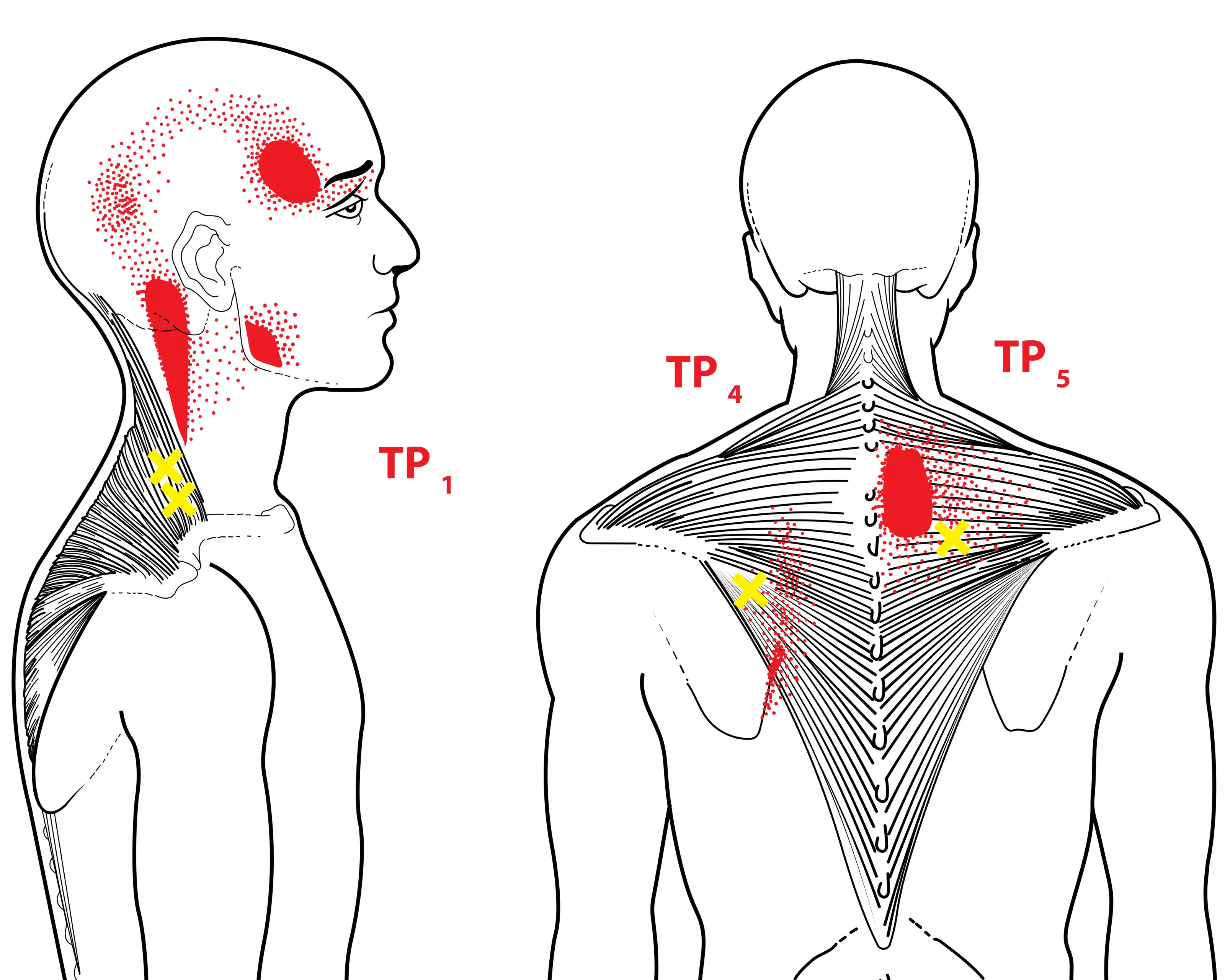
Referral pain pattern of upper trapezius trigger points
“I’m not feeling so great today,” my patient said. It was his third visit and he was two weeks post-op right reverse total shoulder replacement. He described feelings of dizziness and general malaise. His doctor had diagnosed him with vertigo.
“The room isn’t spinning,” he said, “but it feels like I’m floating.” The dizziness worsened for a few seconds if he sat up or laid down.
His current exercise program included wall washing and AAROM exercises of the right shoulder using a stick. He was also performing “well-arm” pulley rows and punches to promote thoracic rotation. He was also active daily with walking his dog and using his right arm as tolerated. “My doctor friend told me if I don’t keep moving it, it will freeze,” he added, explaining his motivation to exercise.
Like most patients who have had a shoulder replacement, his scapula was elevated and protracted (higher and more forward) at rest. He had a severe trigger point in the right upper trapezius and a moderate trigger point in sternocleidomastoid (SCM), infraspinatus and biceps brachii.
This is what I did…
- Performed thoracic sequence to the right (I didn’t do the left because he doesn’t tolerate left side lying yet)
- Released suboccipital muscles (he had increased tenderness on the right)
- Soft tissue mobilization and counterstrain to the right upper trapezius
- Corrected medial clavicle posterior subluxation (may cause chronic shortening of SCM)
- Released trigger points in the infraspinatus (contributes to upward rotation of the scapula) and biceps brachii
- PROM R shoulder
“I feel better already,” he said when he sat up. His feeling of dizziness and light-headedness had disappeared.
What happened and why did that work?
Cervicogenic dizziness has been associated with SCM and upper trapezius trigger points. Lightheadedness and an “off balance” feeling are usually reported versus the typical “spinning” dizziness of vertigo.
An elevated shoulder girdle and posteriorly subluxed medial clavicle are common following shoulder surgery. These positions create chronic shortening of the SCM and upper trapezius, resulting in trigger points that may become active and refer pain.
If you are experiencing light-headedness try this:
- Squeeze your upper trapezius muscle (top of the shoulder) and your SCM (side of the neck)
- If either one of them are tender, squeeze with moderate pressure for 30-45 seconds to release the trigger point
- Re-assess dizziness
Exercise strategies:
- Activate lower trapezius by performing active elevation past 90 degrees
- Restore thoracic rotation
- Practice scapular relaxercise
That’s a lot to chew on. Over activation of SCM and upper trapezius is common in post-surgical shoulder patients due to impaired elevation pattern from muscle weakness. General feelings of malaise and feeling off-balance can be treated successfully by understanding the connection of these two muscles to dizziness. So, check it out and fix what you find.
Because nobody has time to be in pain.
Until next time…

Kind Regards,
MoveWell Academy
[email protected]