
Kinesiology THURSDAY – Tennis Elbow And The Backhand

Lateral epicondylitis, or tennis elbow, is the most common cause of persistent elbow pain. 50% of tennis players may experience this irritation of the common extensor tendon (CET), but less than 5% of of tennis elbow cases are actually caused by tennis. This means a lot of people suffer from this ailment.
Understanding the mechanics of the tennis backhand will help unlock the solutions to this nagging problem, whether the problem occurs on the court or not. Most tendonitis issues occur from eccentric overload of soft tissue and lateral epicondylitis involves the small tendon that is the attachment of the wrist and finger extensors and the supinators. In the scheme of things, the size of the CET is too small to carry the load of impact all by itself.
Being able to test and treat each component can help you solve this nagging problem. Let’s take a look at the biomechanical requirements of the eccentric or loading phase of the backhand from the ground up (looking at the picture above will clue you in to a lot of it):
- Subtalar joint eversion (opposite leg) – Test with single leg balance on a 1/2 foam roll. The ability to evert helps load the larger muscles of the hip. Check for trigger points on the tibialis posterior or FHL (along medial tibial border) and/or mobilize the STJ.
- Knee flexion (opposite leg) – Test with a 15 second single leg wall sit. Knee flexion eccentric loads the quadricep muscle.
- Hip flexion/IR (opposite leg) – Test with a lateral reach with bilateral arms at waist level. There should be less than a 2″ difference between the right and left legs. This motion loads the gluteus maximus, the power house of this move. The lateral low row is a great exercise to wake up this muscle.
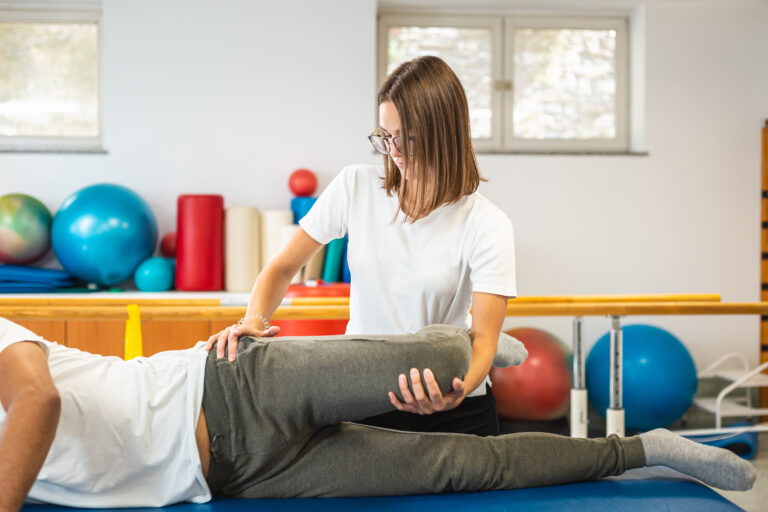
- Thoracic rotation (opposite) – Test with side lying thoracic rotation. Do the thoracic sequence or mobilize the thoracic spine to restore mobility.
- Scapular protraction (ipsilateral shoulder) – This loads the rhomboids. If the scapula is already positioned in protraction at rest, the rhomboids will be insufficient in producing force.
- Glenohumeral horizontal adduction/IR – This loads the posterior deltoid, supraspinatus, infraspinatus and teres minor.
- Forearm pronation – This loads the supinator, commonly involved in tennis elbow.
- Isometric wrist flexion – This loads the wrist extensors. The most commonly insulted wrist extensor is extensor carpi radialis brevis (ECRB). The wrist extensors will also be neurologically weakened in the presence of tight wrist flexors.
The order of this list matters. Solving the problem from the ground up usually yields the best result.
Conventional thinking says: Tennis elbow is an elbow problem.
Real World Thinking says: The small tendons of the elbow are overworked because one or more things in the biomechanical chain is missing. To solve the problem, check out the movement pattern from the ground up. Remember, the tennis backhand is solidly connected to the function of the leg OPPOSITE to the side you hold your racquet. Fix what you find and you will get to the root of the problem.
Check out our Tennis Daily Dozen, Wipe Out Lateral Epicondylitis programs or for a deeper clinical dive, our Think Tank on The Tennis Elbow Joint.
Because nobody has time to be in pain.
Until next time…