
Kinesiology THURSDAY – Why Hamstrings Tear

I read an article last night entitled Prevalence of Hamstring Strain Injury Risk Factors in Professional and Under 20-Male Football (Soccer) Players. I really would have rather been watching an episode of Below Deck after my long day of teaching, working and then sitting through a board meeting. But this article opened my eyes to several interesting facts that will provide points to ponder for the next few weeks. We have much to learn from the soccer players that repeatedly tear hamstring muscles, even if we’ve never kicked a ball.
Let’s get started:
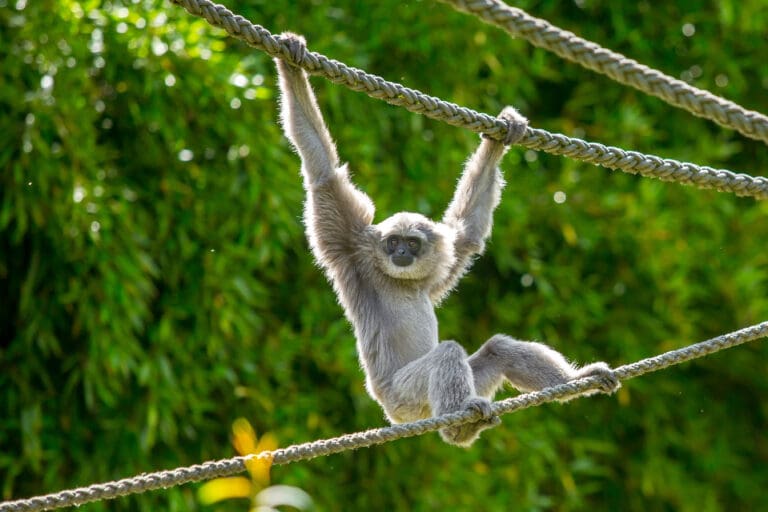
The most commonly torn hamstring muscle is the bicep femoris long head (BFlh). It is the hamstring muscle responsible for the deceleration of rapid hip flexion and knee extension that occurs in terminal swing phase (like the picture above). Here is what that muscle looks like:
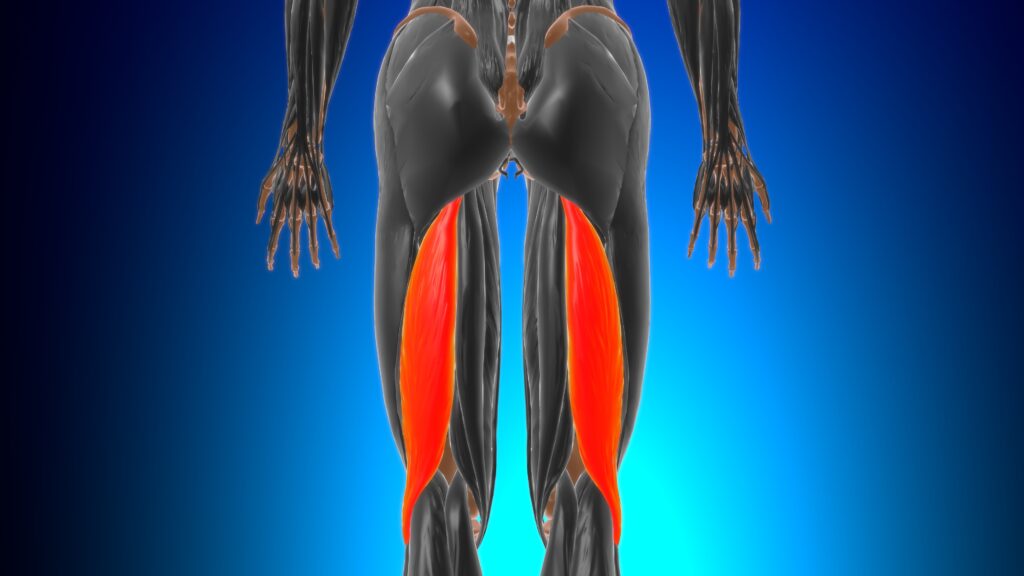
Originating from the ischial tuberosity and inserting on the superior aspect of the fibula, the BFlh is influenced by hip and lower leg rotation.
Here is a list of the top risk factors for hamstring strains as identified in the article that we will discuss in coming weeks:
- History of injury in adjacent regions (39.6%)
- Passive hamstring flexibility (60.4%)
- Functional movements via FMS testing (41.6%)
- Core stability (28.7%)
- Hamstring to quad strength ratio (upwards of 91.2%)
The lowest scoring functional movement test reported in these athletes was the deep squat.
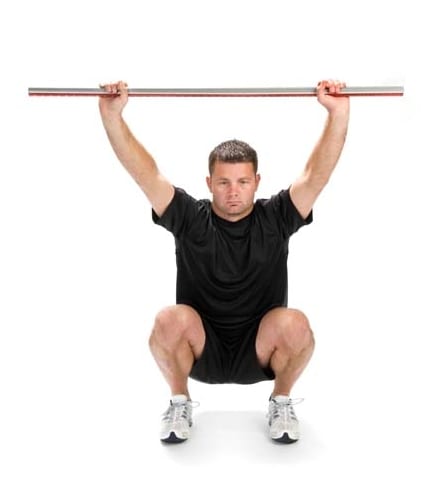
I guarantee you their squat didn’t look like this as this form would have yielded a perfect score for that test. We will discuss what this test tells us next week, but for today, I just wanted you to observe what this test doesn’t tell us: it doesn’t test hamstring length. You should try this test. Here’s a video on how to do it.
Why does this matter?
It is easy to blame hamstring strains and tears on tight hamstrings. But I will leave you with this idea:
- Muscles tear when they are neurologically weak (receiving a weaker signal from the nervous system and thereby not activating as readily)
- Muscles may be placed in a long/weak position by abnormal postures
- Muscles may be weakened by a tight antagonist
- Muscles may be overworked in the presence of weak functional synergists
This will serve as our launching point for the next few weeks. What we learn from soccer players and hamstrings will extend to other muscles and joints of the body. It will be worth it. I’m glad I read this article last night.
Because nobody has time to be in pain.
Until next time…
Kind Regards,
MoveWell Academy
[email protected]