
Muscle Minute TUESDAY – Meet the Adductor Longus
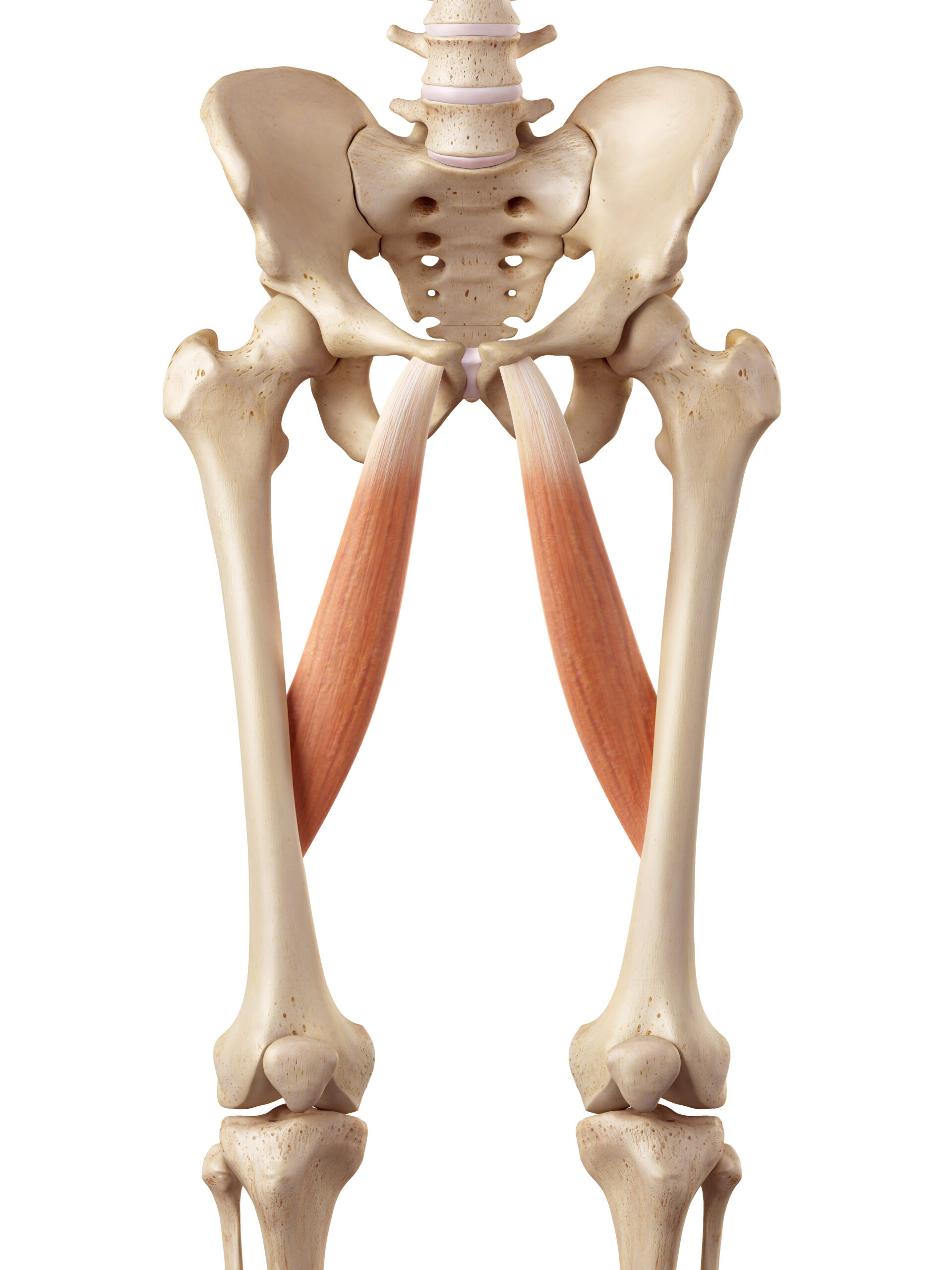
Adductor longus is one of three muscles making up the adductor group but has the distinction of being the most often injured. It is the longest of the adductors and its origin lies most anterior of the three adductors on the pubic ramus. Let’s take a deeper dive.
| Origin | anterior pubic ramus |
| Insertion | linea aspera |
| Action | hip adduction, hip external rotation |
| Innervation | obturator n. (L2, 3, 4) |
| Antagonists | gluteus medius, gluteus minimus, tensor fascia lata |
The Real World Adductor Longus
Wait. This muscle affects a quadricep muscle? The adductor longus is the only muscle of the adductor group to be fascially linked to the vastus medialis. An EMG study showed that squatting to 60˚ of knee flexion with isometric hip adduction activated the VMO to a greater degree than without the adduction component. And wall squats showed greater activation than free squats. (Wall squats typically are more quad dominant as it minimizes hip flexion during the eccentric phase, causing less activation of the hip extensors).
Does it internally rotate or externally rotate the hip? Internet sources are conflicted on this one, with some sources vaguely stating it rotates the hip. But the attachment on the posterior femur (linea aspera) would clearly make this adductor an external rotator and a decelerator of hip internal rotation when the foot hits the ground.
How does it stabilize the pelvis? When your foot hits the ground and you begin to transfer weight to the other side, the adductor group decelerates abduction of the hip stabilizing the pelvis through this transition.
Why is this most often injured adductor? There was no definitive source for why the adductor longus was most affected. However, risk factors of adductor tears included: previous adductor injury, decreased total hip rotation ROM and any injury in the previous season.
The last factor is interesting as one of the most common compensations after a lower extremity injury is decreased subtalar joint eversion. When the foot hits the ground and the subtalar joint everts, the hip adducts shortening the adductor longus. A lack of closed chain subtalar joint eversion causes decreased hip adduction up the kinetic chain resulting in a long weak adductor in the frontal plane. There would also be an associated trigger point in the gluteus medius.
Conventional thinking says: The adductor longus adducts the hip
Real World Thinking says: The adductor longus decelerates hip internal rotation (when the foot hits the ground) and abduction (when you transfer weight to the other leg). It is placed in a weak position if the subtalar joint does not evert or if the hip abductors are tight. With adductor injuries, listen to the adductor and look elsewhere for the cause.
Because nobody has time to be in pain.
Until next time…

Kind Regards,
MoveWell Academy
[email protected]