

Anatomy TUESDAY – Tonic v. Phasic Muscles – Part 1 – Psoas Major v. Rectus Femoris
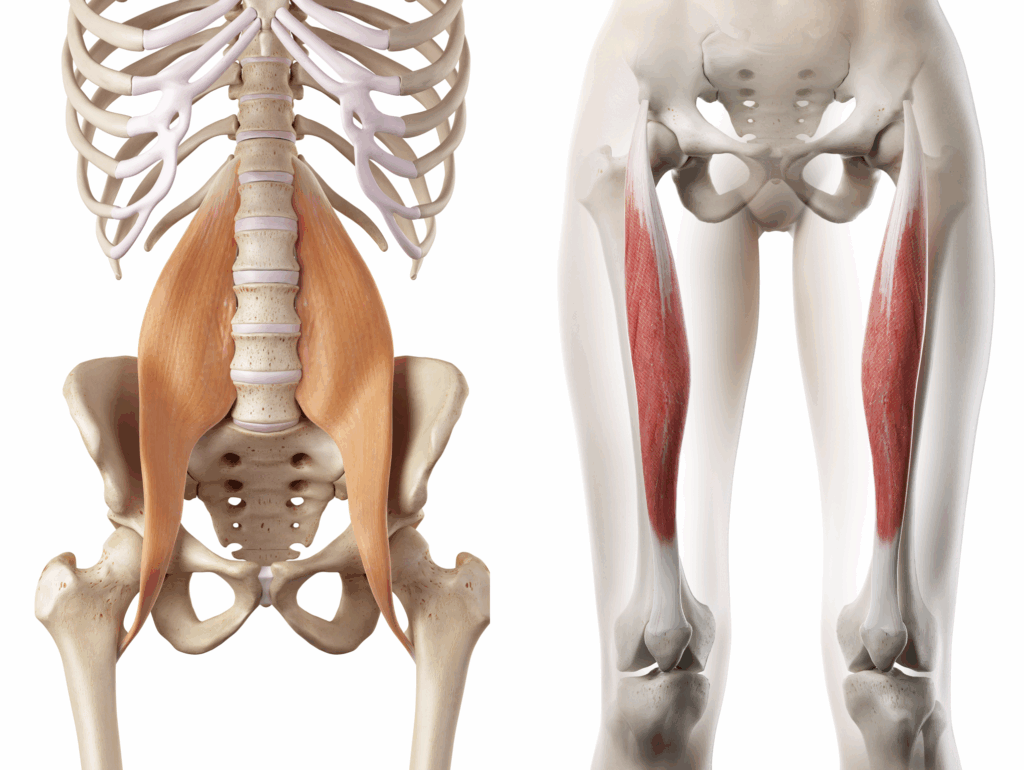
“So, I’m confused,” my intelligent patient said. “There’s conflicting information on the internet. Is the psoas muscle often tight? Or is it weak? Should you stretch it? Or should you strengthen it?” My day is always made when a patient has an inquiring mind.
In the 1960’s, Dr. Vladimir Janda, a physiotherapist and neurologist, used EMG studies to classify muscles as tonic (postural) and phasic (movement). The general characteristics are as follows:
| TONIC | PHASIC |
| Constantly active | Active during movement |
| Resistant to fatigue | Fatigue easily |
| Prone to tightness | Prone to weakness |
| Function to stabilize or maintain posture | Function to produce movement |
The psoas major is largely tonic, maintaining upright posture. The rectus femoris is largely phasic, providing powerful movement. These muscles are also classified as synergists, in that they are both capable of performing hip flexion. But they are not the same, having different characteristics in function.
How do we determine if someone has a weak hip flexor? We manually muscle test by resisting hip flexion. If it’s weak, is it commonly assumed the psoas major is the culprit, but this is rarely the case.
How do we determine if a muscle is overactive or tight? We palpate for a trigger point. Trigger points are common in the psoas major, as it is a tonic muscle that is constantly active.
Synergistic dominance is a phenomena whereby one muscle becomes overactive causing inhibition of another. In the case of the psoas major versus the rectus femoris, this is common. A tight psoas major often results in a weak rectus femoris. If someone reports straining their hip flexor (usually pointing to the anterior hip), they have most likely strained the rectus femoris.
Why does this matter?
If someone has hip flexion weakness, it’s helpful to remember the tonic/phasic classification of each and their relationship to each other. To regain hip flexion strength:
- Inhibit/release the psoas major with these exercises and using manual therapy THEN
- Strengthen the rectus femoris (in fact, you should test rectus femoris by resisting hip flexion right after you inhibit the psoas. You just might find that strength has been restored).
- Hint: Rectus femoris flexes the hip in neutral while psoas major performs hip flexion with external rotation. If rectus femoris is the muscle you want to activate, keep the hip in neutral or internal rotation while flexing.
Release the psoas major and strengthen the rectus femoris. Stay tuned for more in the tonic v. phasic series.
Because nobody has time to be in pain.
Until next time…
Kind Regards,
MoveWell Academy
[email protected]