
Kinesiology THURSDAY – Viktor Hovland’s Herniated Disc
Viktor Hovland, a Norwegian professional golfer known for his powerful drive, sustained the only injury of the 2025 Ryder Cup. A recurring neck injury, Viktor first describes hearing a loud crack in his neck at the Traveler’s Cup in June which caused severe neck pain and an inability to flex his neck or bend it to one side. During the Ryder Cup, he felt a twinge of pain during warm-ups on Saturday and woke up Sunday unable to move his neck, resulting in his withdrawal from the tournament.
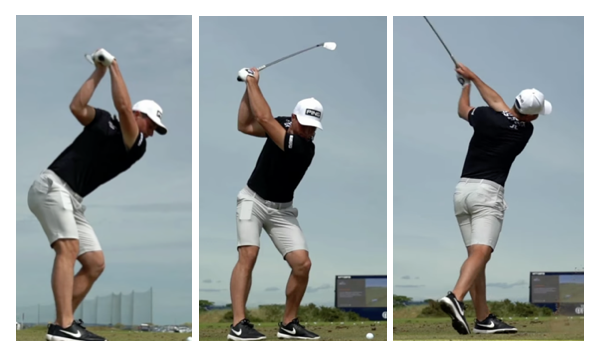
Look at the photos above and you can see the extremes of rotation and right side bending that have to occur during his drive. An MRI revealed a herniated disc. Specifics on the MRI were not available so it is unknown it the disc was herniated to the right or left.
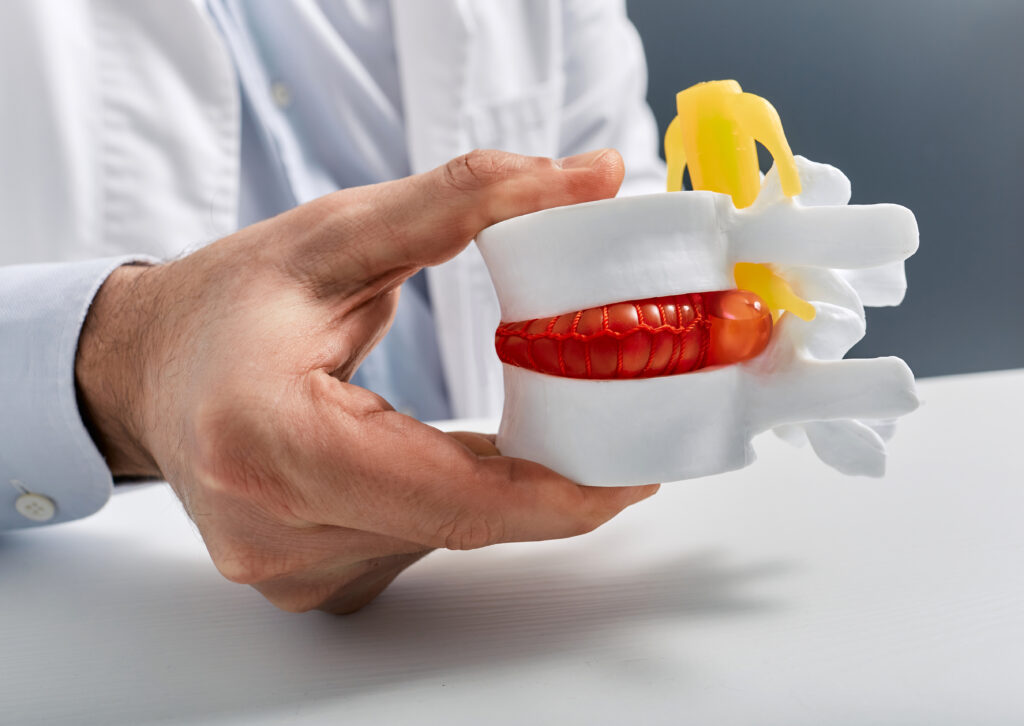
The intervertebral disc is a lot like a jelly donut. The soft nucleus (center) of the disc is surrounded by the more rigid annulus designed to keep the nucleus in place. With prolonged pressure on one side, the annulus may weaken, causing a bulge. Below is an illustration of a herniated lumbar disc.
Typically, a bulging disc doesn’t cause pain unless it presses on something, like one of the nerve roots exiting the spinal cord, in which case there is usually associated pain, numbness or tingling into one arm along a dermatomal reference. There was no report of arm pain with Viktor, just limitations in flexion and side bending to one side. Here is his headshot:

Notice how his left shoulder is higher than his right. This is a common postural asymmetry in a right-handed athlete, which also may predispose him to a herniated disc to the right. A higher left shoulder results in compensatory left cervical side bending. (Notice how his left ear is closer to his left shoulder compared to the distance of the right ear to the right shoulder.)
So, it might be an aggravation of a herniated disc. But imaging results should be coupled with other evaluation procedures to determine the cause of an injury. There are people exhibiting herniated discs on MRI that are asymptomatic.
But what else could it be?
The report of a “crack” in his neck when he took a swing in June alludes to another possible diagnosis, somatic dysfunction. This occurs when a cervical vertebra over rotates and becomes “stuck”.
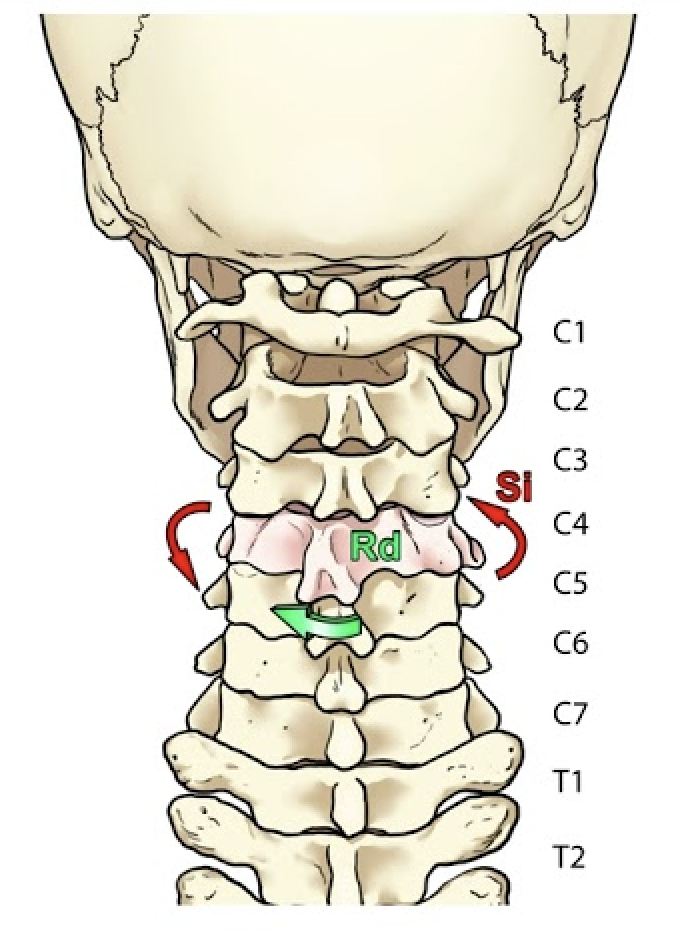
Have you ever had a “kink” in your neck? If you have experienced this, you realize it feels impossible to bend your neck to one side. You can move it in the other direction with no pain, but there is a limitation usually in flexion or extension and side bending to one side.
Herniated discs are usually treated with decompression. Somatic dysfunction is usually treated with a manual technique (manipulation or muscle energy) to correct the position of the vertebra.
What Would I Do?
If Viktor was my patient, I would figure out why his left shoulder is sitting so high. Here are some possible causes:
- Lack of left subtalar joint eversion
- Trigger points in the left quadratus lumborum or psoas major
- Decreased thoracic rotation
- Trigger points in the left upper trapezius or quadratus lumborum
Even if the pain was on the right side, I would see what was elevating the left side. Correcting the higher shoulder usually resolves pain on the opposite side.
Then I would check each cervical vertebra for somatic dysfunction and fix what I found. Remember, when you flex, the transverse processes of the cervical spine should move forward and when you extend they should move backwards. (As an example, if someone moves into flexion and the right transverse process becomes more prominent, this indicates a segment that is extended, rotated and side bent right.)
Exercises would target the cause of the higher left shoulder.
I hope Viktor recovers quickly from his injury. I’ll probably never get to treat Viktor, but if this information helps you, then I’m good with that.
Because nobody has time to be in pain.
Until next time…
Kind Regards,
MoveWell Academy
[email protected]