
Kinesiology THURSDAY – Six Degrees to Pelvic Rotation
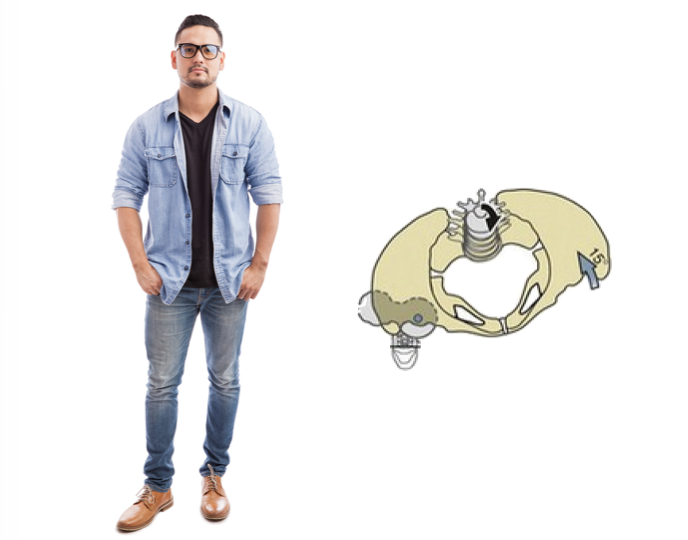
I did a whole series on this pelvic rotation scenario last year because it is so prevalent in my patients with chronic overuse injuries: meniscal tears, lower back pain, Achilles tendonitis, rotator cuff tendonitis, etc. Repetition breeds impression, so here I am talking about it again. What are the common reasons that cause this pelvic position? Let’s look at six degrees to left pelvic rotation:
- Weak left glute squeeze – Not sure what comes first, the chicken or the egg, but people with this pelvic rotation have a hard time squeezing (tightening) their left butt cheek. Give it a try. stand with your feet hip width apart and toes pointed straight ahead. Tighten just your right butt cheek. Now tighten just your left. Is it harder to do one versus the other? The pelvis is often rotated towards the weaker side. The FIX: Practice squeezing just one butt cheek. Hold it for 6 seconds. Do 6 repetitions.
- Stuck left subtalar joint – If you’ve ever sprained an ankle, had surgery to your leg or had chronic back pain, chances are your ankle on the side of pain lacks the ability to evert (or roll in). This will cause your pelvis to rotate to that side. You can check this by checking the wear pattern on your shoe. Is it worn out on the lateral side? Unlocking your subtalar joint will help correct pelvic rotation. Stand on one leg. The leg you are more unstable on tends to be the one with the subtalar joint that lacks eversion. The FIX: Walking slowly on a line, standing on one leg for 1 minute, carioca walking.
- Decreased right ankle dorsiflexion – If your calf muscle (gastrocnemius) is tight on one side, this will cause you to toe-out when you walk (one of many reasons). If you toe out on one side it will cause your leg to pronate (knee will fall in). This, in turn, causes the other leg to supinate (knee rolls out). The pelvis will rotate towards the supinated side. The FIX: Gravity drop, downward dog, standing calf stretch, long stride walking.
- Weak right quad – One of the most common reasons someone toes out is because their quad is weak. Stand with your back to a wall and your feet together. Lower down into a squat and then pick up one leg and hold it for 15 seconds. Put that leg down and lift up the other leg. Is one weaker than the other? The weaker side is the one that will tend to toe-out and over pronate, causing the pelvis to rotate to the opposite side. The FIX: Single leg wall sit x 30 seconds; fierce beast, four point knee taps.
- Left leg feels short – Two of the most common causes of a functional short leg are trigger points in the quadratus lumborum and psoas major. These are usually confirmed by palpation. Trigger points set up in muscles that are chronically short. The FIX: Wall washing (to stretch quadratus lumobrum) and power posterior pelvic tilts (to inhibit the psoas major).
- The way we drive – I’ve often wondered why I see way more left rotated pelvises than ones rotated to the right. My most intelligent guess is its the way we drive. When we sit and put our right foot forward, this naturally rotates the pelvis to the left. Over the course of a human adult life, we can end up spending a lot of time in this position. The FIX: Next time you drive, make sure your back is flat to the back of the seat. If your right leg feels too short to reach the pedal, just move your seat a little forward. If your back hurts when you drive, try squeezing your left butt cheek to level your pelvis.
Why does this matter?
A left rotated pelvis lies at the root cause of many overuse injuries. If you have a nagging ache or pain that just won’t go away, check out the six degrees to a rotated pelvis. You just might find your solution.
Because nobody has time to be in pain.
Until next time…

Kind Regards,
MoveWell Academy
[email protected]