Anatomy TUESDAY – How Exercise Shapes Your Body – HIIT

High-Intensity Interval Training (HIIT) is often marketed as: “The fastest way to get fit.” Short workouts. Big results. Maximum efficiency. But what makes HIIT unique isn’t just that it’s intense—it’s how that intensity affects your body’s tissues. Because unlike steady cardio or strength training, HIIT pushes multiple systems at once.
HIIT combines short bursts of high effort with periods of rest.
During those intense intervals, your body experiences: rapid energy demand, oxygen shortage and high mechanical and metabolic stress.
This sends a powerful signal to become faster, more efficient, and more resilient—quickly. As a result, HIIT drives broad, overlapping adaptations across tissues.
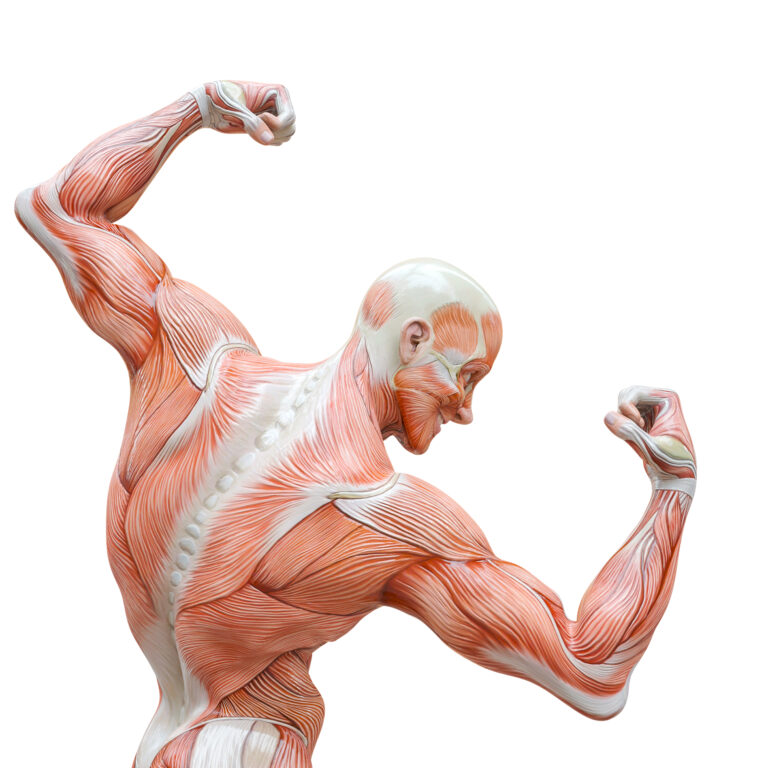
MUSCLE
Unlike steady cardio, HIIT heavily recruits fast-twitch muscle fibers. These fibers produce more force and fatigue quickly. They are often underused in low-intensity exercise.
When you exercise, your body utilizes three different energy systems: phosphagen (immediate energy 0-10 seconds), glycolytic (30 seconds to 3-minutes), aerobic (>3 minutes). With repeated HIIT training, fast-twitch fibers become more fatigue-resistant and muscles improve their ability to switch between energy systems. HIIT trains muscles to be both powerful and efficient.
MITOCHONDRIA
Even though HIIT is short, it strongly stimulates mitochondrial biogenesis (produces more mitochondria) and enzymes involved in energy production. This allows for faster energy production and better recovery between efforts. In some some cases, HIIT can produce similar mitochondrial adaptations to longer endurance training—in less time.
CARDIOVASCULAR SYSTEM
With HIIT, your heart rate rises quickly as oxygen demand spikes and blood flow must increase rapidly. Over time, this improves stroke volume and VO₂ max (a key longevity marker). This is one of the most efficient ways to improve cardiovascular capacity.
NERVOUS SYSTEM
Because HIIT often involves explosive or fast movements, the nervous system adapts to produce force more quickly. Coordination between muscles improves and reaction time decrease. This helps maintain speed and responsiveness, qualities that often decline with age.
TENDONS and CONNECTIVE TISSUE
HIIT places significant stress on tendons, ligaments and fascia. When programmed appropriately, these tissues become stronger and more resilient. But they adapt more slowly than muscle. Excessive intensity without recovery may increase injury risk. HIIT is powerful, but also demanding on connective tissue.
Real World Application
- If you want to use HIIT effectively, limit to 1-3 sessions per week
- Keep sessions short (15-30 mins total)
- Prioritize good form, even at high intensity
- Pair with lower intensity cardio and strength training
Here is an example of a simple HIIT session:
Warm-up: 5-10 minutes easy movement
5 rounds:
- 30 seconds hard effort (sprint, bike, row)
- 90 seconds easy recovery
Cool-down: 5 minutes
Total time: 20 minutes
Why does this matter?
HIIT is not a replacement for everything else. It works best when combined with: strength training (for tissue resilience), moderate cardio (for base endurance) and mobility work (for movement quality). Think of HIIT as a high-impact signal that complements (not replaces) other forms of training.
HIIT is a high-intensity signal that forces your muscles, heart, and nervous system to adapt quickly and work together under stress. And when used correctly, it can deliver powerful results in a short amount of time.
HIIT can be done using various forms of exercise, like circuit training, as well as sprinting, biking and rowing. But I’ve found it useful to keep the movement simple so I can concentrate on keeping the intensity high.
I once had a patient who ran many marathons (26.2 miles). She said her most comfortable and fastest marathon was where her longest run was 15 miles, but where she regularly did speed training (HIIT) workouts. She hated those workouts, but loved the result. I never forgot her telling me that.
Stay tuned for the next blog where we take a look at how stretching and mobility workouts shape your body.
Because nobody has time to be in pain.
Until next time…

Kind Regards,
MoveWell Academy
[email protected]