
Anatomy TUESDAY – Stuff That Gets Pinched (Part 4) – Anterior Ankle

Pull your toes up towards your shin. Try it passively (as shown above) and actively (without using your hands). What do you feel? You should feel a stretch in the back of your legs. If you feel a pinch in the front, your ankle isn’t moving the way it is designed to move.
The ankle joint is made up of the talus sitting in the mortise, made up of the distal tibia and fibula. It is wider anteriorly and laterally causing the lower leg to internally rotate as you dorsiflex when your foot is on the ground. This is part of the shock absorbing mechanism of your body as the dorsiflexion eccentrically loads the gastrocnemius, soleus and toe flexors in preparation for push off.
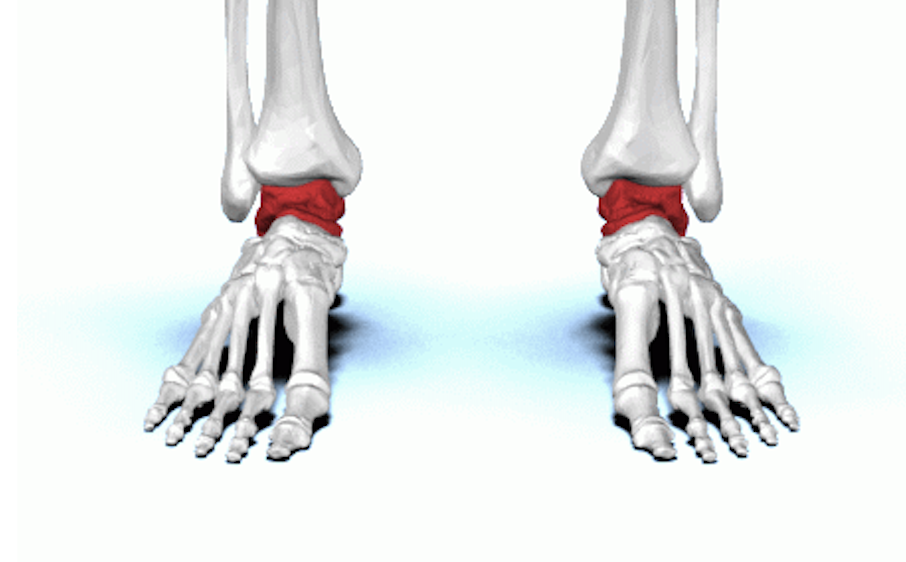
But if you get a pinch in the front of your ankle, dorsiflexion will be limited, causing decreased shock absorption and altered lower extremity mechanics. Here is a short list of what can cause an anterior ankle pinch:
- Lack of subtalar joint eversion
- Trigger points in the tibialis anterior
- Trigger points in the tibialis posterior
- Trigger points in the flexor hallucis longus and flexor digitorum
- Tight posterior ankle capsule
Tightness in any muscle that inverts the ankle will cause an anterior ankle pinch in end range dorsiflexion.
Why does this matter?
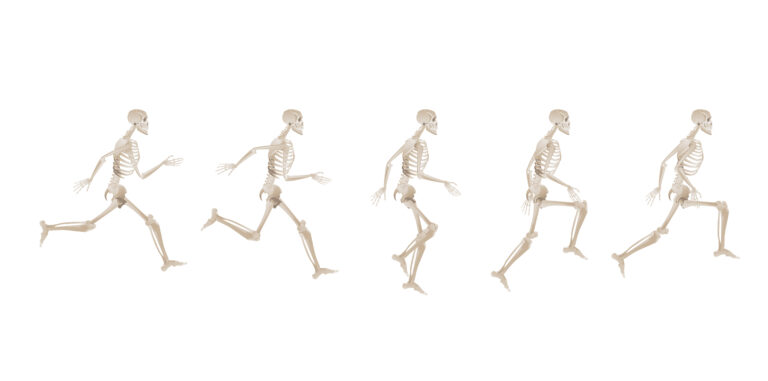
Chronic pinching of the anterior ankle (talocrural) joint may result in osteophyte formation on the anterior ankle, bone growth that is a response to increased stress. Check out the picture below:

Dorsiflexion is most necessary in late stance phase (the left leg in this illustration). In late stance, your body should naturally rotate towards the other side. In this photo, the left ankle is in dorsiflexion while the trunk is rotated to the right. This natural “wind-up” is what helps propel you forward to the next step.
A lack of ankle dorsiflexion will shorten the opposite stride length, which will in turn limit rotation to the opposite side. So many overuse, insidious onset injuries such as: rotator cuff impingement, meniscal tears of the knee and lower back pain are a result of decreased rotation to one side. This is how an ankle pinch may sit at the root of many orthopedic problems.
So, test your ankle. Pull your toes up towards your shin. Do you feel a pinch? If you want to learn one quick fix now, watch this video and share it with someone you think it might help. Get rid of an ankle jam.
Because nobody has time to be in pain.
Until next time…

Kind Regards,
MoveWell Academy
[email protected]