Kinesiology THURSDAY – Plank Variations (This or That?)
I recently came across this blog post demonstrating 15 plank variations. Planks are an excellent core stabilizing exercise and are often used in treatment of lower back pain. But what of the variations? Variety is the spice of life and your core thrives and strengthens when placed in different scenarios. Let’s take a look at a few of these variations.
Variation #1 – Forearm plank
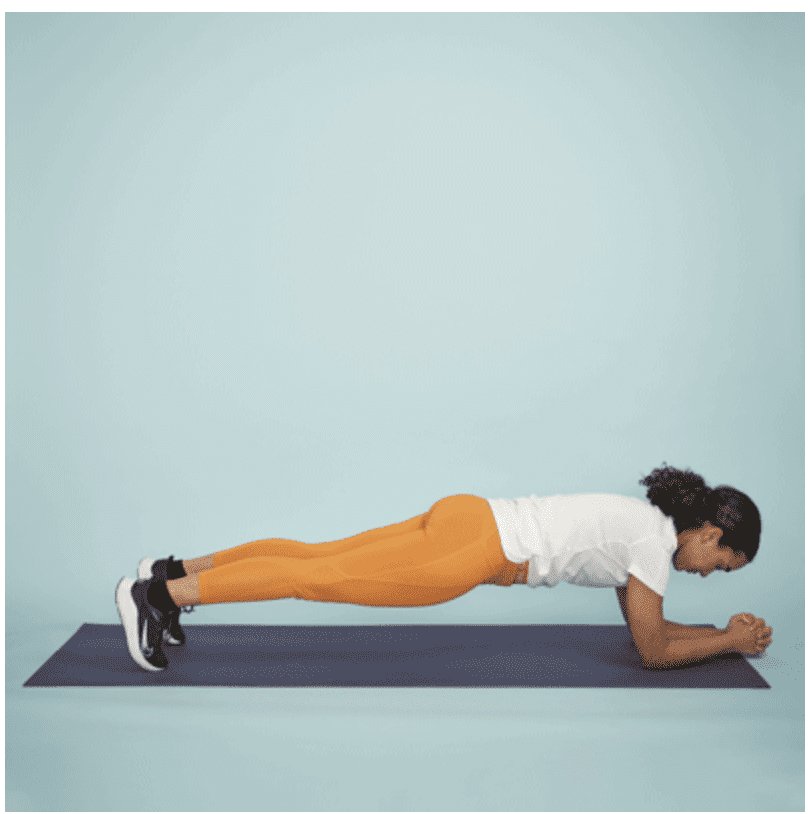
This is the basic plank. You should be able to hold this position for 60 seconds without experiencing back pain. This activates the transverse abdominus and bilateral internal obliques. It is actually harder than its counterpart, the straight arm plank (high push-up position) because the forces of gravity on the trunk are greater the more horizontal your body is to the ground. So if you are just starting out, try to maintain this position with your arms straight and then graduate to the forearm plank.
Variation #2 – Spiderman Plank

This variation emphasizes stability in the transverse plane and mobility in the frontal plane. By lifting one leg up and decreasing your base of support, the deep rotators of the spine (transversospinalis) must work harder to prevent excessive rotation of the pelvis. Approximating a knee to the same side elbow elongates the opposite quadratus lumborum, providing a dynamic stretch to a muscle that is often tight in people with lower back pain. The transverse abdominus works even harder when you rapidly alternate arm or leg movement.
Variation #3 – Plank with alternating knee to elbow

This variation emphasizes stability AND mobility in the transverse plane. The deep spinal rotators are working to stabilize the rotational force of moving your knee to the opposite shoulder while your internal and external oblique are concentrically working to move your knee towards the opposite elbow. Whenever both hands remain on the ground, the serratus anterior stabilizes the scapula.
Variation #4 – Plank with Shoulder Tap

Due to the alternating lifting of the arms, this exercise is also emphasizing transverse plane stability, but is easier than the variations where you lift your leg as you base of support is wider and your legs are longer and stronger than your arms. Use this exercise as a precursor to the ones where you alternately lift your legs. Unlike the planks where both hands remain stationary, when you lift one arm, the scapular stabilization requires rhomboid activation to prevent the relative horizontal adduction force of the arm.
Variation #5 – Plank Walk

This variation involves alternately lifting both an arm and a leg, making it perhaps the most challenging stabilizing exercise for the deep spinal stabilizers in the transverse plane. Compared to the knee-to-opposite-elbow variation, this requires more stabilization and less movement in the transverse plane.
Why does this matter?
Planks are an excellent core exercise as they naturally activate the abdominal muscles when we are preventing our belly buttons from hitting the floor. But variations will also call into play deep stabilizers of the spine, elongate the quadratus lumborum and activate scapular stabilizers for healthier shoulders.
One of the toughest things for our back patients to do (and it always surprises them) is vacuuming the floor. Though there is little resistance and it doesn’t look like a big rotational move, the challenge lies in the constant directional changes of the push and pull. Every time you change direction, the core must be stabilized to transfer force from your feet to your hand. By training transverse plane stabilization, you will contribute to healthier spines and cleaner houses.
Give these plank variations a try. Because nobody has time to be in pain.
Until next time…

Kind Regards,
MoveWell Academy
[email protected]