
Kinesiology THURSDAY – Rake. Rotate. Repeat.
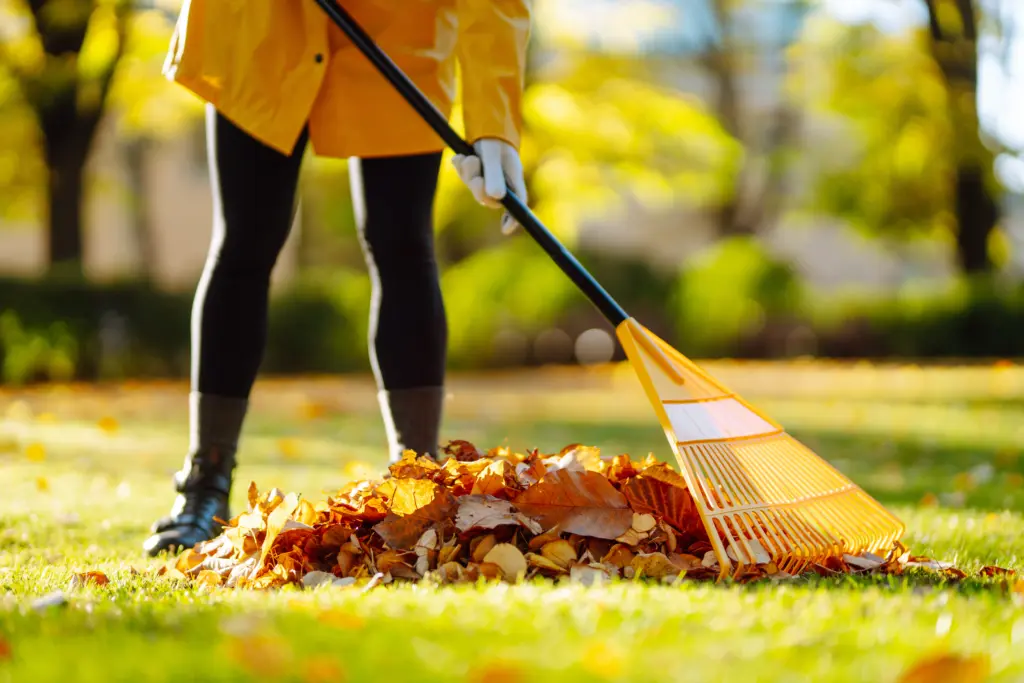
It’s that time again. Fall sports. Football and yard clean up. Rake. Rotate. Repeat.
Raking leaves seems simple: grab a rake, pull the leaves into a pile, repeat. But spend an hour cleaning up the yard and you may discover muscles you didn’t realize were involved.
That’s because raking isn’t really an “arm exercise.” It is a whole-body movement involving rotation, weight shifting, pulling, gripping and repeated transfer of force from the ground through the legs and trunk to the upper extremities.
Let’s take a closer look. (Let’s assume you are a right-handed raker with your right hand lower on the rake.)
It Starts at the Ground
Good raking mechanics begin with your feet.
As you reach the rake forward in preparation for the pull of the rake towards you, your right leg should be in front and your weight should shift to your right leg. This allows the muscles of your right leg to eccentrically load in preparation for the pull.
The idea is to load the joints and muscles from the foot on up to the largest muscle of your body, the gluteus maximus. In order for this to happen, the following must occur:
- Subtalar joint eversion – make sure your foot (and the ball of your big toe) is solidly on the ground
- Ankle dorsiflexion – this loads the soleus and toe flexors
- Knee flexion – your knee should be unlocked as this loads the quadricep muscle
- Hip flexion – this loads the hamstrings and gluteus maximus
As you pull the rake toward you, your body should naturally shift weight from one leg toward the other. The rule of thumb is, if you reach to your right, you should be loading your right butt (gluteus maximus). As you pull the rake, your weight should shift slightly to your left leg.
The hip muscles—particularly the gluteus maximus and gluteus medius—help control the pelvis while the legs provide a stable foundation for the movement.
If your feet remain planted and your legs contribute very little, more of the rotational demand has to occur higher in the body, compromising your lower back.
Your Trunk Is Designed to Participate
Watch someone rake efficiently and you’ll usually see their entire torso moving with the rake.
Some rotation occurs through the hips, while the thoracic spine rotates to help move the shoulders across the body. With right-handed raking, the following muscles are loaded in preparation for the pull: right external oblique/left internal oblique and the left erector spinae/left transversospinalis. The internal oblique and transversospinalis group are deeper and designed to stabilize, while the external oblique and erector spinae are the prime movers of the trunk.
The lumbar spine can rotate too, but it has considerably less rotational mobility than the thoracic spine. That makes repeatedly twisting primarily through the lower back a less efficient strategy and one that could produce injury.
A better strategy is to move your feet, rotate through your hips and upper trunk, and allow your body to follow the rake.
The Shoulder Blade Matters
The shoulder does much more than simply pull the rake.
As one arm reaches forward, the scapula moves around the rib cage through protraction. As you pull backward, it moves toward retraction.
The serratus anterior helps reach the rake forward (protraction), but it is the trapezius and rhomboids that are eccentrically loaded in preparation for the pull.
The latissimus dorsi provides the strong pull at the humerus to extend the shoulders.
If you continually reach too far away from your body, the lever arm becomes longer. That increases the muscular demand on both the shoulder and trunk.
In practical terms: the farther the rake gets away from you, the harder your muscles have to work to control it.
Don’t Forget the Forearms
Your hands and forearms may be the first areas to fatigue.
The finger flexors maintain an isometric grip on the rake while numerous wrist and forearm muscles stabilize the handle as you pull through leaves, wet grass and uneven ground.
Gripping harder than necessary increases this demand. Over hundreds of repetitions, that additional effort adds up.
Why Does Your Back Sometimes Hurt After Raking?
Fatigue often changes the way we move.
Early in the job, you may shift your weight and move your feet. Thirty minutes later, you may find yourself standing in one spot, bending forward and repeatedly pulling with your arms and back.
Now combine trunk flexion, rotation, reaching and hundreds of repetitions, and it becomes easier to understand why the lower back may feel tired afterward.
The problem isn’t necessarily that bending or rotating is “bad.” Our bodies are designed to do both.
The bigger issue is often repeating the same movement strategy for a long period without enough variation or recovery.
Make Raking a Whole-Body Movement
Instead of thinking about protecting one particular joint, think about sharing the work across your entire body.
Change your hand position occasionally. Switch which side you rake from. Move your feet instead of reaching farther. Shift your weight as you pull. Take breaks before fatigue significantly changes your movement.
Most importantly, let your legs, hips, trunk, shoulder blades and arms work together.
That is the fascinating thing about kinesiology: even something as ordinary as raking leaves demonstrates how remarkably coordinated human movement really is.
Why does this matter?
Raking isn’t just an arm movement. It’s a coordinated sequence of weight shifting, hip and trunk rotation, scapular movement, pulling and gripping. The more parts of your body that share the job, the less any single area has to do all the work.
If raking makes your lower back ache, chances are it isn’t the low back’s fault. Look to the joints from the ground up and figure out what isn’t contributing. Are your ankles stiff? Do your legs feel weak? Is your thoracic spine stuck from hours of looking at your phone?
Answer these questions and fix what you find. Fall may turn out to be your favorite season after all.
Because nobody has time to be in pain.
Until next time…
Kind Regards,
MoveWell Academy
[email protected]