
Kinesiology THURSDAY – Six Degrees to Tight Hamstrings
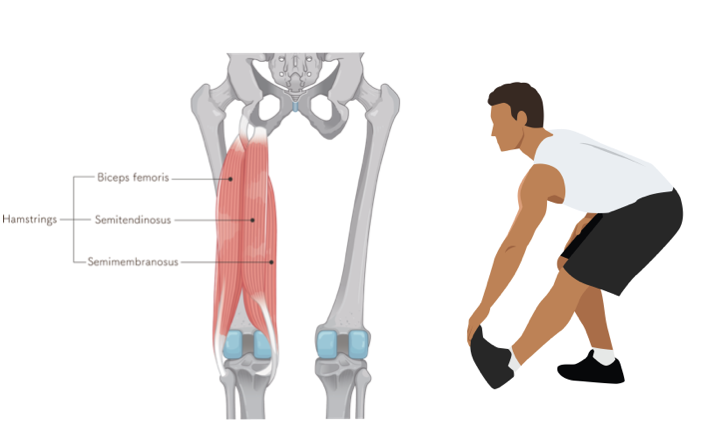
Have you ever encountered hamstrings that are chronically tight even though you keep stretching? They loosen up with a stretch, but each day you return to stretching they seem to have returned to their shortened length. That’s a signal that something in your everyday movement/posture or biomechanics is perpetuating that tightness. Let’s explore six degrees to tight hamstrings:
- Posterior pelvic tilt associated with poor sitting posture – This is the obvious one. If you are required to sit for prolonged periods of time and don’t sit on your sit bones, your pelvis is posteriorly rotated, shortening the distance from the ischial tuberosity to the tibia/fibula. The FIX: Make sure when you sit, you feel your sit bones on the chair. Sacral sitting promotes tight hamstrings.
- Toe-out walking – Walking with your toes pointed out shortens the bicep femoris (lateral hamstring). This is typically associated with over pronation. The FIX: Walk with your feet pointed straight ahead and only 2″-4″ apart.
- Weak gluteus medius leading to a valgus squat – If you squat and one knee falls in or both of your knees come together (valgus squat) this is a sign of a weak gluteus medius. This means with every step, most likely your knee falls into valgus as well, creating chronic shortening of the semitendinosis (medial hamstring). The FIX: Strengthen your gluteus medius with mini-band lateral stepping, single leg balance and side planks. Do the triangle pose to lengthen the medial hamstring.
- Decreased subtalar joint eversion – When your foot hits the ground, your subtalar joint (STJ) should evert, causing tibial internal rotation and lengthening of the bicep femoris (lateral hamstring). When you walk, your first metatarsal head (ball of the big toe) should touch the ground. Check the bottom of your shoes. Are they worn out on the lateral side (outside)? A lack of subtalar joint eversion will cause chronic shortening of the bicep femoris. The FIX: Improve STJ eversion by walking on a line, carioca stepping, medial reach with the leg and balancing on one leg on a 1/2 foam roll. Do the revolving triangle to stretch the lateral hamstring.
- Weak erector spinae – Weak back muscles often contribute to a posterior pelvic tilt (see #1). Are you able to lie on your stomach (prone) with your arms overhead and lift your arms and legs off the floor? Or can you lie on your back with your knees bent up and perform a bridge? These are two simple tests that may reveal weakness of the erector spinae. The FIX: Kettlebell swings, back hyperextensions, bridging.
- Weak quadricep muscles – Every muscle in the body has an antagonist (a muscle that performs the opposite action). If one muscle is chronically tight, it may be that its antagonist is weak. The quads are antagonistic to the hamstrings. Can you hold a single leg wall sit for 30 seconds? Test both sides. The weaker side is often associated with the tighter hamstring. The FIX: Squat with arms overhead or with a 1/2 foam roll under your heels, anterior reach with the leg or the fierce beast (my favorite for quadricep activation).
Why does this matter?
Tight hamstrings are a common problem lying at the root of many overuse injuries and tightness isn’t usually due to a lack of a hamstring stretch. Tightness often is due to improper mechanics performed throughout the day the keep the hamstring in a short position. Don’t let tight hamstrings frustrate you. If you feel like your stretching is in vain, check out one of the six degrees to the tight hamstrings and toss the fix into your exercise program.
Because nobody has time to be in pain.
Until next time…

Kind Regards,
MoveWell Academy
[email protected]