

Kinesiology THURSDAY – Revolving Triangle (This or that)
The revolving triangle is a diverse exercise, stretching the ankles, hips and thoracic spine. Specifically, it is one of the best ways to stretch the lateral hamstring (bicep femoris), a key muscle that is often the culprit of turning your toe out when you walk.
Let’s look at variation #1 – Revolving triangle with back foot turned out
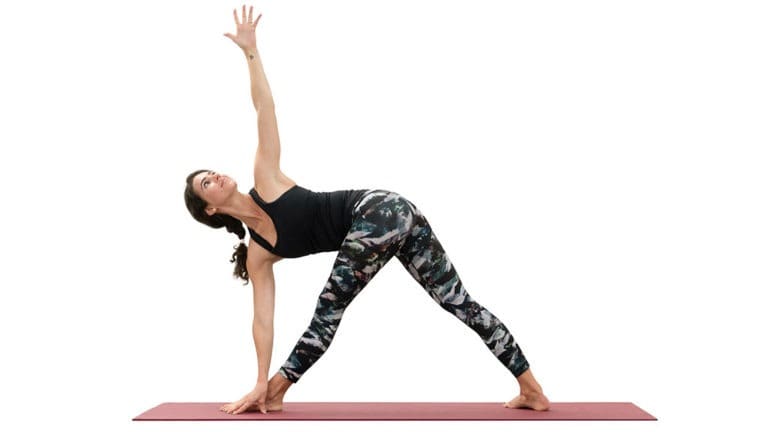
Variation #1 – Back foot turned out 45˚ emphasizes:
- hip flexion/knee extension (front leg) – stretching distal lateral hamstring
- hip internal rotation (front leg) – stretching hip external rotators
- hip external rotation (rear leg) – stretching anterior fibers of glute med
- ankle supination (rear leg) – stretching peroneus longus/brevis
- Ipsilateral thoracic rotation
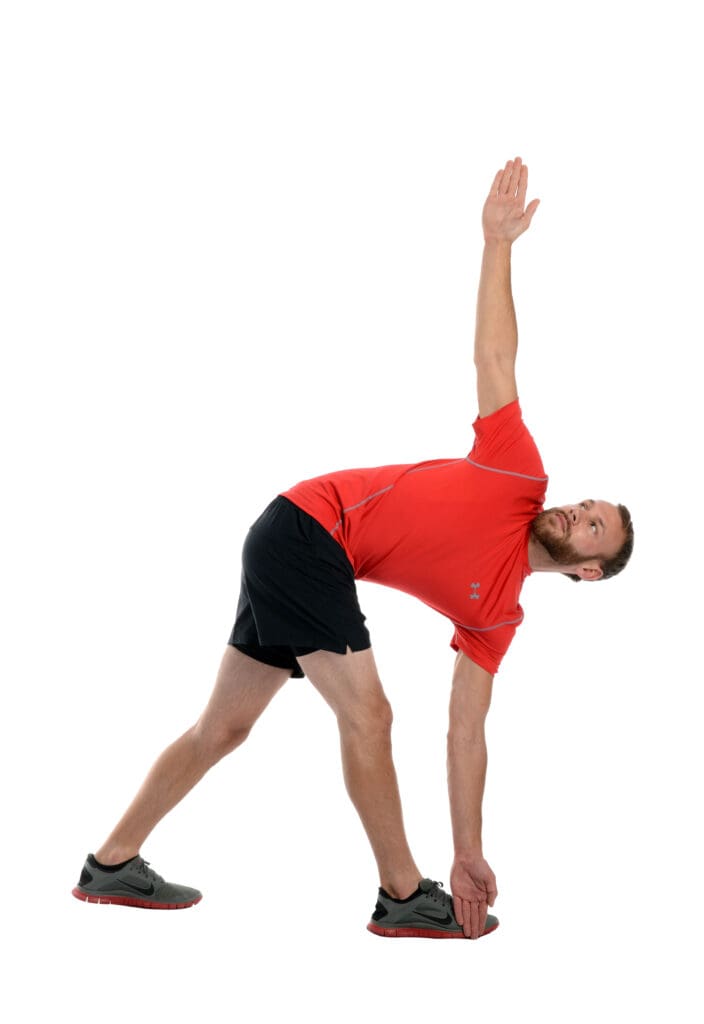
Variation #2 – Back foot pointed straight ahead emphasizes:
- hip flexion/knee extension (front leg) – stretching proximal hamstring
- hip internal rotation (front leg)
- ankle dorsiflexion (rear leg) – stretching the gastrocnemius
- ipsilateral thoracic rotation
The subtle difference of pointing your rear leg forward squares the pelvis up to the front, placing a greater stretch on the proximal hamstring attachment of the front leg. Ankle dorsiflexion is emphasized on the rear leg, while minimizing the stretch on the hip of the rear leg.
Why does this matter?
If you are wanting to emphasize opening of the rear hip and stretching the lateral line of the rear leg, choose variation #1. If someone stands with a rotated pelvis (many people do) or if they toe-out when they walk due to tight calf muscles, choose variation #2. Both stretches emphasize thoracic rotation. The main difference lies in the front hamstring and the rear hip and ankle.
Try both variations. Which one feels harder? That’s is the one you should choose to master first.
Because nobody has time to be in pain.
Until next time…

Kind Regards,
MoveWell Academy
[email protected]