Kinesiology THURSDAY – Six Degrees to a Painful Squat

The squat. One of the most avoided exercises and yet, one of the most crucial to maintain and master for pain-free function. When asked what a great exercise is for the quads/glutes, there is no better answer than the squat. “But my doctor told me I shouldn’t squat because it hurts my knees,” patients tell me. Here’s the thing:
Squatting isn’t bad for you. Bad squatting is bad for you.
Squatting is great for you, but a good squat elicits no pain in the low back and knees. Let’s look at six degrees to a painful squat:
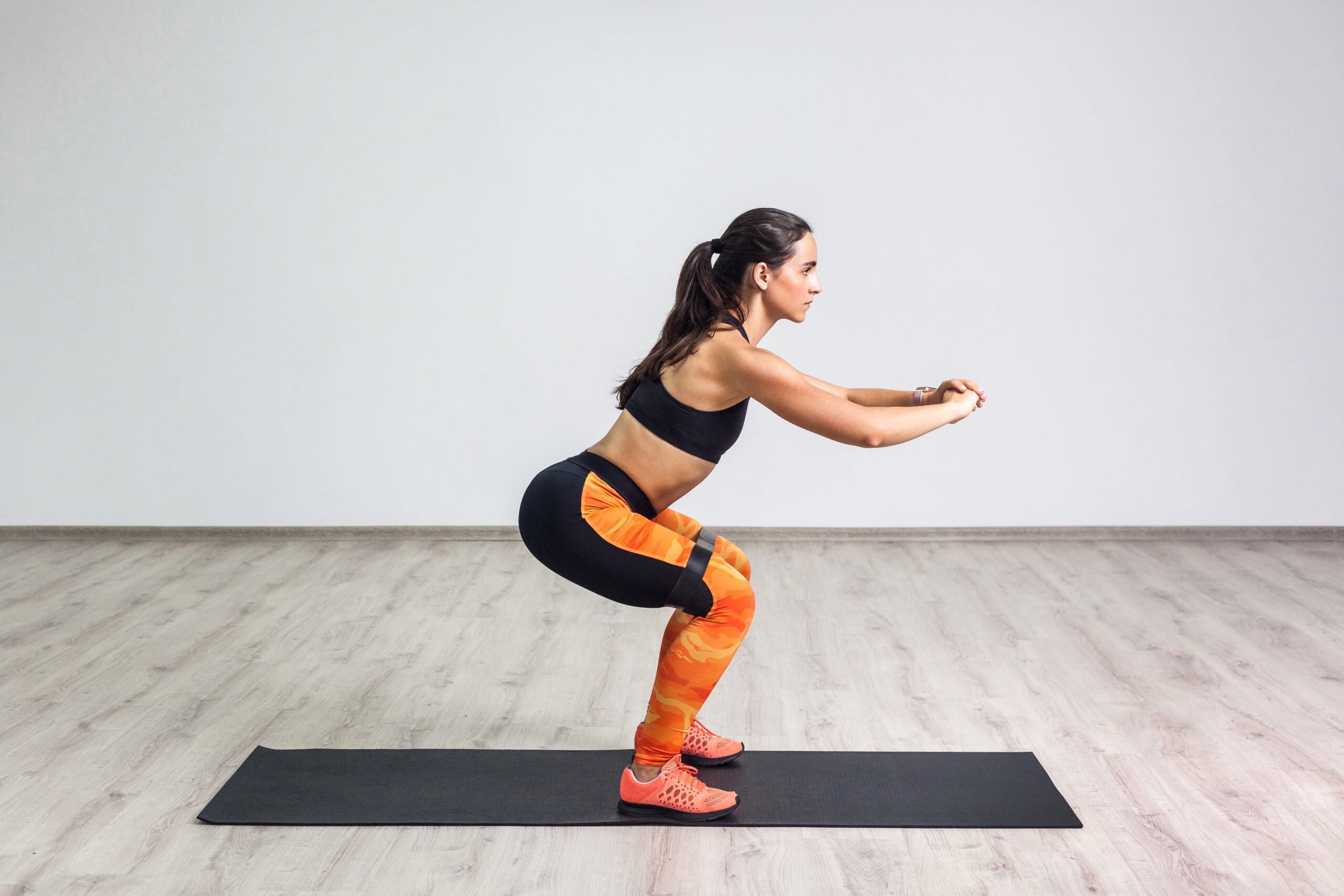
- Lack of ankle dorsiflexion – Limited ankle dorsiflexion will cause your toes to turn out as you lower down into the squat or lift your heels up (see above photo). This misaligns the knee joint, causing increased pressure on the lateral patellofemoral joint. The FIX: Downward dog, gravity drop
- Lack of subtalar joint eversion (rolled to outside of foot) – As you lower into the squat, your feet should remain flat. Limitations in STJ eversion will cause you to roll to the outside of your feet. This causes tibial ER and may result in medial patellofemoral or meniscal pain. The FIX: walking barefoot on a line, carioca walking
- Knees not in line with second toes (knees rolled in or out) – Knees falling in (valgus) is often the result of a weak gluteus medius. This version of the squat will cause increased lateral patellofemoral compression and lateral mensical pinching. The FIX: side planks, mini-band lateral stepping
- Tight proximal hamstrings (butt tucks under) – If you find yourself having to reach forward as you squat to keep your balance, this may be due to tight proximal hamstrings (the attachment at the pelvis) that causes your butt to tuck under. The FIX: Staff pose, standing forward bend
- Tight hip external rotators – Tightness of the piriformis, quadratus femoris, gemelli and obturators may cause the femur to remain externally rotated throughout a squat. This will cause abnormal rotation at the knee and result in anterior/medial or posterior/lateral meniscal impingement and/or medial patellofemoral compression. The FIX: Pigeon pose, supine figure 4 stretch
- Biomechanical unfamiliarity – sometimes a squat hurts because you just haven’t done it in awhile. It is helpful to move through the squat motion with assistance to allow your body to “figure it out”. Hold onto a pole or TRX as you descend into a squat. Don’t judge how the first squat feels. Lower yourself down and then press through your feet to stand up. Only do 3-6 repetitions. Take your time and fix the errors in your squat. By holding on to something and leaning back, you will naturally minimize knee pressure.
Why does this matter?
Check your squat in the mirror. As you lower down into the squat, what do you see? Do your knees fall in or out? Do your toes turn out? Do you feel like you are about to lose your balance?
Understanding and mastering the squat will go a long way in solving many overuse injuries of the low back and lower extremities. Use the checklist above to try an intervention and then immediately re-try your squat. And as an add-on, get a really good deep tissue massage of your legs/hips. The trigger points that reveal themselves will help you solve your squat problem.
Because nobody has time to be in pain.
Until next time…

Kind Regards,
MoveWell Academy
[email protected]