Kinesiology THURSDAY – Sleep THIS Way
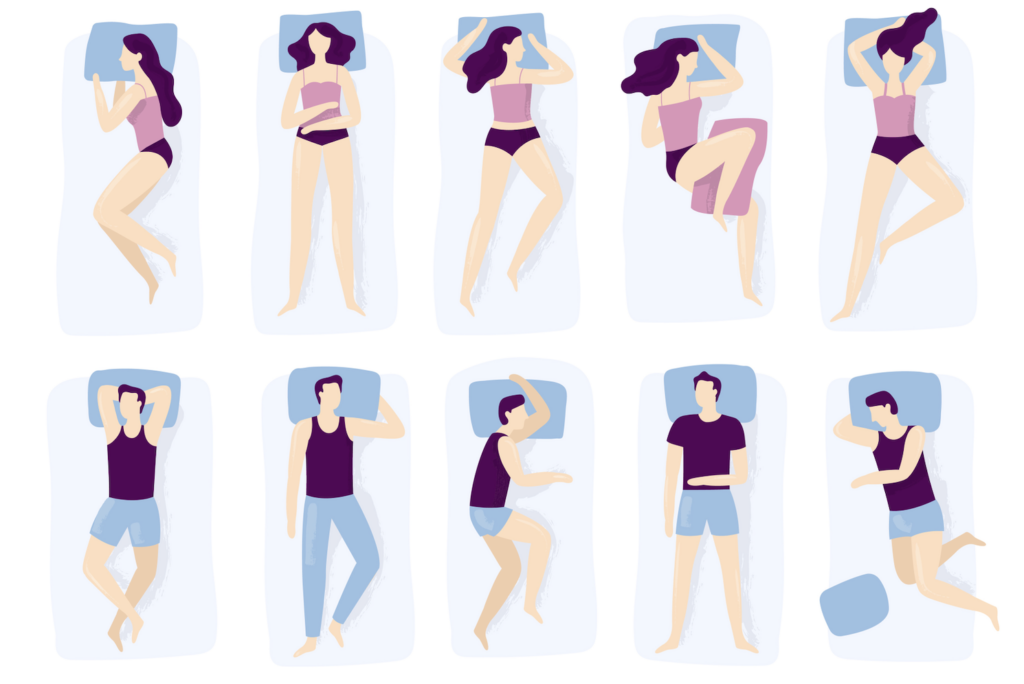
“What’s the best sleeping position?” people often ask me. If you ask the internet, there are basic rules you hear a lot:
- Don’t sleep on your stomach
- If you sleep on your back, put a pillow under your knees
- If you sleep on your side, put a pillow between your knees and make sure your head is supported with a pillow that isn’t too high or too flat
Those answers aren’t wrong, just maybe incomplete. If there has to be rules to how you sleep, then maybe time would be better spent discovering why you don’t tolerate certain sleeping positions. The real world answer is this:
- You should be able to sleep in a variety of positions
- You shouldn’t wake up in the same position in which you fell asleep. Active bed rest is key
Active bed rest is best achieved by sleeping on a firm mattress. My advice is always buy the firmest mattress you can tolerate and make sure it has a pillow top for comfort. Spring mattresses or hybrid mattresses tend to be more firm than foam mattresses.
Now let’s talk about why people DON’T tolerate certain sleeping positions.
- Sleeping on your stomach (prone) – Sleeping prone requires adequate thoracicextension and hip extension. Tight hip flexors and/or increased thoracic kyphosis (slouch) will force the lumbar spine to hyperextend when in the prone position. Exercises that mobilize the thoracic spine in three planes of motion and/or exercises that inhibit tight hip flexors will help you become a happy stomach sleeper again. You used to do it when you were a baby. You should be able to do it now. Hint: if you sleep on your stomach and pull one knee up and out to the side, that is usually the side of the tighter hip flexor.
- Sleeping on your side – Sleeping on your side requires thoracic side bending, healthy lumbar discs and a flexible quadratus lumborum (QL), the muscle that runs from your pelvis to your twelfth rib. Because your knees are typically bent in this posture, your hip flexors are on slack and don’t usually cause a problem if they are tight. But if you feel better sleeping on one side than the other, it could mean one of your QL muscles is tight. Hint: it’s usually tighter on the side of your higher shoulder (as a higher pelvis will also hike up the shoulder). How do you know one shoulder is higher? That’s the side you carry your purse, backpack or gym bag on. Improving thoracic side bending and doing exercises like the triangle pose and wall washing will help stretch out your QL and make side sleeping on either side comfortable. Another hint: If you need a pillow between your knees, that signals tightness either in the QL or the gluteus medius, your side butt muscle.
- Sleeping on your back – Sleeping on your back requires adequate hip, knee and thoracic spine extension. If when you lie on your back, your toes turn out, this signals restrictions in either the hips or knees. Tight hip flexors (psoas major) muscles are a key culprit preventing full hip extension. Tight calf muscles (gastrocnemius) will also limit knee extension and make lying with your toes pointed straight up difficult. If you require a pillow under your knees to sleep on your back, chances are you lack hip or knee extension. And if you feel the need for a high pillow, your thoracic spine extension is most likely limited.
Why does this matter?
In conclusion, you should be able to tolerate a variety of sleeping positions and active bed rest is key. But in order to give your body options, you need adequate thoracic spine, hip and knee flexibility. Don’t just avoid certain sleeping postures. Figure out WHY your body doesn’t like a certain posture and work to fix it.
Because nobody has time to be in pain.
Until next time…
Kind Regards,
MoveWell Academy
[email protected]