

Kinesiology THURSDAY – Terminal Knee Extension
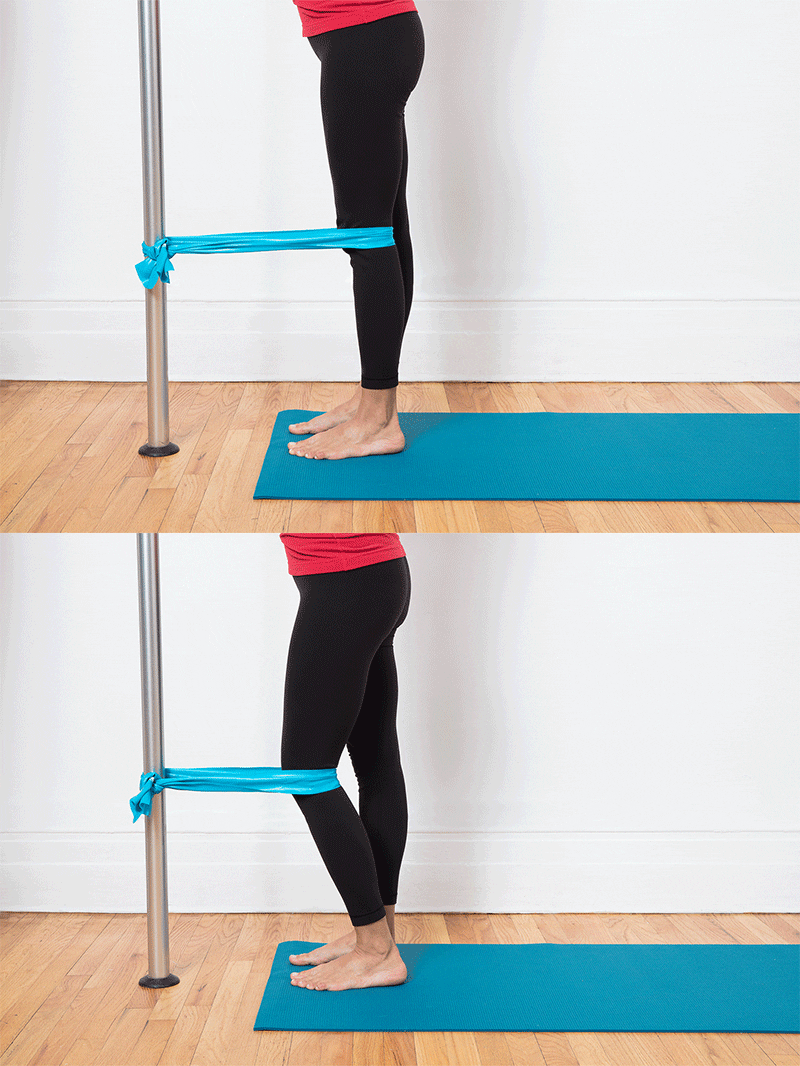
The quad set. Sitting or standing, it is an exercise that is a part of every knee rehab protocol. And for good reason. Being able to set your quad in end range extension activates the vastus medials obliques (VMO), a muscle integral to knee function and one that is often inhibited following knee injury or surgery. The problem is it usually shows up early in the rehab protocol and then is dismissed once the person is able to squat, lunge, run and jump.
The TEST
You should be able to stand and tighten your quad and feel a strong activation in the VMO. Some things people feel when things go wrong:
- a pinch in front of the knee (meniscal pain)
- inability to activate the VMO
Why does this happen?
The science of the perfect quad set lies in the kinesiology of terminal knee extension(TKE). In order to actively achieve end range extension the tibia must externally rotate (in open chain) or the femur must internally rotate (in closed chain) in late extension. If one or both of those things does not occur, a full quad set can’t happen and can cause abnormal rotation in the knee resulting in patellofemoral pain or meniscal injury.
If your patient can’t achieve a quad set, or there is anterior knee pain with the quad set, try this:
- If the tibia doesn’t externally rotate – check for trigger points in the medial hamstring or popliteus.
- If the femur doesn’t internally rotate – check for trigger points in the lateral gastrocnemius, piriformis, posterior gluteus medius, adductor magnus, psoas major and/or vastus lateralis. Whew! That is quite the list. Yes, these are all the muscles that prevent the femur from internally rotating.
- Perform a mobilization with movement – with the patient in supine, manually externally rotate the tibia while they perform an active quad set. Does it clear the pinch in the anterior knee? If so, perform six repetitions.
But, it’s such a small movement, and I don’t ever do this move in function. Why does this matter?
- Lack of TKE means the patella never “floats” off the femur, creating chronic patellofemoral compression
- Lack of TKE is often the reason people have a hard time sleeping at night after a knee injury.
- Lack of TKE that results in an anterior pinch at the knee joint line means a meniscus is being abnormally compressed, which can aggravate a tear or cause one.
- It can be the reason a knee stays chronically swollen or “feels thicker” after activities.
It’s an easy move to neglect because we often are satisfied when a patient achieves 0˚ of extension. But full normal extension goes beyond that. It requires rotation and the lack of rotation in end range can make all the difference in the world. People will be able to run, jump, hop and return to sports without this skill, but it may be the reason why the knee swells or feels stiff after activity.
Conventional thinking says: 0˚ extension is normal and if someone can’t do a quad set just have them keep practicing.
Real World Thinking says: Normal extension requires rotation or the tibia and femur and results in hyperextension of 5-10˚. If someone can’t do a quad set, check the barriers to these things and fix them. It’s the path to getting a lot of knee function from a little move.
Because nobody has time to be in pain.
Until next time…