
Muscle Minute TUESDAY – The Patellofemoral Joint (The Train on the Track)
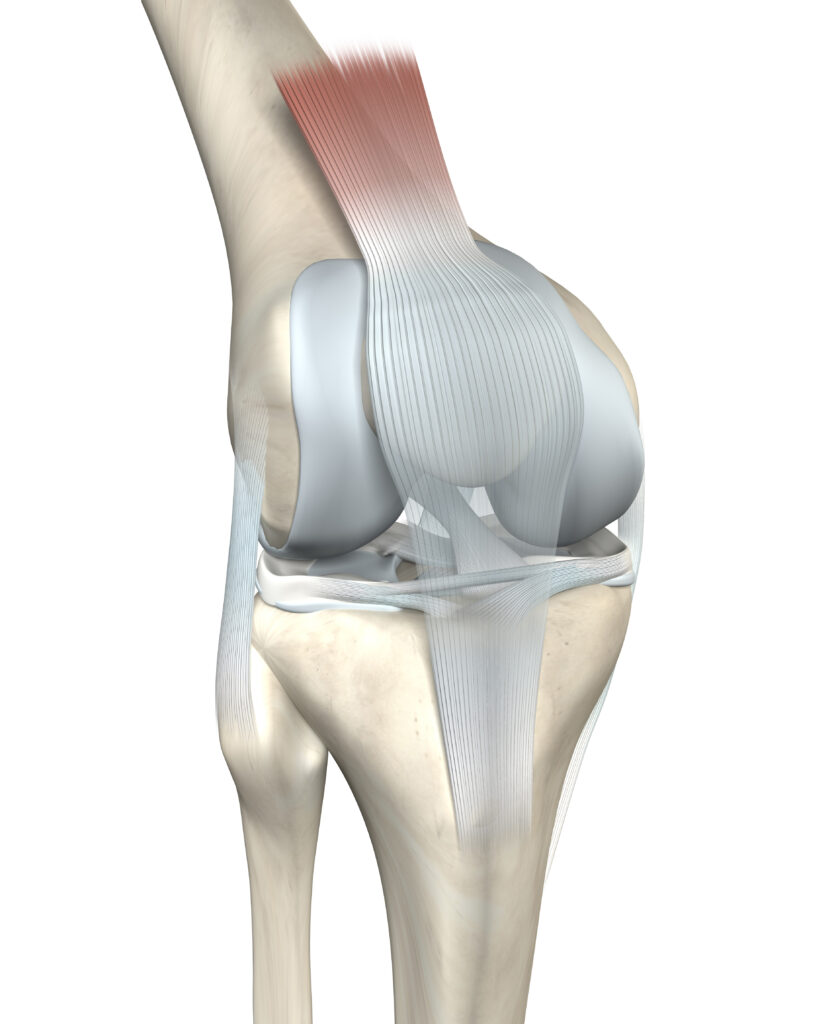
Patellofemoral pain (pain under the knee cap) is one of the most frustrating things to treat if you do not consider the concept of interregional dependence (pain in one area may be caused by things happening elsewhere). That is due to the fact that the patella is situated in between the femoral condyles but attached, via the patellar tendon, to the tibia. It really is “stuck in the middle” with nowhere to run and nowhere to hide.
The key thing to remember when treating the patellofemoral joint is:
- The superior portion of the joint (the distal femur) is controlled by the hip
- The inferior portion of the joint (the tibia) is controlled by the ankle
When the foot hits the ground, the tibia internally rotates due to subtalar joint eversion and the hip follows suit by internally rotating, causing the distal femur to follow the reaction of the proximal tibia. If this occurs, the patella is happy, avoiding any unnecessary friction.
What makes noisy knees? (Over supination causes)
Crepitation under the patella is often due to prolonged abnormal forces of the underside of the patellofemoral joint. Here are three common scenarios for noisy knees:
- A knee that doesn’t hyperextend. The only time the patella “floats” off the femur is when the knee is hyperextended. If a person lacks full knee extension, a common finding in post-surgical cases, the patella is under constant compression.
- A femur that doesn’t internally rotate. When the foot hits the ground and the subtalar joint everts, the tibia will internally rotate. If the femur does not follow suit or is delayed in internally rotating, the medial patella will rub on the medial femoral condyle.
- A subtalar joint that does not evert. If the subtalar joint does not evert, the tibia stays in relative external rotation. When the femur internally rotates, the lateral femoral condyle will come in prolonged contact with the lateral patella.
How do I fix this?
| Evaluation | Treatment | |
| Lack of knee extension | Patient should be able to generate a quad set and press the back of the knee into the treatment table. Check for trigger points in the popliteus, medial and lateral gastroc, medial and lateral hamstrings and POPLITEUS (remember this muscle unlocks the knee joint and will prevent knee hyperextension if tight) | Release trigger points with counterstrain or soft tissue mobilization Stretch the appropriate muscle Re-check ability to hyperextend |
| Femur doesn’t internally rotate | Piriformis test Side sit test Check for trigger points in: – psoas major – piriformis – posterior gluteus medius – vastus lateralis – adductor magnus – lateral gastroc | Release trigger points with counterstrain or soft tissue mobilization Re-check hip internal rotation |
| Subtalar joint does not evert | Subtalar joint eversion hypomobility test | Mobilize the subtalar joint Exercise: Cross over steps (carioca) Walking on a line Standing foam roll single leg balance |
Why does this matter?
Patellofemoral pain is one of the most common overuse knee complaints. The pain usually exhibits itself in the sagittal plane (pain with squatting, lunging, ascending/descending stairs and prolonged sitting). But the cause is almost always due to lack of or excessive movement in the transverse plane. So in the case of noisy knees, take your ears and listen to the crunch, then take your eyes and look above and below for the solution.
Because nobody has time to be in pain.
Until next time…

Kind Regards,
MoveWell Academy
[email protected]