Kinesiology THURSDAY – Hyperextension and Knee Buckling
Ever feel your knee want to “buckle” (flex) or snap back (hyperextend)? It’s a common occurrence following knee injury. I remember hearing patients describe these phenomenon as a young PT.
“You mean you tripped and then your knee buckled?” I would ask.
“No, I was just walking and my knee buckled.”
Or, I would hear, “It feels like my knee wants to snap back. Like I can’t control it.” This statement was often made without a history of a hyperextension injury.
What is supposed to control this?
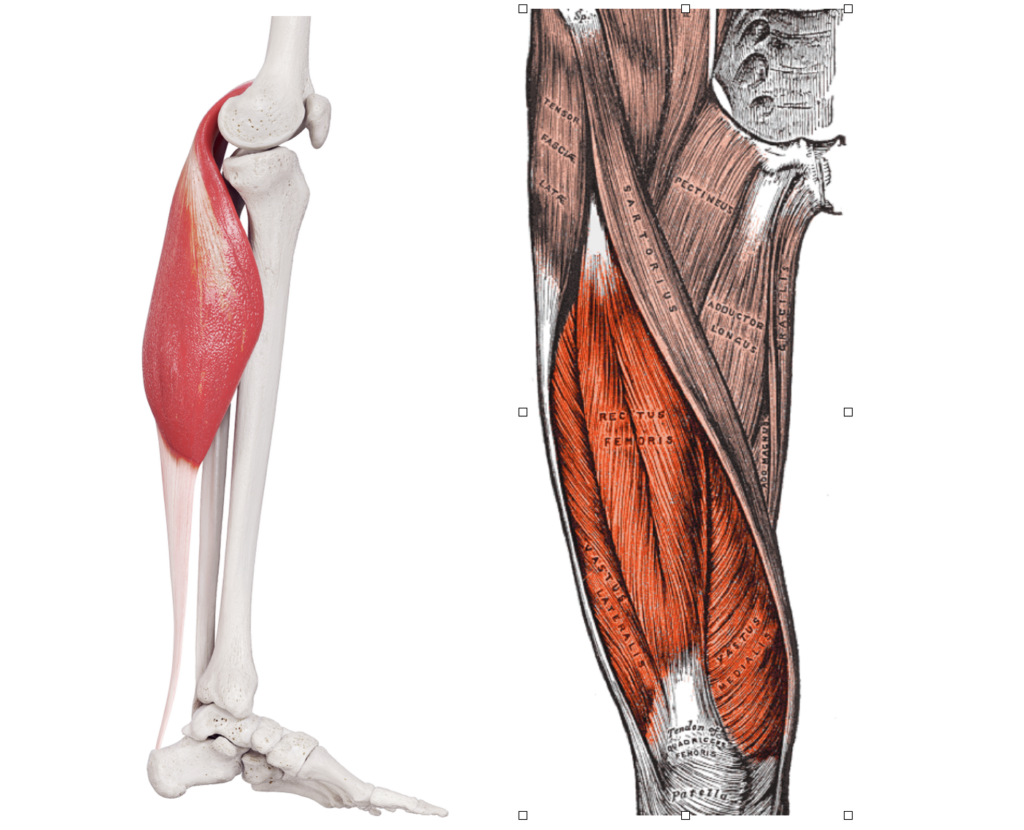
The quadricep muscle is responsible for decelerating knee flexion. In fact, that is its primary job. When your foot hits the ground, it is the quadricep that must react to prevent your knee from flexing too much. So, “buckling” of the knee occurs when the quad is not doing its job.
The gastrocnemius muscle is responsible for decelerating knee extension during gait. When the foot hits the ground and your body weight is moving forward, the gastrocnemius first decelerates ankle dorsiflexion and then as the femur continues its forward progression above the tibia, the gastrocnemius decelerates extension of the knee. Knee hyperextension occurs when the gastrocnemius is not doing its job.
What’s going on?
Two major things cause reflex knee buckling:
- Knee effusion – swelling in the knee joint may cause reflex inhibition of the quad
- Prolonged hyperextension of the knee. Remember the “hitting the back of the knee” prank? This is not a nice thing to do. But if you observe the video, this only works if the knee is hyperextended in stance. When the knee is in this closed-pack position, the muscles are virtually silent. A rapid force to flex the knee catches the quad by surprise and the knee buckles. People who stand with their knees locked out have less reactive quadriceps muscles.
Two major things cause reflex knee hyperextension:
- Knee effusion – swelling in the knee joint may also cause reflex inhibition of the gastrocnemius
- Weak gastrocnemius – In order to strengthen the gastrocnemius to prevent hyperextension, don’t just rely on heel raises. Instead, train the person to take a step with the uninvolved leg while keeping the stance leg unlocked. You can assist by manually holding the knee in slight flexion while they take a step forward with the other leg.
See what they both have in common? Knee effusion. If you or your patient are experiencing knee buckling or hyperextension, it is important to deal with the swelling. My favorite techniques are using kinesiotape to control edema and a good old-fashioned edema massage. And remember R.I.C.E. for swelling (hint: compression is the most effective).
Why does this matter?
Knee buckling and hyperextension are most often due to reflex inhibition from swelling. More important than just strengthening the muscles, reducing or eliminating swelling is job #1. Massage, compression and taping are key.
And then with strengthening the quad and gastrocnemius, don’t just go to squats and heel raises. Instead, train the knee to work in an unlocked position with the foot on the ground. Have the patient practice stepping over something with the other leg while maintaining a stable, unlocked knee position.
When it comes to buckling and hyperextension, think outside of the box.
Because nobody has time to be in pain.
Until next time…

Kind Regards,
MoveWell Academy
[email protected]