
Anatomy TUESDAY – Baxter’s Nerve Entrapment
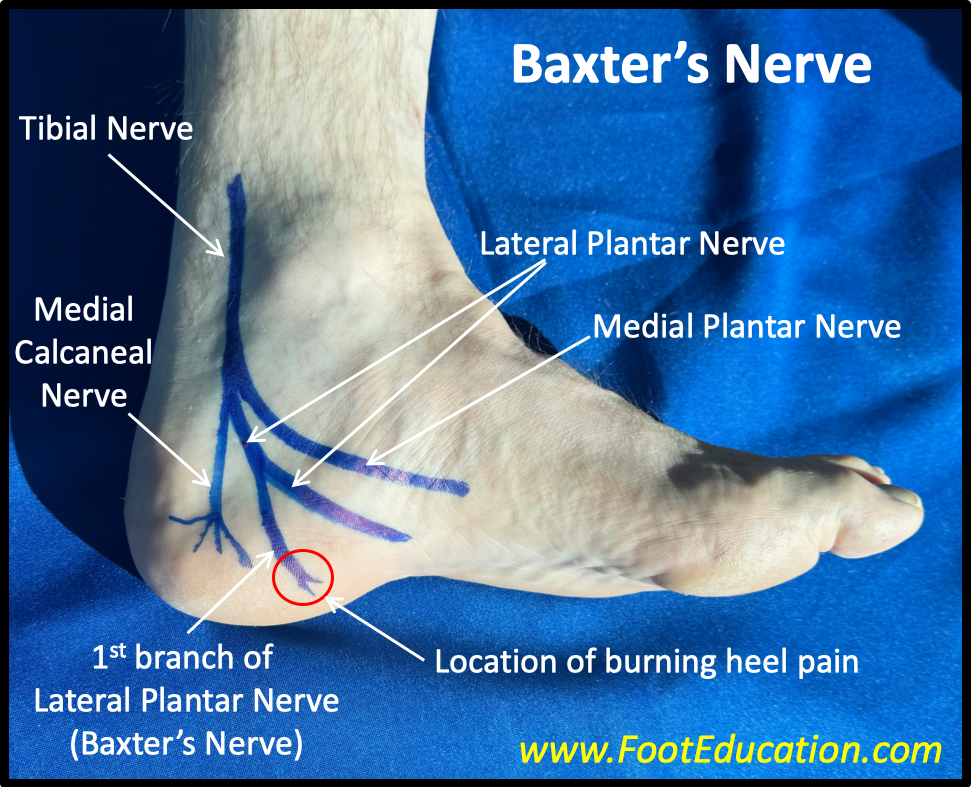
Baxter’s nerve. Ever heard of it? I can honestly say that I hadn’t…until last week. A patient presented with symptoms similar to plantar fasciitis: pain in the arch of the foot near the medial calcaneal tubercle that increases with weight bearing. It began after she wore a particular type of sandals that did not have a soft cork footbed four months ago. She never wore them again and the pain has persisted. She was diagnosed with Baxter’s nerve entrapment.
Baxter’s nerve is the first branch of the lateral plantar nerve which extends to the inferior medial calcaneus. It traverses between the abductor hallucis and quadratus plantae muscles.
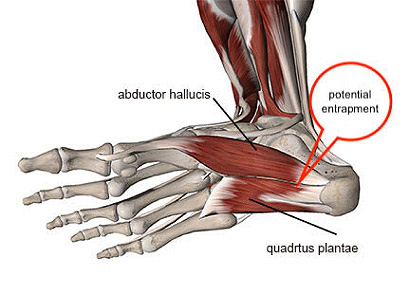
Abductor hallucis is responsible for moving your big toe away from the other toes (great toe abduction). Quadratus plantae helps support the arch and assists flexor digitorum longus in flexion toes 2-5. Both of these muscles help maintain the integrity of the arch and stability of the foot when your foot hits the ground.
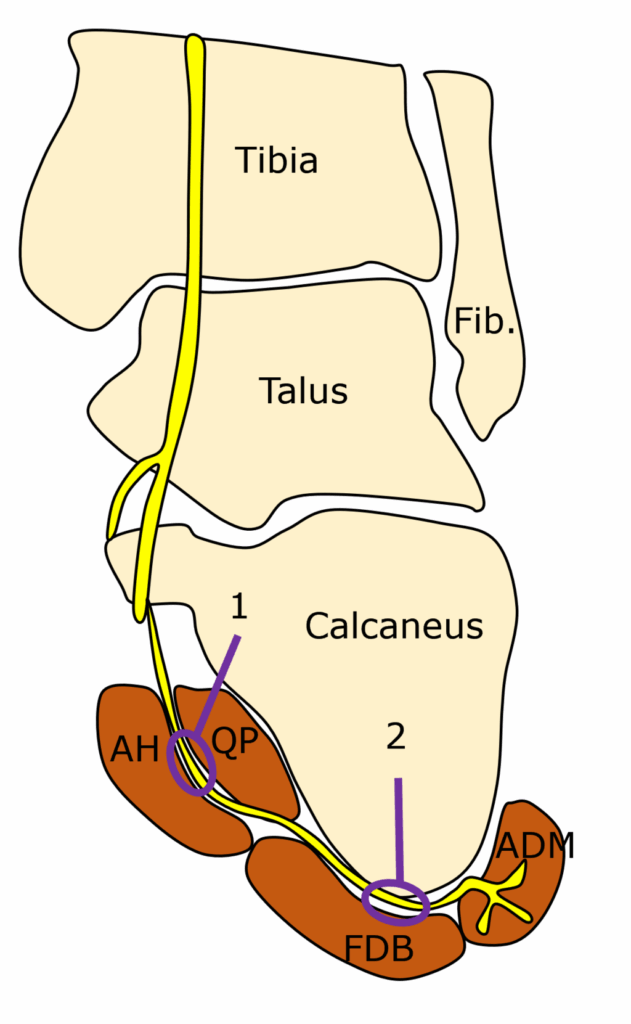
Baxter’s nerve entrapment is difficult to diagnose solely with clinical evaluation, with accurate diagnosis being aided by high resolution ultrasound and EMG. Treatment should include interventions to decrease over pronation of the foot.
My patient reported decreased pain following soft tissue release of abductor hallucis and activation of gluteal muscles with clam shell exercises performed at a recent Pilates class.
Why does this matter?
Baxter’s nerve entrapment accounts for approximately 20% of all heel pain cases, making differential diagnosis from plantar fasciitis and tarsal tunnel syndrome important. From a practical standpoint, it is important to make sure you can abduct your big toe and curl your toes on command (try it now!). Weakness or inhibition of abductor hallucis longus and quadratus plantae will affect the integrity of the arch. Trigger points or tightness in these muscles may also contribute to Baxter’s nerve compression. And don’t forget to activate the gluteal muscles. When it boils down to it, over pronation is almost always about the butt. Think about it.
Because nobody has time to be in pain.
Until next time…
Kind Regards,
MoveWell Academy
[email protected]