
Anatomy TUESDAY – Stuff That Gets Pinched (Part 1) – Hip Labrum
“I was sitting on the couch yesterday and when I went to stand up, my hip was killing me,” a patient told me yesterday. “I could barely put weight on it for several steps, but as I walked, it started to feel better. It’s still a little sore today” she continued. She pinpointed pain in the area of her left hip.
“Can you touch it?” I asked. “Or is it deep.”
“It’s deep,” she replied.
She presented with a positive FABER test on the left which was improved by 50% following correction of an innominate outflare and posterior rotation. The FABER test was normalized with release of trigger points in the vastus lateralis, piriformis and lateral gastrocnemius.
Why does this matter?
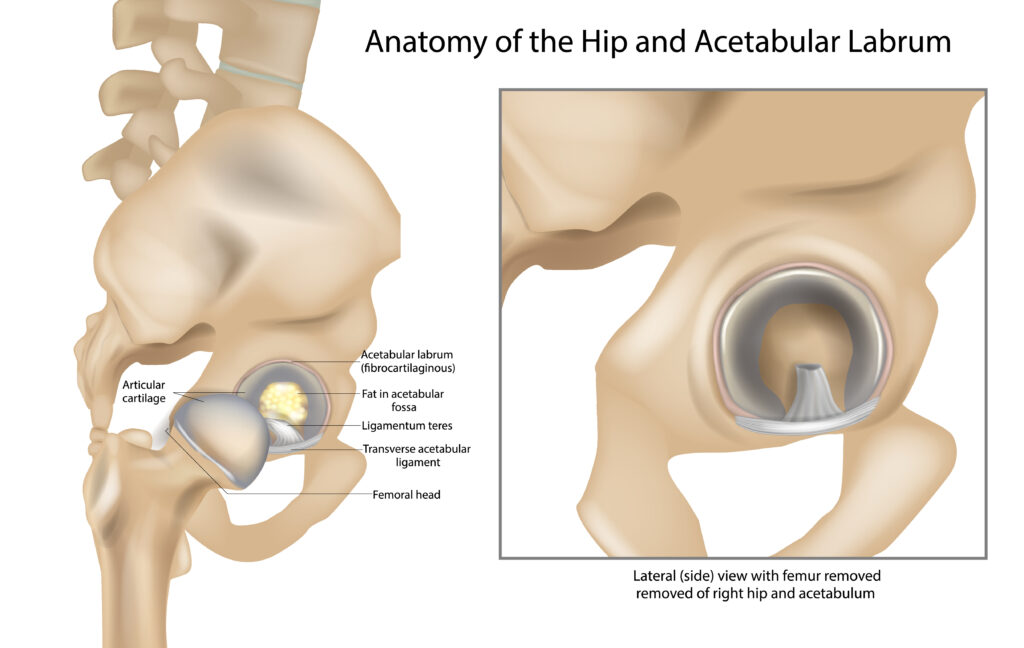
Sudden onset of sharp hip pain following prolonged sitting often signals impingement of the hip labrum. The labrum is a cartilaginous disc that makes up 4/5ths of a ring and acts to deepen the acetabulum (hip socket), adding stability to this ball and socket joint.
Labral impingement occurs with chronic, uneven pressure. The most common is prolonged, end-range hip external rotation in someone whose hip already sits in slight external rotation, such as someone who walks toed-out or sits with their knees out. This resting position places pressure on the anterior portion of the labrum.

Standing up from sitting requires anterior movement of the femoral head (moving from flexion to extension). If the femoral head is already sitting anteriorly, then the hip joint “bottoms out” or runs out of room, causing a labral impingement. The trigger points detected in the patient described above signals a chronically externally rotated femur. The positive FABER test confirmed this.
The solution: Give the femoral head room to move anteriorly by ensuring it starts in a neutral position. If you are one of those people who sits with their knees wide apart, before you stand up, put your feet together and squeeze your knees together a few times before you stand up.
And if you are a clinician who sees a case like this, don’t panic. A sharp, sudden pain after prolonged position usually signals a soft tissue impingement. Let the trigger points tell you about the position of a bone and then fix what you find.
Because nobody has time to be in pain.
Until next time…
Kind Regards,
MoveWell Academy
[email protected]