Kinesiology THURSDAY – Why Hamstrings Tear (Part 2)
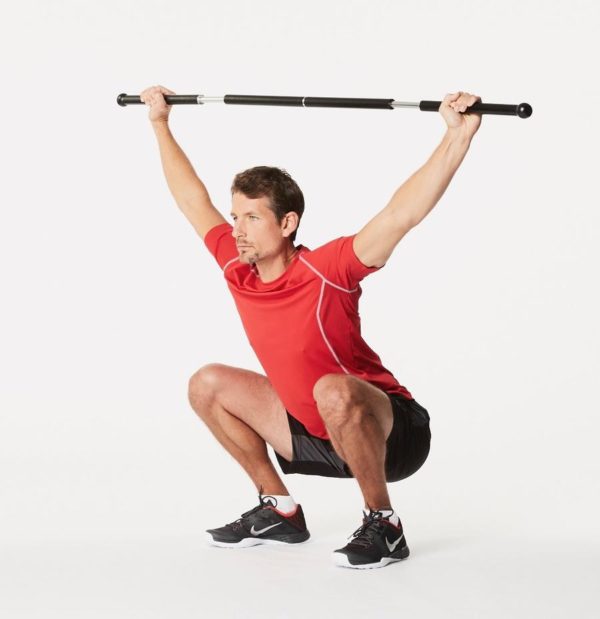
In the article, Prevalence of Hamstring Strain Injury Risk Factors in Professional and Under 20-Male Football (Soccer) Players, the Functional Movement Screen (FMS) scores for players with hamstring strains were low in 41.6% of the players with the lowest scoring test being the deep overhead squat. What does this test tell us? Let’s start from the ground up:
- Ankle dorsiflexion range – In order to achieve full squat depth, 30˚- 35˚ of dorsiflexion is required. Less than this will cause compensatory knee valgus, putting the bicep femoris long head (BFlh) in a long/weak position. A FIX: Downward dog
- Hip flexion and internal rotation – Inability to keep the knees in line with the second toe in the deep range of a squat is often due to tight hip external rotators (piriformis, posterior gluteus medius), exhibiting as knees falling out as the squat depth increases. This places the gluteus maximus in a less than optimal length tension, inhibiting activation. Remember, the gluteus maximus is the strong functional synergist to the hamstrings. Decreased activation of gluteus maximus requires more work of the hamstrings in decelerating hip flexion, increasing risk for overload injury. A FIX: TRX closed stance deep squat
- Latissimus dorsi flexibility – The latissimus dorsi attachment at the iliac crest and thoracolumbar fascia has a direct effect on pelvic position, causing anterior pelvic tilt. When you place your arms overhead (and it’s an even better test for lat flexibility if your arms are shoulder width apart and not spread so wide as the picture above), you place the lat on a stretch. At the deep end of the squat, the pelvis should posteriorly tilt slightly (butt should tuck under). Inability to do so is often caused by a tight latissimus dorsi. An anteriorly rotated pelvis places the hamstrings in a long/weak position, increasing risk for overload injury. A FIX: Supine foam roll alternating shoulder flexion
Why does this matter?
These are three reasons why a poor overhead squat could signal causes of hamstring strain injuries. Remember:
- Muscles tear when they are neurologically weak (receiving a weaker signal from the nervous system and thereby not activating as readily)
- Muscles may be placed in a long/weak position by abnormal postures
- Muscles may be weakened by a tight antagonist
- Muscles may be overworked in the presence of weak functional synergists
Here is a version of this squat test you can try at home. And if you have patients with repetitive hamstring strains, be sure to put this test in your evaluation.
Because nobody has time to be in pain.
Until next time…
Kind Regards,
MoveWell Academy
[email protected]