
Kinesiology THURSDAY – Scroll, Slouch, Repeat (Phone Neck)

Think about how many times you look down at your phone throughout the day. You check a text, scroll through social media, answer an email, or watch a quick video. Before you know it, you’ve spent a significant amount of time with your head tilted forward.
It seems harmless. After all, your neck is designed to move.
But what is actually happening beneath the surface when you repeatedly look down at your screen?
The answer involves biomechanics, muscle activity, and the way your cervical spine manages the weight of your head.
Let’s break down the science behind what’s commonly called “phone neck”.
Your Head Is Heavier Than You Think
The average adult head weighs approximately 10–12 pounds. When your head is balanced relatively upright over your shoulders, your cervical spine and surrounding muscles work together to support that weight. Your neck is designed to handle this load.
However, as your head tilts forward, the mechanics change.
As the angle of flexion increases, the center of mass of your head moves farther forward relative to parts of the cervical spine. This creates a larger turning force, known as torque, that your neck muscles and supporting tissues must manage.
In simple terms, the farther forward your head moves, the greater the mechanical challenge of supporting it.
A frequently cited 2014 biomechanical modeling study by Kenneth Hansraj estimated the following equivalent loads associated with different degrees of forward head inclination:
Head Position Estimated Equivalent Load
Neutral (0°) – 10–12 pounds
15° forward – 27 pounds
30° forward – 40 pounds
45° forward – 49 pounds
60° forward – 60 pounds
In other words, the more forward our head sits, the heavier it feels to the muscles supporting it.
The Supporting Cast
Your cervical spine doesn’t work alone.
An interconnected system of muscles helps support your head, stabilize your neck, and coordinate movement between your shoulders and upper back. When you spend prolonged periods looking downward, several of these muscles may need to maintain sustained activity.
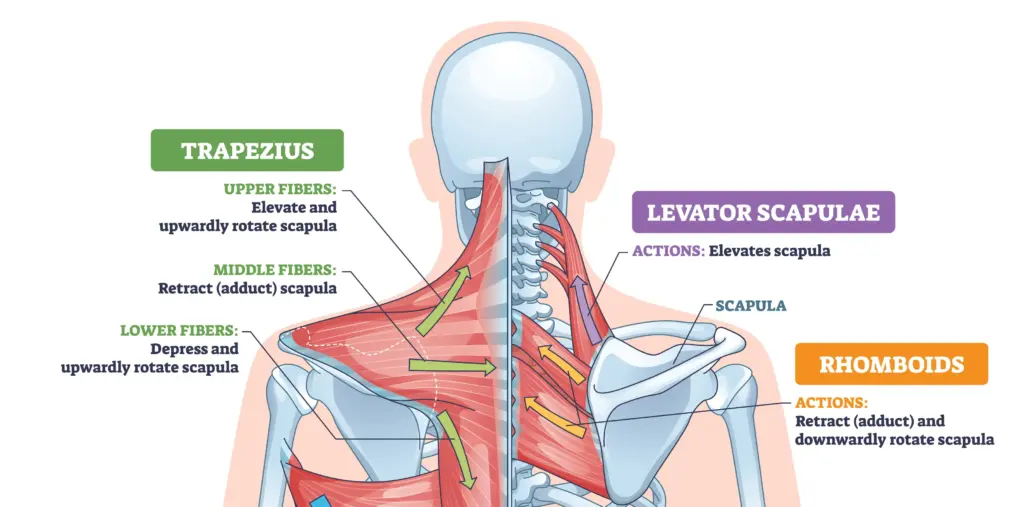
- Upper trapezius – extends from the back of the skull and neck toward the shoulders and collarbones. It contributes to arm elevation and is also responsible for holding your head on your shoulders. Work load to the upper trapezius increases the more forward your head sits. Trigger points in this muscle often lie at the root cause of cervical pain, rotator cuff tendonitis/tears and cervicogenic headaches.
- Levator scapula – The levator scapulae runs from the upper cervical spine to the superior medial border of the scapula. It contributes to elevating the scapula and stabilizing the neck. Trigger points may develop in this muscle with prolonged forward head posture or cervical flexion. This is one reason neck discomfort sometimes feels as though it extends towards the upper inside corner of your shoulder blade.
- Cervical extensors – Along the back of your neck are muscles responsible for helping extend and stabilize the cervical spine. These include the splenius muscles, semispinalis cervicis, semispinalis capitis, and other deep posterior cervical muscles. When your head moves forward, gravity creates a flexion moment that these muscles may need to counteract. The longer you maintain a position, the longer some of these muscles may be required to sustain tension.
Why Your Upper Back Matters, Too
Phone neck isn’t exclusively a neck issue.
Your cervical spine, thoracic spine, shoulder blades, and surrounding muscles function as an interconnected system.
When you look down at your phone, you may also:
- Round your upper back
- Allow your shoulders to drift forward
- Keep your elbows and arms unsupported
- Remain relatively motionless for long periods
The rhomboids, middle and lower trapezius become long and weak and serratus anterior may become short/tight. All of these muscles contribute to shoulder blade control and upper-body positioning.
Increasing thoracic flexion will naturally place your head more forward of your shoulders. That’s the bad news. The good news is it is fixable.
Improving thoracic extension and rotation will automatically place your head more on top of your shoulders, minimizing workload to the upper trapezius, levator scapula and cervical extensors.
The body is built for movement. The challenge is often staying in one position for too long. It’s more important to focus on postural variety v. postural perfection.
Why does this matter?
Looking down at your phone isn’t inherently dangerous.
But the biomechanics behind the movement are worth understanding.
As your head moves into cervical flexion, its position changes the torque acting around the cervical spine. The muscles of your neck, shoulders, and upper back work together to manage those forces.
When the same position is maintained for long periods, muscular fatigue and discomfort can develop.
The solution isn’t to eliminate neck flexion or chase perfect posture.
It’s to build strength, support your body when possible, vary your positions, and move regularly.
Your phone isn’t necessarily the problem. How long you stay in one position—and how well your body tolerates that position—may matter more.
So the next time you catch yourself looking down at your screen, remember: your neck is doing more than simply holding up your head. It’s managing a complex balance of forces, muscles, and movement.
Give it a little variety.
Because nobody has time to be in pain.
Until next time…

Kind Regards,
MoveWell Academy
[email protected]