
Kinesiology THURSDAY – Getting to the bottom of Knee Pain
Do your knees hurt when you squat? Do you hear noises coming from your knee joints when you go up and down stairs? Knee pain is one of the most common complaints, but just because it’s common doesn’t mean its normal.
You can get rid of knee pain and it begins with understanding what causes it. The knee is an interesting joint in that it is made up of your thigh bone (which is controlled by your hip) and your shin bone (which is controlled by movements at your ankle). In other words, the knee is stuck in the middle with nowhere to run and nowhere to hide.
Osteoarthritis, patellofemoral pain (pain under your knee cap) and meniscal tears are often caused by weakness in the large muscles of your hip and tightness in the hips and ankles. It is similar to a set of gears on a machine being just slightly out of line. The gears still work, they just wear out quicker. That’s why osteoarthritis is also called “wear and tear” arthritis.
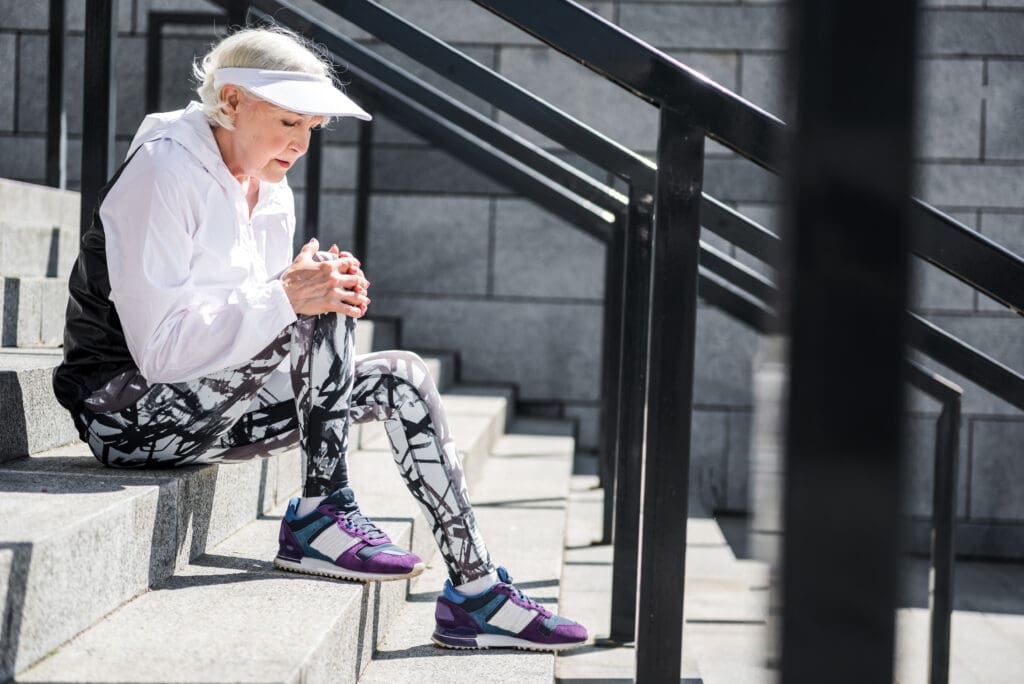
The body has an amazing ability to relearn new movement patterns that can strengthen and lengthen the appropriate muscles with every step you take. Pain-free squatting, lunging and stair climbing can be achieved by performing three simple exercises on a daily basis: downward dog, triangle and revolving triangle.
The downward dog is one of the best exercises to restore ankle mobility. When performed with the toes straight ahead, it positions the shin bone in proper alignment to the thigh bone. By stretching the back of your legs in this fashion, you unleash both ankle and hip flexibility that keeps your knees in the proper position.
The triangle stretch will unlock the hips in the frontal (side-to-side) plane. This motion is often neglected in our daily activities and for many people, it is more stiff on one side than the other. By balancing hip flexibility in this plane, you unlock the potential of your gluteal muscles which will help dissipate forces that can cause knee pain.
Finally, the revolving triangle, unlocks the hips in the transverse (rotational) plane. It isn’t unusual for this one to feel the most difficult, and perhaps it is the most important. It will help you to walk with your toes pointed straight ahead, keep your knees from falling in when you squat and get your big toe down to the ground when you walk, key factors in loading the large muscles of the hip with every step you take.
By performing these exercises just one time each day, you will be well on your way to healthier, pain-free knees. Before you know it, painful squats and stair climbing will be a thing of the past. Have a healthy, pain-free day!