
Kinesiology THURSDAY – Biomechanics of Noisy Knees

You’ve all heard it, either on yourself or on others. The sound that doesn’t allow you to sneak up on people. Sometimes it’s louder than others. Most of the time it isn’t associated with pain. It’s the snap, crackle and popping of your knees.
Try this test: Stand in a quiet room. With your feet hip width apart and toes pointed straight ahead, squat down. Do you hear anything? Does it hurt?
The crackling of your knees is known as crepitation. In an article published in the British Journal of Sports Medicine titled Noisy knees – knee crepitus prevalence and association with structural pathology: A systematic review and meta-analysis, here were the key findings:
Analysis of 103 studies involving more than 36,000 participants revealed knee crepitus was present in:
41% of the general population
36% of pain-free individuals
81% of people with knee osteoarthritis
Crepitus was associated with higher odds of radiographic osteoarthritis, but the certainty of the evidence was low to very low, meaning crepitus alone should not be considered diagnostic of osteoarthritis.
This paper supports one of the most reassuring messages for patients:
Many healthy people have noisy knees, and knee sounds by themselves do not necessarily indicate injury or arthritis.
Great news! But then what do noisy knees indicate?
The patella (knee cap) sits between the femoral condyles, but it is attached to the tibia via the patellar tendon. The only time the patella is not touching the femur is when your knees are hyperextended. During the squat, the patellar surface begins to come in contact with the femur, with maximal contact pressure at 90˚ of flexion and forces up to 6.5x your body weight. As you squat past 90˚, there is increased pressure, but some of the patellofemoral force is absorbed by the patellar tendon coming in contact with the femur.
A patella that remains centered between the femoral condyles during knee flexion, is the quiet knee. This is no small feat as when you flex your knee, the femur and tibia rotate. If the patella moves to one side or the other during function, articular cartilage will start to experience increased pressure and, over time, cracking noises will occur.
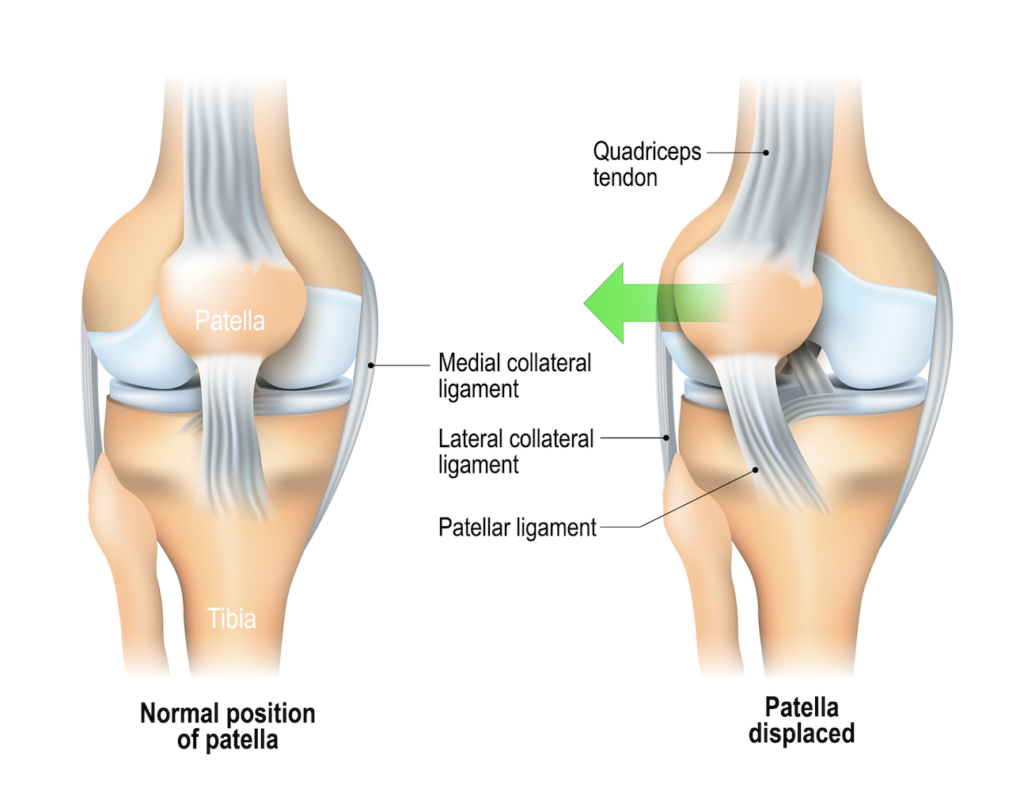
Here are some things to consider:
- If the patella is sitting in proper alignment, the knees will be quiet
- Quad (VMO) weakness may cause the patella to track laterally
- A tibia that is positioned in internal rotation due to tight medial hamstrings may cause medial patellar pressure
- A tibia that is positioned in external rotation due to tight lateral hamstrings may cause lateral patellar pressure
- Increased knee valgus, usually due to decreased dorsiflexion or a weak gluteus medius, may cause the patella to track laterally
- Tightness (trigger points) in the piriformis or lateral gastrocnemius will delay or prevent internal rotation of the femur, causing increased medial patellar pressure
Hopefully you looked at that list above and noticed a key thing: the things that create noisy knees are not at the knees at all. If you want quiet knees:
- Stretch your gastrocnemius muscles using a 1/2 foam roll (gravity drop)
- Strengthen your gluteus medius with mini-band lateral walks or side planks
- Stretch your hamstrings using the triangle and revolving triangle yoga poses
- Stretch your piriformis with the “figure 4” stretch or pigeon pose
- Strengthen your gluteus maximus and quadriceps with variations of lunges and squats
And if you’re really brave, have a deep tissue massage to the gastrocnemius, hamstrings, piriformis and posterior gluteus medius. Releasing these muscles goes a long way in correcting patellofemoral maltracking.
Do the noisy knees test of squatting in a quiet room. And then try the list of activities above. If you really want to figure out the cause of your noisy knees, do the squat test after each of the activities listed above and see if any of them change the noise level. The activities that feel the most difficult to do probably lie at the root cause of your noisy knees.
Why does this matter?
Noisy knees don’t necessarily mean you have osteoarthritis, but the noise indicates a knee that is off balance due to muscle tightness and/or weakness. Addressing the causative factors before pain starts is key.
Start squatting in a quiet room. Fix what you find.
Because nobody has time to be in pain.
Until next time…

Kind Regards,
MoveWell Academy
[email protected]