Kinesiology THURSDAY – Lessons from the Woodpecker
It isn’t often that I get an email from Bob (my mentor) on the weekend.
“I have focused on this over the past week or so and it works on humans who aren’t athletes but have back pain. I think it is just part of good mechanics during exertion. Check it out.”
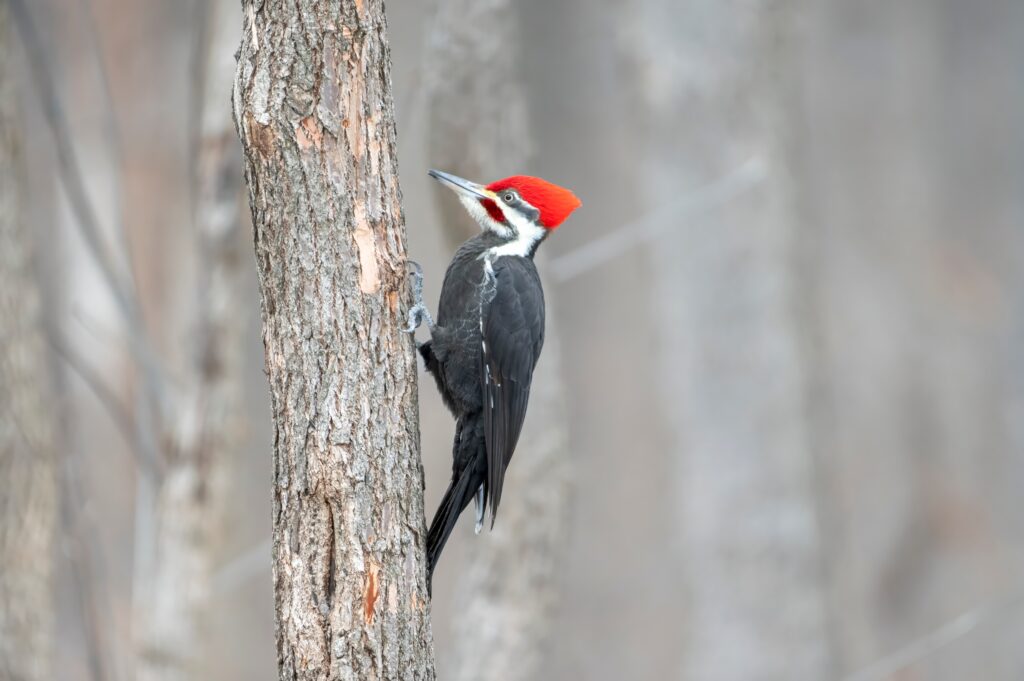
It was an article from the Journal of Experimental Biology entitled, Neuromuscular coordination of movement and breathing forges a hammer-like mechanism for woodpecker drilling. I was immediately intrigued.
A woodpecker can peck upwards of 20 times per second which can amount to over 12,000 pecks per day. Each peck can exert a force of 1,200-1,400 g’s which is beyond the force that causes human concussion and yet, their noggins stay intact. The article highlighted some interesting facts:
- Pecking engages muscles in the head, neck, hips, tail and abdomen
- The head and neck muscles isometrically create stiffness in that region to allow the forces from below to be transferred to the beak
- The hip flexors power the movement while the tail stabilizes the body against the tree
- The woodpecker exhales taking mini-breaths with each strike, much like an athlete grunts to stabilize the core and produce force,
All those factors combine to allow a small bird to exert great and repetitive forces without sustaining injury. Stabilized neck. Movement powered from the core. Exhaling with exertion.
We should all take a clue.
The transverse abdominus, our deepest abdominal muscle, is designed to stabilize the spine prior to movement of the extremities. It activates milliseconds before you lift an arm or a leg. Or at least it should.
It is a stabilizer, activating best when there is a need for stabilization. The faster the movement, the greater the need for stabilization. When you walk quickly and swing your arms rapidly, the transverse abdominus activates to stabilize your spine. As an added bonus, it also flattens your belly.
When we lift, push or pull, we require a stable base. Like the woodpecker’s tail braced against the tree, our feet planted on the ground offer us the support we need to move a lot of weight or produce a lot of force. This base is compromised if our feet are over pronated or over supinated at rest. Toes that can move and grip (have you tried actively curling and abducting your toes lately?), ankles that are flexible and joints that are pliable are what allow our feet to conform to uneven surfaces and maximize our stability.
In contrast to the woodpecker’s hip flexors, our movements are primarily powered by the gluteus maximus which is neurologically connected to the transverse abdominus. Weak abdominal muscles are often associated with a weak butt.
Finally, breathing. Exhaling during exertion. Not the long exhale, but the abrupt exhale you get when you grunt. Here’s the thing, in order to produced that end range abrupt exhale, you must be able to exhale fully. Try taking a deep inhale (four seconds) and then exhale (eight seconds). Can you do it? Practicing the range of motion of your diaphragm and respiratory muscles just may save your lower back.
Why does this matter?
Our bodies, just like the woodpecker, are intricately and amazingly designed to allow us to function in powerful and enduring ways. But we have to respect the design. If we allow any of the elements to weaken or shut-off, the kinesiological chain can break and so can you. Remember the woodpecker.
Because nobody has time to be in pain.
Until next time…
Kind Regards,
MoveWell Academy
[email protected]