
Muscle Minute TUESDAY – Meet the Popliteus
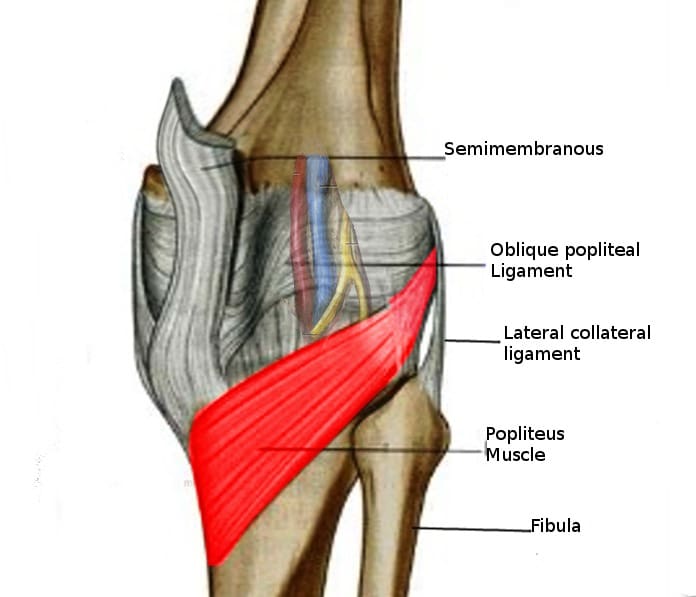
We don’t talk about this muscle much, but we should. You probably remember the popliteus from anatomy class as the muscle that unlocks the knee, but clinically, it does so much more. Let’s dive in.
| Origin | lateral femoral condyle |
| Insertion | proximal surface of tibia |
| Action | femoral external rotation, tibial internal rotation |
| Innervation | tibial n. (L5, S1) |
| Antagonists | bicep femoris (lower leg ER), gluteus medius (femoral IR) |
The Real World Popliteus
A lot can be learned about this muscle by observing its orientation in the picture above. When the foot hits the ground, the popliteus assists the gluteus maximus in decelerating internal rotation of the femur. Concentrically, it can also internally rotate the tibia, hence why it became known as a muscle that unlocks the knee. It also acts as a dynamic lateral stabilizer assisting the LCL in preventing varus injuries of the knee. And it sends a slip to the posterior lateral meniscus, pulling it out of the way and preventing impingement as the knee flexes.
Remember, terminal knee extension involves tibial external rotation (open chain) or femoral internal rotation (closed chain). Though the popliteus is known to unlock the knee, it’s greater clinical significance lies in its prevention of knee hyperextension.
You probably have observed post-surgical knee patients lacking end range extension. When you passively push their knee into extension, where do they typically feel the pain? Do they feel a stretch in the back of their knee or a pinch in the front? The latter may be due to a popliteus trigger point preventing tibial external rotation thereby causing a meniscal pinch.
Releasing this muscle will restore normal end range rotational knee mechanics. It’s interesting to note the many videos on treating the popliteus often mention it as being weak. Remember, trigger points set up in muscles that are chronically short.
Here’s a short list of why we should care about the popliteus:
- A trigger point will prevent knee hyperextension. Lack of hyperextension means the patellofemoral joint is under constant compression.
- A trigger point will prevent tibial external rotation, creating impingement of the anterior medial meniscus and posterior lateral meniscus.
- A trigger point is often the reason why your post-surgical knee patients can’t sleep at night. If the knee can’t relax into hyperextension, they will feel meniscal and/or patellofemoral pain.
- It is also one of the muscles occupying the deep compartment of the lower leg(along with flexor digitorum longus, flexor hallucis longus and tibialis posterior). This means they share the same nerve and blood supply and are wrapped in the same facial sheath. It’s also interesting to note all of these muscles would become tight in someone who over supinates.
Conventional thinking says: The popliteus unlocks the knee.
Real World Thinking says: A trigger point in the popliteus may cause prevent normal hyperextension mechanics. Weakness of this muscle may cause lateral knee instability and impingement of the posterior lateral meniscus. So, consider this muscle in your knee patients.
Because nobody has time to be in pain.
Until next time…

Kind Regards,
MoveWell Academy
[email protected]
https://www.youtube.com/channel/UClg54YAEMFDWCCYdXvvOIEw