
Muscle Minute TUESDAY – Palpation Series (Part 1 – Shoulder)
Here’s the first video in the series on palpation. We will be palpating some key structures in the anterior shoulder.
Key structures to palpate (and why):
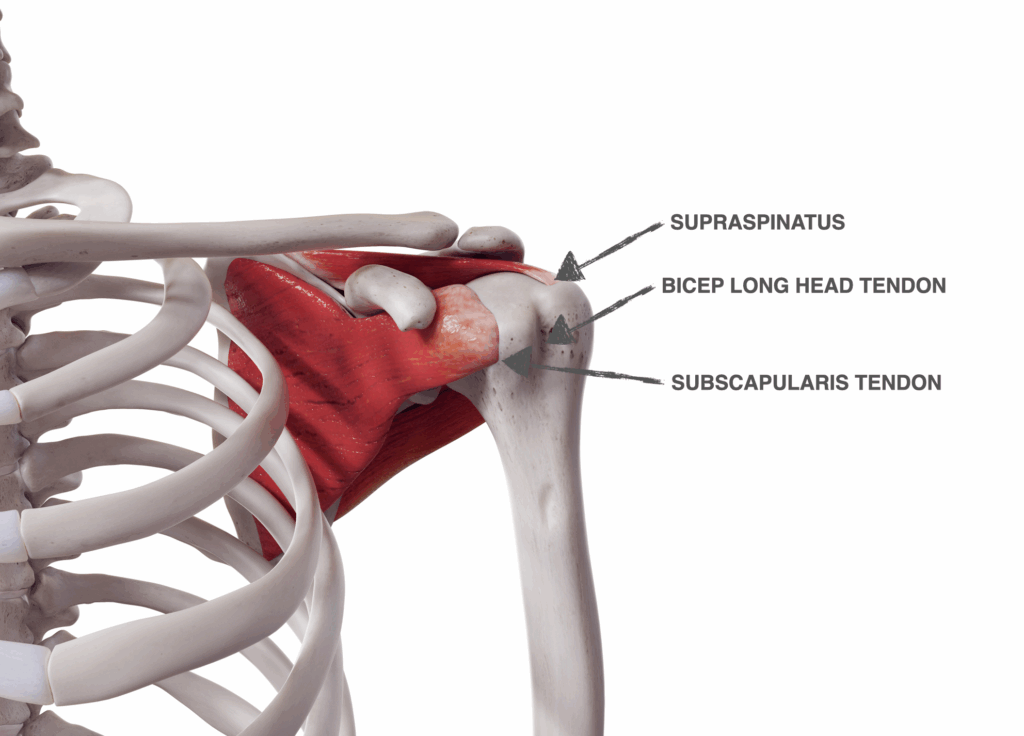
- Supraspinatus tendon – most commonly injured rotator cuff tendon and most impinged tendon of the shoulder
- Bicep long head tendon – 2nd most commonly impinged shoulder tendon
- Subscapularis tendon – a tear of this tendon usually coincides with bicep long head tendon subluxation due to fascial connections.
- Pectoralis major tendon – prime mover for shoulder internal rotation
- Latissimus dorsi tendon – prime mover for adduction/internal rotation (not often injured)
- Teres major tendon – internal rotation stabilizer (not often injured but commonly tight; trigger point palpated in posterior shoulder)
- Acromion – impingement of rotator cuff and bicep long head tendon occur just inferior to this boney prominence
- Infraspinatus tendon – 2nd most torn rotator cuff tendon
- Acromioclavicular (AC) joint and fascia – restriction at this joint mimics rotator cuff impingement in end range arm elevation
- Sternoclavicular (SC) joint – first phase of arm elevation (0˚-90˚) occurs here. Subluxation may cause impingement syndrome at the AC joint
Why does this matter?
Palpation of these key shoulder structures will aid in diagnosing the most common shoulder overuse injures: rotator cuff tendonitis, tears and impingement syndrome. Let me know what you think of this format and if it was helpful. I’ll see you next week for the second part of shoulder palpation where we will explore common trigger points that affect shoulder function. See you then!
Because nobody has time to be in pain.
Until next time…

Kind Regards,
MoveWell Academy
[email protected]