

Muscle Minute TUESDAY – Windswept (Part 8 – Trigger Points)
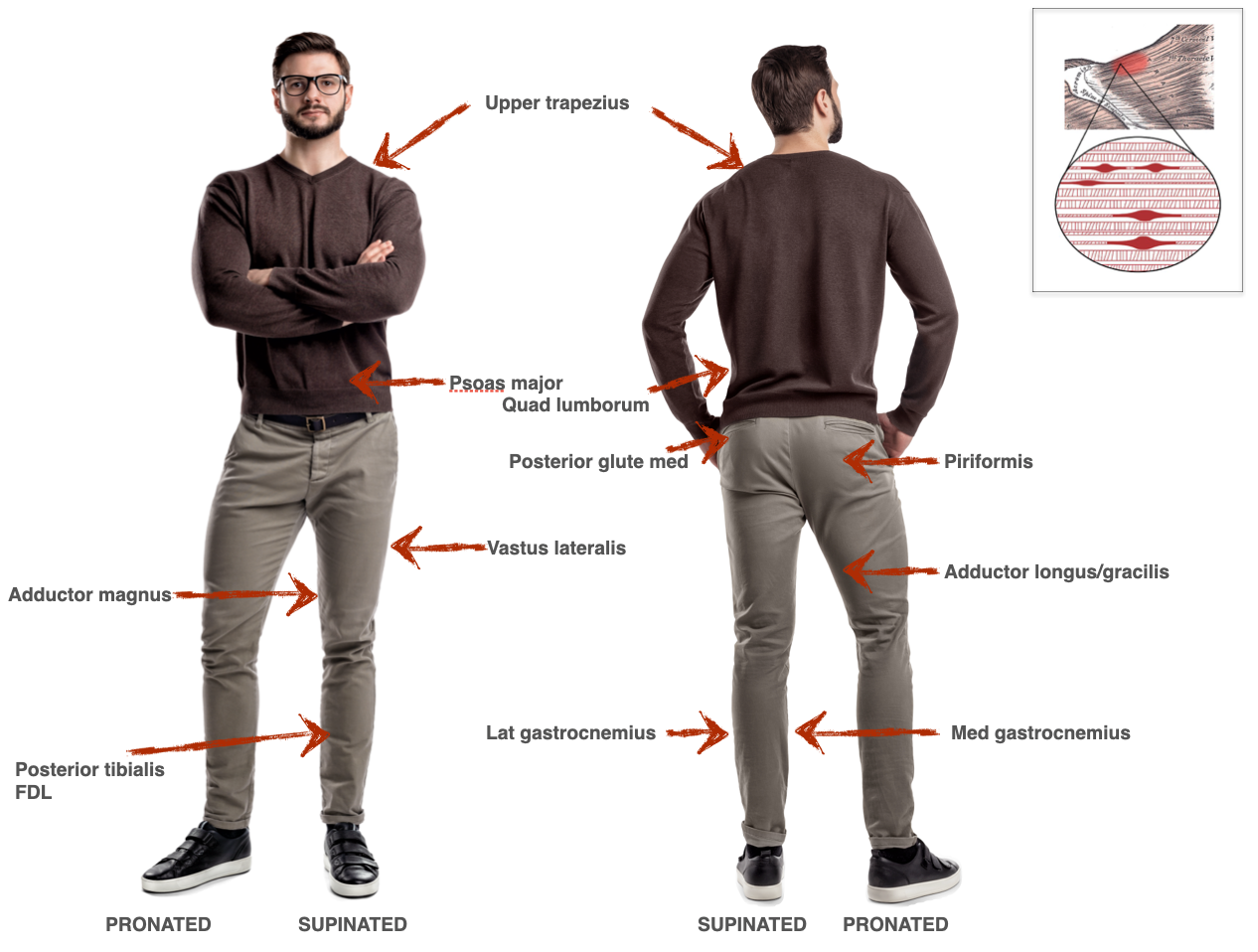
As we wind down the series on the windswept posture, I wanted to highlight an interesting observation I’ve noticed in my years of clinical practice. I often refer to the supinated side as the short/tight side and the pronated side as the long/weak side. The supinated side, lacking shock absorption, often exhibits compression type injures or injuries to the lateral ankle, lateral knee and medial hip soft tissues (muscles/ligaments). The pronated side tends to exhibit injury in the medial ankle, medial knee and lateral hip soft tissues.
This series has been extensive, but I wanted to conclude it with a simple way of determining which side is functioning more supinated. And that is in assessing trigger points.
A trigger point is defined as a hypertaut band of muscle that, when palpated, feels “4x more tender than normal tenderness”. I put that in quotes because I heard a practitioner say that once. I’m not sure how accurate that number is but it is true that there is a positive “jump sign” when a trigger point is palpated. (That means it makes the person jump). If you are pressing around a muscle and the person is not sure if it is tender, then it probably isn’t a trigger point.
Trigger points tell a story of how the body is or isn’t moving and mapping them out will often point out which side is more supinated or more pronated. Here’s an easy set of rules:
- Trigger points set up in muscles that are chronically short
- Most trigger points (as noted in the diagram above) tend to set up on the over supinated side
Adductor longus, gracilis and piriformis are the most common trigger points on the over pronated side and usually occur if someone visibly toes out when they walk or their knee falls in when they squat. Otherwise, a majority of the trigger points are associated with over supination. And if one leg over supinates, the other one most likely over pronates or vice versa.
Why does this matter?
Treating using the biomechanical model requires you to see the big picture. If someone presents with a complaint, listen to that complaint and then take your assessment skills and answer the following questions:
- Is the involved limb over pronated or over supinated?
- Why?
If you can answer those two questions, you will most likely find a solution to the problem.
It might take some time to integrate this kind of thinking into your practice. But as you seek out solutions, you will begin to see patterns emerge. In the meantime, fix what you find. You will learn along the way. This goes for clinicians AND the proactive lay person.
Because nobody has time to be in pain.
Until next time…

Kind Regards,
MoveWell Academy
[email protected]