
Muscle Minute TUESDAY – Meet the Bicep Femoris
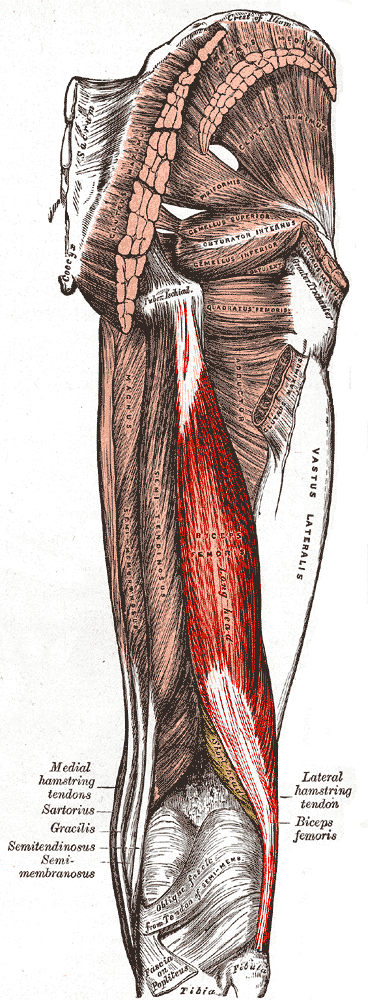
The bicep femoris (BF) muscle, or lateral hamstring, is the most often injured hamstring muscle, accounting for 80% of all hamstring injuries. An MRI study demonstrated possible increase risk for injury due to semitendinosis having a lower eccentric strength endurance capacity, causing the bicep femoris to have to carry a great load. Another study noted the bicep femoris is responsible for generating the highest eccentric load of the hamstrings. Let’s take a closer look to determine what may predispose this muscle to injury.
| Origin | ischial tuberosity (inferior portion) |
| Insertion | fibular head (lateral) |
| Action | hip extension, knee flexion, lateral rotation of lower leg |
| Innervation | tibial n. (L4-S3) |
| Antagonists | quadricep, semitendinosis |
The Real World Bicep Femoris
The key differentiator between the bicep femoris and its medial hamstring counterparts, semimembranosis and semitendinosis, is that it laterally rotates the lower leg. As most muscles are injured during the eccentric phase, it is important to consider when the foot hits the ground, BF decelerates lower leg internal rotation.
Excessive tibial internal rotation is associated with over pronation. And the two most common causes of over pronation are: a weak gluteus medius and a lack of ankle dorsiflexion. Another potential predisposition of BF injury would be an anteriorly displaced fibular head, also often associated with over pronation.
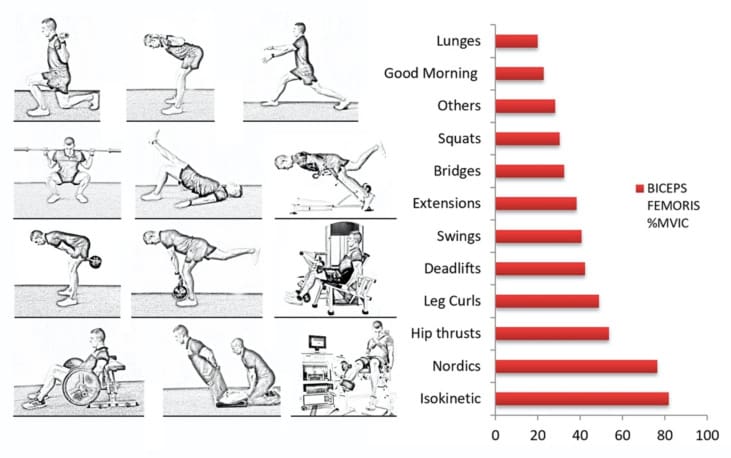
A retrospective study examined exercises recruiting the highest BF maximal volitional contraction (MVC) with Nordic hamstring curls ending up at the top. Deadlifts had a higher %MVC than lunges, good mornings or squats. The same study noted Nordics performed with ankle dorsiflexion ranked higher than any other version of that exercise.
Here’s a short list of why this matters:
- The BF differentiator is its ability to externally rotate the lower leg (and decelerate internal rotation)
- BF would be long/weak in over pronation scenarios
- A tight semimebranosis/semitendinosis would predispose BF to injury as they are functionally antagonistic in the transverse plane.
- Since BF takes on a higher eccentric load than the other hamstrings, rehab of BF injury should include high speed eccentrics.
- Tweaking the deadlift by holding a dumbbell in the opposite hand will bias the exercise in the transverse plane.
Conventional thinking says: BF, like the other hamstrings, extend the hip and flex the knee.
Real World Thinking says: A BF injury is most likely to happen in the transverse plane or due to improper transverse plane biomechanics as this is what differentiates it from the other hamstring muscles. Eccentric BF exercises in the transverse plane are necessary to restore full function after injury.
That was a lot, but thanks for reading.
Because nobody has time to be in pain.
Until next time…

Kind Regards,
MoveWell Academy
[email protected]