
Anatomy TUESDAY – Don’t Be So Sensitive (The Gamma Motor Neuron)

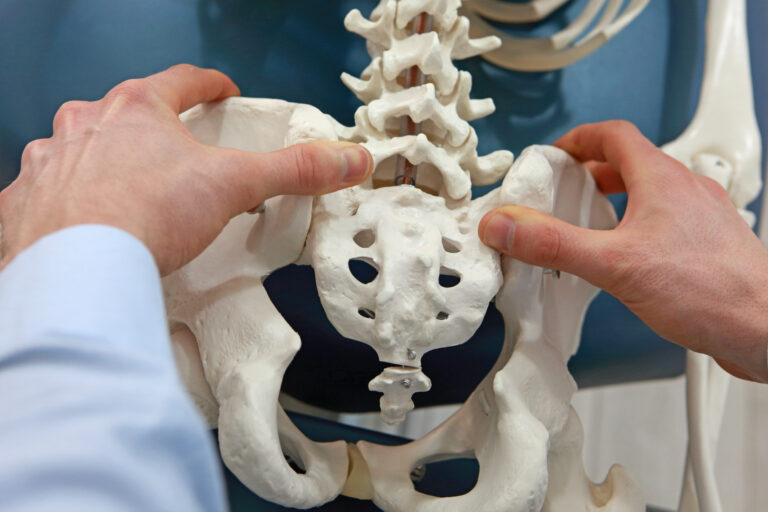
I put this picture up because I wanted people to keep reading. Soften your hearts a little bit before I talk about one of the coolest mechanisms in your body that regularly made my kinesiology student’s heads spin: the muscle spindle and the gamma system. Here’s what it looks like:
I talk about trigger points all the time. The “knots” in muscles that occur when a muscle is in a chronically short position. And I wanted you to understand how that happens. But before we talk about how a trigger point forms, we have to talk about normal.
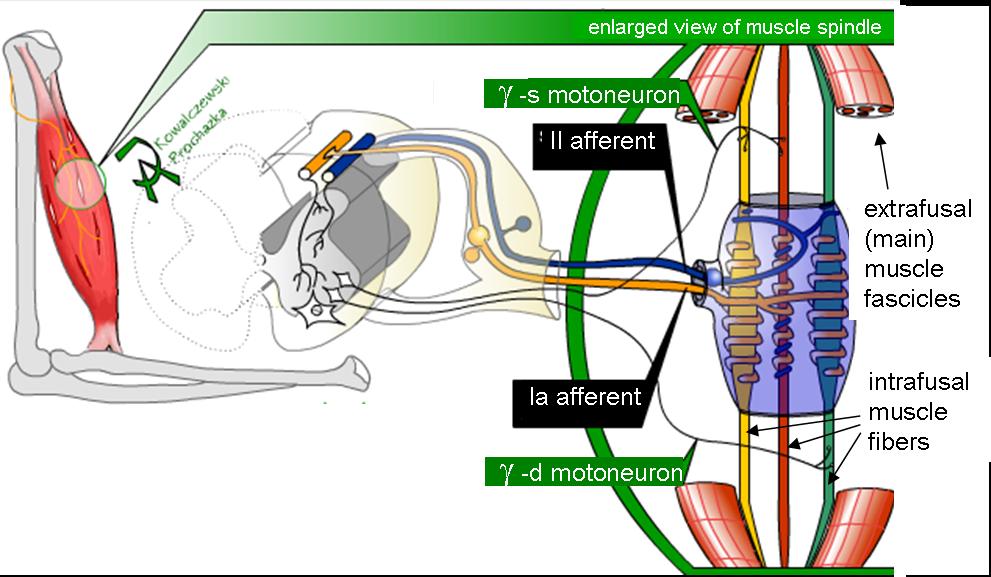
A large muscle is made up of a lot of muscle fibers. Extrafusal muscle fibers are the muscles we picture in our heads when we think of muscles. A muscle spindle is within each of those muscle fibers and detects a rate of stretch. If a muscle is stretched rapidly, the message gets sent to the brain and automatically causes the muscle to contract. This is known as the stretch reflex and is a form of protection.
Intrafusal muscle fibers are located on the ends of the muscle spindle and control the length of the muscle spindle. And the gamma motor neuron (labeled with the green boxes) is what controls the sensitivity. If a muscle is placed in a chronically short position, the intrafusal muscle fibers are placed on slack and can’t detect a rate of stretch. The gamma motor neuron tells the intrafusal muscle fiber to contract and “take up the slack”. This, in turn, signals to the brain a new normal (but shortened) length of the muscle. When someone then tries to move to a more normal position, the body perceives that as a stretch and causes a muscle contraction that doesn’t quit. These are known as trigger points.
(Phew! You made it past that paragraph. Here’s your palate cleanser).

Why does this matter?
Trigger points tell us a story. That is the point. And successful treatment requires resetting the gamma system. Muscle energy techniques and counterstrain (positional release) are common treatment methods used to reset the gamma system of muscle fibers. Deep ischemic pressure and percussion massage are also methods that affect the gamma system through mechanical stimulation.
If you are a follower of this blog, you were already probably using these techniques. But it’s good for you to understand why they work. And the next time a patient asks you how that “knot” got there, you can help them understand too. So, consider the gamma system. Small but mighty.
Because nobody has time to be in pain.
Until next time…

Kind Regards,
MoveWell Academy
[email protected]